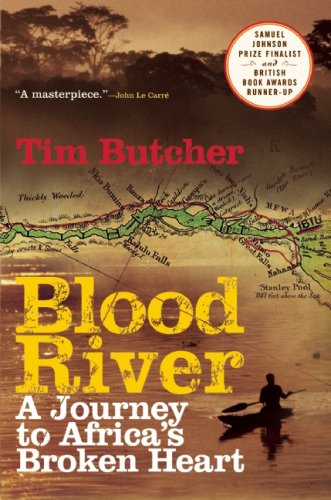
In 2004, Tim Butcher did a very brave and/or a very foolish thing: He tried to retrace Henry Morton Stanley’s 1874–77 expedition charting the course of the Congo River from Lake Tanganyika westward to the Atlantic Ocean. There was already a connection of sorts. Butcher and Stanley both worked as journalists for Britain’s Telegraph. Butcher, now the paper’s Jerusalem correspondent, was posted to Johannesburg in 2000 to cover Africa. That Telegraph-Africa bond, Butcher claims, led to an “obsession” with re-creating Stanley’s trip—something he managed in 44 days, compared with the 999 it took Stanley.
The first expedition suffered grievous losses and inflicted high casualties on the locals. It had other consequences, too, as Butcher recounts in Blood River, his memoir of his Congo trek. “Stanley’s Congo expedition fired the starting gun for the Scramble for Africa,” he writes. “Before his trip, white outsiders had spent hundreds of years nibbling at Africa’s edges, claiming land around the coastline, but rarely venturing inland.” Afterward, it was a free-for-all, as European powers competed to see who could squeeze the most out of the continent. What Stanley found caught the attention of “a minor European monarch, Leopold II, King of the Belgians.” The rest, as anybody who has read Heart of Darkness knows, is history—and a bloody, brutish history it is.
Apart from the details of Stanley’s trip, Butcher mainly focuses on the Congo’s postindependence plight. After the 1961 assassination of the country’s first democratic leader, Patrice Lumumba, the dictatorship of Mobutu Sese Seko, and some of the world’s worst civil warring, the Democratic Republic of the Congo is anything but a working democracy. Who’s to blame? Is it all the fault of Stanley, whose 1874 trek “turned into one of the greatest missed opportunities of modern history”? Butcher believes that Stanley’s “expedition could have been a positive turning point for Africa and its people. A continent cut off from the outside world could have benefited hugely from Stanley’s achievement, as the positive aspects of the modern world—medicine, education, technology—were made available to Africa for the first time.” Maybe so, but it’s oddly ahistorical for a twenty-first-century journalist to speculate that a nineteenth-century explorer could have had the best interests of the natives at heart. Victorian adventurers—even those cloaking their ambitions in the sort of civilizing mission that Butcher outlines here—were star players in the imperial drama; to suggest otherwise is largely beside the point.
Meanwhile, as a travelogue, Blood River is only fitfully satisfying. Most of it involves riding along as Butcher clings to the back of an aid worker’s motorbike or languishes in the fetid cabin of a river steamer run by the UN. Towns slip by in a sometimes disjointed blur of postcolonial decay—Kabambarre, Kalemie, Kasongo, Kisangani—as Butcher downs antimalarial pills and hopes he has enough boiled water to get him through the next leg of the journey. However—and this is a big however—the trip allowed Butcher to bring back the kind of news that rarely makes the pages of The Telegraph or any other Western paper. He describes how people actually get by, day by miserable day, in a country whose infrastructure long ago crumbled or was reclaimed by jungle, and where the rule of law usually means the whim of whatever mai-mai (rebel militia) or corrupt local official has the most power.
Although a peace treaty in 2002 ended all-out civil war, “the humanitarian crisis in the Congo claims lives on a staggering scale,” Butcher points out, citing a 2006 Lancet estimate of twelve hundred deaths a day arising from “violence and insecurity.” That seems a plausible number, set alongside Butcher’s account of how all but the luckiest or most elite Congolese make do. He describes the basic conditions for many Congolese as “medieval”—lacking in sanitation and other amenities Westerners consider rights, not privileges. Job prospects, health care, education, and electricity are next to nonexistent.
Butcher traces the chaos and lawlessness of today’s Congo back to Stanley’s nineteenth-century errand. “The greatest shame arising from Stanley’s Congo journey was how it started this pattern of sovereignty-stripping, a process whereby the vast majority of Africans in the Congo and elsewhere have ended up not just without any say in the running of their country, but abused and exploited by their African leaders,” he says. But he adds that “the people of Africa must share responsibility for showing themselves unable to change it.”
Fair enough. It’s worrisome, though, to see that the generalizations made by Victorian imperialists 130 years ago still infiltrate the conversation. What is “Africa,” exactly? Is it useful to issue a continent-wide call for “the people of Africa” to take responsibility? Do Congolese and Senegalese and Malians and South Africans et al. have the same postcolonial problems? Some of Butcher’s grander observations come across as a progressive version of the “benighted natives” talk of Stanley’s era. Butcher risked a great deal and traveled a long way to write this book. But his account makes it plain that Westerners and Africans still have some distance to travel in how they deal with each other.