

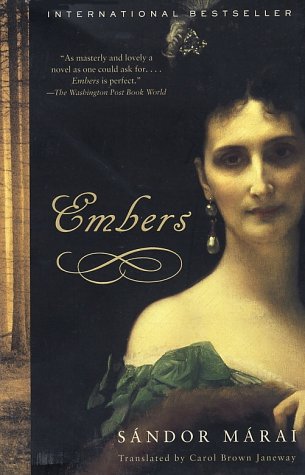

At first glance, the Hungarian writer Sándor Márai could easily be accused of trafficking in stale plots: Of his four novels published posthumously in English translation, three hinge on the return of a long-lost lover or companion, and the other involves the appearance of a mysterious stranger. But Márai’s spellbinding prose restores strangeness and beauty to traditional motifs. The figurative language conjuring the standard castle-in-the-forest setting of his 1942 novel Embers illustrates this stylistic power:
The castle was a closed world, like a great granite mausoleum full of the moldering bones of generations of men and women from earlier times, in their shrouds of slowly disintegrating gray silk or black cloth. It enclosed silence itself as if it were a prisoner persecuted for his beliefs, wasting away numbly, unshaven and in rags on a pile of musty rotting straw in a dungeon. It also enclosed memories as if they were the dead, memories that lurked in damp corners the way mushrooms, bats, rats, and beetles lurk in the mildewed cellars of old houses.
Such artfully refashioned clichés abound in the novel. They reflect the way the protagonist, a retired general named Henrik living in seclusion, perceives the world. Henrik is visited by his childhood companion Konrad for the first time since a fateful event forty-one years ago, when the two, by then men, were out hunting: On that day, Henrik sensed Konrad’s gun pointed not at the deer they were stalking but at the back of his head. The general later came to realize that his wife, Krisztina, had betrayed him with his dearest friend, who then lost the nerve to kill him and left the country. Now Henrik confronts Konrad with urgent questions about the past, seeking “the truth, that other truth that lies buried beneath the roles, the costumes, the scenarios of life.”
But Konrad offers no response. Rather than persisting, Henrik gives long speeches on war and revenge, the lost world of the Habsburg Monarchy, non-European peoples, hunting, friendship, and love. His impressions of an Arab he once watched slaughter a lamb are typical of his commonplace views: The thrust of the knife was “an Oriental movement straight out of the time when the act of killing still had a symbolic and religious significance. . . . I realized that these people are still intimately familiar with the act of killing, blood is something they know well, and the flash of the knife is as natural to them as the smile of a woman, or the rain.” The hackneyed mise-en-scène—a storm is raging outside the castle; lightning “slices down through the night like a golden dagger” and strikes the electric station, forcing the men to dine by candlelight—mirrors Henrik’s trite discourse. Márai discloses no deeper meaning beneath the seamless tapestry of banalities.
Embers was the first of Márai’s books to appear in English, twelve years after the the author’s death in 1989. Born in 1900 in the provincial Hungarian city of Kassa—which after the breakup of the Austro-Hungarian Empire in 1918 became Ko¨ice, Czechoslovakia—he achieved fame in the ’30s as a prolific dramatist and novelist, publishing sixteen books in that decade alone. When war broke out, Márai responded to Hungary’s authoritarian regime and alliance with Nazi Germany, as he wrote in his journal, “by turning completely inward, toward my work.” His output of fourteen books during the war years testifies to this “internal emigration.” Eight more books appeared from 1945 to 1948, but Márai grew ill at ease as he witnessed the rise of the Hungarian Communists and the specter of Soviet totalitarianism. In 1948, he went into exile, first in Switzerland, then in Italy, and finally in the United States. He moved from New York to California in 1979, and ten years later, after the deaths of his wife and their adopted son, took his own life at the age of eighty-nine.
Outside of Hungary, his work remained obscure until 1998, when Roberto Calasso of the publishing house Adelphi brought out an Italian translation of Embers that became a best seller. Shortly thereafter, the novel appeared in German, and a critic for Die Zeit declared that Márai belonged in the company of Joseph Roth, Stefan Zweig, Robert Musil, and “even Thomas Mann and Franz Kafka.” Márai was introduced to English-speaking readers in 2001 with Carol Brown Janeway’s translation of Embers, dubiously based on the German version instead of the original. But this curious choice detracted little from the book’s success and its critical reception as a rediscovered masterpiece. Since then, the poet George Szirtes has translated Márai’s novels from the Hungarian, rendering Casanova in Bolzano (1940) and The Rebels (1930) in supple, suggestive English prose, both to acclaim. Szirtes’s gifts are displayed in Casanova in Bolzano in the rhythmic lyricism of the title character’s paean to Venice:
You have to be born there to know her. You have to taste her damp, sour, stale smell in your mother’s milk, smell the noble scent of decay which is like the breath of the dying or the memory of happy times without fear of either life or death, when the spell of the moment, the dizziness of reality, the enchanted consciousness of living here and now in Venice, filled each fiber of your body and every nook and cranny of your intellect. I bless my fate and I go down on my knees in gratitude to the destiny that decreed I should be born in Venice. I thank heaven that my first earthly breath was of the rotten wisdom that lingers in the scent of the lagoon! I was born a Venetian and that means everything is mine, that everything that makes life worth living has been given to me as a gift: the sense of freedom, the sea, art, manners. . . . Venice is happiness!
Szirtes’s most recent offering from Márai’s voluminous oeuvre, Esther’s Inheritance (1939), lends greater insight into the novelist’s aesthetic of the cliché, his use of formulaic scenarios, inherited themes, and stock characters to exemplify life as theater. Narrated by the eponymous protagonist, a middle-aged woman living in humble circumstances, the novel conveys Márai’s theatrical sensibility with brevity and straightforwardness. Esther receives a telegram from Lajos, the only man she has ever loved, announcing his return after an absence of twenty years. Long ago, Lajos professed his love to Esther but then married her sister, Vilma, who has since died. At the beginning of the tale, we are told he is an inveterate liar: “He lied the way the wind howls, with a certain natural energy, in high spirits.” In the past, Lajos swindled Esther and her family and friends out of money and possessions. That he has not changed his ways is evident from his telegram, which is “like an opera libretto, just as theatrical, as dangerously childish and false, as everything he had said and written.”
Esther no longer has any illusions about Lajos’s duplicity. But from early on, there are hints that she is liable to play along with his con game: When she puts on her lilac dress from earlier days in anticipation of his arrival, it is “like donning an old theatrical costume, the clothes of life.” And when Lajos shows up, everyone behaves “like actors in a mime,” yielding to whatever he demands as if in accordance with “an unalterable law.” By the time Esther signs the deed of her house over to him, relinquishing the last object of value she owns, it is clear that she knew from the start what he was after. Despite her hypersensitivity to his fraudulent scenes and sentimental confessions (she even notices the way he smoothes his hair “with a cheap, stagy gesture”), Esther is moved by his insistence that she “obey the law that is the meaning and the content of [her] life.” She concludes that there is an “invisible order in life and that what one has begun one has also to end.”
Márai suggests that life should have the finality and inevitability of theater. At the novel’s close, the wind blows out a candle flame, evoking the lights going down at the end of a play. Theatrical allusions thread through the narrative. Lajos’s return is portrayed as a “magic show,” and the ensuing events are announced in the form of a dramatic production: “Scene One, ‘The meal,’ Scene Two, ‘A walk round the garden.’” Such metaphoric gestures reveal a profound fatalism: For Márai, life is a stage on which people are bound to act out their roles.
The character of Lajos exhibits the novelist’s preoccupation with what Diderot called the “paradox of the actor”: The genius of the actor, his unlimited capacity to assume multifarious identities, lies precisely in his being no one in particular, “a man without character,” as Lajos refers to himself. A quintessential actor, Lajos is nothing but the masks he adopts: “His tears were real tears,” Esther observes, “but they did not dissolve anything in him, no memory, no pain: Lajos was always fully committed to delight or melancholy but actually felt nothing at all. There was something inhuman in all this.”
Márai’s enduring fascination with dissemblers is evident as early as The Rebels, which was written about a decade before the other novels available in English. A traveling actor named Amadé appears among a gang of four young men in a European town toward the end of World War I. They have rejected the adult world, which has descended into madness and slaughter, in favor of youthful escapades and camaraderie. But then they fall under the corrupting influence of the actor, who draws them into his theater one night. There they stage an elaborate homoerotic fantasy and end up in disgrace. Amadé is the embodiment of protean simulation: At one point, he boasts that he has thirty-six faces; his features are “mere raw material that [their] proprietor could shape as he liked.”
The actor type turns up again in Casanova in Bolzano, in which Márai imagines the arrival of Giacomo Casanova in Bolzano after his escape from a Venetian prison. In the opening scenes, Márai describes the legendary lover’s art of seduction in terms of theatrical performance. When, to Casanova’s dismay, he fails to conquer a servant girl at the inn where he is staying, he feels like “a great actor who had not appeared in public for years and who, when the time came for him to sing again, was confronted by an icy auditorium and silence in the stalls.” But he persists and eventually prevails, regaining the certainty “that every word, every movement of his, found favor with the audience.”
Theater remains the overarching metaphor. Five years ago, Casanova fought a duel with the Duke of Parma over the duke’s fifteen-year-old fiancée, Francesca. Victorious, the duke spared Casanova’s life nonetheless but forbade him to return. Now Casanova, haunted by a sense that Francesca may be his one true love, has failed to heed this warning. The duke visits him at the inn and delivers a sixty-page monologue, appealing principally to Casanova’s essence as a “writer” and an “artist.” An artist, the duke proclaims, is “merely the personal embodiment of the creative genius that drives him.” He has no will of his own, “for his genius will press a pen, a chisel, a brush, or even, occasionally, a sword into his hand, whether he will or no.” The duke proceeds to propose a bargain that relies on Casanova’s faithfulness to his artistic nature.
Having discovered a message that his wife has written to Casanova, consisting of only four words—“I must see you”—the duke offers his rival a sum of money and a letter of safe passage, in exchange for which Casanova must promise to woo Francesca, spend a single night with her, and then vanish from her life forever. Expecting that Francesca will then return and remain by his side during his dying days, the duke treats Casanova as a hired performer and requests his “guest appearance in Bolzano for one night only.” He asks him merely to “remain true to your art and to create a masterpiece.” The performance is to be put on at the duke’s masked ball and in Casanova’s bedroom at the inn. Appropriately, when Casanova and Francesca encounter each other, they are in costume; he is disguised as a woman and she as a man. Francesca entreats him to renounce a life of masquerade in the name of true love: “There are so many masks we have to discard before I can get to see and recognize your face. But I know that somewhere, far, far away, the other face exists and that one day I must see it, because I love you.” But Casanova, like Esther, is a heroic fatalist, who decides to follow the duke’s bidding so as to remain true to his “earthly task” and his “role.”
By depicting characters who accept artificial roles and scenarios as essential to their lives and destinies, Márai invites readers to surrender to the novelist’s own caricatures as so many masks in his fictional performances. As always, he brings his own touch to superficial tropes, as when Francesca calls Casanova’s dagger his “one-word answer” to whatever the world inflicts on him, or when Casanova notes the moment of silence that occurs at a crucial turn in his life by observing that “it was as if the mountains, the snow-covered street, the river, and the stars, the whole of Bolzano, were holding its breath.” Still, all the familiar romantic imagery of the novel—the flames flickering in the seducer’s eyes, the beloved standing beside a crumbling castle wall in a garden under the blue Tuscan sky, the duelers’ swords gleaming in the moonlightcomes across as a flawless facade. The proposition that the duke presents to Casanova, whom he views as a writer at heart, invokes the contract between author and reader: “It is not just writers like yourself who like a story to be properly finished, the world, too, likes it that way: it is only human nature that both writer and reader should demand that a tale should reach a genuine conclusion and end appropriately. . . . We want the well-placed period, the full stop, all t’s crossed and all i’s dotted.” And so Casanova must forsake Francesca out of deference to the rules of storytelling.
But for all its philosophical underpinnings and stylistic seductiveness, Márai’s embrace of literary convention is susceptible to crude stereotypes. In The Rebels, for example, he portrays a Jewish pawnbroker who is as carnivorous as he is rapacious. Surrounded by meats and the “smell of decaying rancid fat,” this monster horrifies the young men in his presence, who “could not have been more surprised if he had dragged a live kid into the room, dismembered it in front of them, and proceeded enthusiastically to consume it.” A similar character surfaces in Casanova in Bolzano, the moneylender and usurer named Mensch: “A short, scrawny creature, he was sitting in a dressing gown at a long narrow table, the fingernails of his delicate, yellow hands grown sharp and curling, so that he appeared to grasp things the way a bird of prey seizes its quarry.” Mensch mumbles and lisps ingratiatingly and at one point even rubs a thumb and a forefinger together. Márai’s marriage to a Jewish woman and his abhorrence of anti-Semitism only underscore the problem with these ugly representations: They are symptomatic of his derivative mode of expression, which uncritically reflects prevalent European attitudes of his time. This danger is not limited to anti-Semitism; it is no less apparent in Konrad’s description of his Malaysian mistress in Embers: “an animal, a murderess, a priestess, a magician, and a fanatic all rolled into one.” Márai, who is celebrated for his condemnations of Fascism and Soviet Communism, incongruously made standardized perceptions his stock-in-trade.
Márai’s Casanova insists that “truth can only survive as long as the hidden veils of desire and longing draw a curtain before her and cover her. That is why I did not lift the veil and bathe truth’s mysterious face in the light of reality.” This affirmation of the fictive and theatrical aspects of life, also epitomized in Esther’s Inheritance, finds expression in an all-too-complete literary mimicry. As in the insular drama of Embers, which leaves no room for any truth outside the old general’s coarse sentiments, Márai so wholly inhabits his impersonations that he erases ironic distance. He grants his readers not even a peek under the veil. Instead, he puts them in the helpless position of Esther reading Lajos’s letters, which are full of lies but still exhilarate her with their “miraculously authentic” style, their power to “bring . . . false-truth alive.”
Márai prompts us to ruminate on what makes fiction’s illusions so attractive— on why, like Esther, we as readers would knowingly succumb to deceit. Indeed, this mirror game between readers beguiled by his stories’ enchanting surfaces and characters who choose to live by “false-truth” draws critical attention to the author’s own technique. But within the frame of his tales, the world of pretense is simply inescapable and irresistible. Francesca tells Casanova, “We needn’t hurry to throw away our masks, because we will only find other masks beneath them, masks made of flesh and bone and yet as much a mask as these.” Márai refuses to unmask the clichés of life and literature, on the grounds that there is no final truth beneath them. Yet however much Márai may have intended it to do so, his deliberately contrived art fails to repudiate its own falsities.
Ross Benjamin is a writer and a translator of German literature living in Brooklyn. His translations include Friedrich Hölderlin’s Hyperion (Archipelago) and Kevin Vennemann’s Close to Jedenew (Melville House; both 2008).