

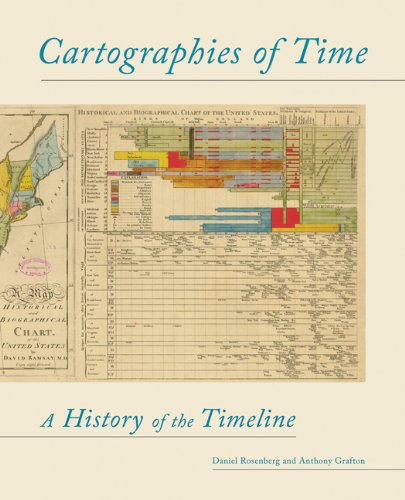
You may not be able to save time in a bottle, but surely it can be laid on the line. Beginning with fourth-century Christian theologian Eusebius’s Chronicle, the timeline has been a mainstay for historians eager to visualize the temporal. In Daniel Rosenberg and Anthony Grafton’s scholarly yet spirited account, we can see the church father’s “image of history” recast with increasing intricacy and decorative flourishes. If some intriguing examples require viewers to decipher minuscule type and thread through labyrinthine structures, the best are often the clearest—those comprehended almost instantly. The timeline, the authors note, comes naturally to us—we think of time as inherently spatial, as long or short, with a start and a finish. Every day, every millennium, can be paced out from one side of the page to the other, or wound in a circle, as a few of these were, in fact, originally wheel charts with moving parts. Joseph Priestly constructed “A New Chart of History” (1769) with the intention of enlivening the march of the ages for viewers, showing them at a glance “all the empires subsisting in the world” so they might “observe which were then rising, which were flourishing, and which were upon the decline.” While this isn’t quite history written with lightning, these charts deliver whole epochs to the eye with a swiftness that belies the myriad days they condense.