

As literary careers go, E. M. Forster’s had a singular, storied arc: a remarkable burst of creative energy that produced five books in the seven years from 1905 to 1911 (Where Angels Fear to Tread, The Longest Journey, A Room with a View, Howards End, and The Celestial Omnibus, the last of which appeared when the author was all of thirty-two), and an equally stupendous—and, to his contemporaries, stupefying—silence, which followed the publication of A Passage to India in 1924 until his death in 1970 at the age of ninety-one.
“Perhaps his future biographer will be able to explain,” Lionel Trilling wrote as early as 1943, Forster’s “possibly permanent retirement after the great success of his last novel.” Biographers had that explanation handed to them in the form of a pair of books “about homosexual love” (Maurice [1971] and The Life to Come [1972]), which Forster circulated privately for more than half a century but didn’t allow to be published until he died, sparking even more interest in the author than death usually does (Salinger’s executors, take note). More than a decade later, a spate of five movies further revived Forster’s name but also made it synonymous with, and to some degree subordinate to, a kind of well-meant but essentially inconsequential period melodrama.
This status seems less lamentable than inevitable, reflecting as it does the difficulty Forster’s own and subsequent generations have had in ascertaining his contribution to English literature. Generation is an arbitrary measure, of course, and it was Forster’s bad luck to straddle two: the late Victorianism of which Henry James was the undisputed “fluent master,” and the heroic early modernism of Gertrude Stein, James Joyce, and Forster’s friend and rival Virginia Woolf. But to which did he belong? Was he, with Conrad, Wharton, Ford, and Lawrence, part of the tradition that restored the “common stuff” to James’s “maimed” realism, or was he actually a Jamesian manqué whose mannered style rendered him a footnote to the radical innovators now regarded as the progenitors of twentieth-century fiction? In a letter in 1930, Woolf wrote that Forster’s novels were “very good, I think, though impeded, shrivelled and immature” (about which: ouch), while just more than a decade later Trilling declared him “the only living novelist who can be read again and again.” The confusion only increased with the appearance of Maurice and The Life to Come, as revisionist sentiment warred with aesthetics in the appraisal of what were clearly “thin” if not simply “dismally flawed” books, and a new set of questions was added to an already contentious situation, namely: Was Forster a groundbreaking homosexual writer, first repressed, then oppressed, and finally (self-) suppressed, or was he in fact just another minor novelist whose reputation had been revitalized by the identity-oriented theories of the 1980s and ’90s (Radclyffe Hall, anyone?) and bolstered by Merchant, Ivory, and Co.?
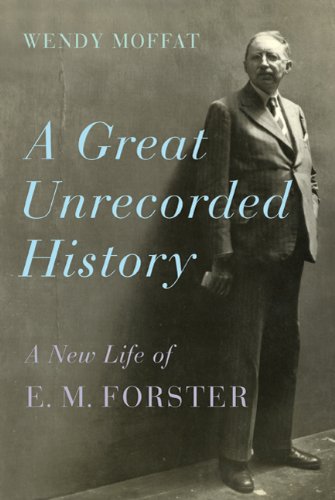
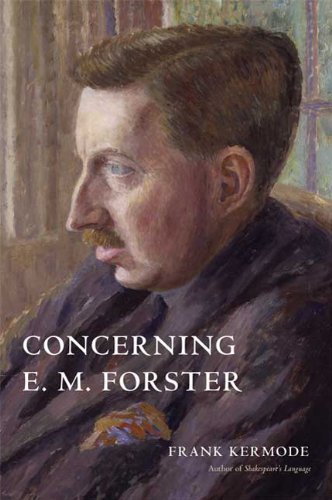
The ongoing uncertainty about these aspects of Forster’s literary reputation is neatly reflected in a pair of new books on the author, a full-length biography by Wendy Moffat and a pithier “causerie” by Frank Kermode. For Moffat, Edward Morgan Forster’s life only comes into focus when, like a 3-D movie, it is viewed through the paired lenses of homosexuality and homophobia. Moffat opens A Great Unrecorded History with a prologue pointedly titled “Start with the Fact That He Was Homosexual,” in which Christopher Isherwood unboxes the manuscripts of Maurice and the stories that would be published as The Life to Come and, in Moffat’s telling, felt that “the future of fiction, and the true meaning of Morgan’s life, was in his hands.” Moffat writes evocatively about her subject, bringing to life Forster’s very English diffidence and stoicism—about writing, about success, about being gay—but her case that Maurice represents “a new way forward” is less compelling. In fact, the arguments are almost all Forster’s and taken from the novel’s “Terminal Note,” in which Forster told his future audience: “I was determined that in fiction anyway two men should fall in love and remain in it for the ever and ever that fiction allows.” The language and the sentiment, as Cynthia Ozick pointed out in her 1971 review of the just-published Maurice, smack of “fairy tales,” and in her opinion the novel, “while pretending to be about societal injustice . . . is really about make-believe.”
Kermode’s take on Maurice is starker still—“Leaving aside the posthumously published and inferior Maurice, one thinks of Forster primarily as the author of [the first] five novels”—but to an almost baffling extent, he seems to consider Forster’s homosexuality irrelevant to “a writer who began with confident originality, reached his apogee in 1924, and then stopped, much concerned about his loss of creativity but unable to recover it.” Thus, though Kermode shines the coruscating light of his formidable critical apparatus on Forster’s “creativity” and “the personal and social circumstances that restricted it,” he mostly creates more shadows, so that Concerning E. M. Forster ends pretty much where it begins: Forster
irritates readers who nevertheless feel obliged in the end, to do him honour. I think that’s right, and will pay the debt of honour without ceding my right to some bouts of irritation. I do believe Forster was an artist of peculiar distinction; excellent books have been written to prove it. But I also believe that there are reasons for dissentient judgements and some of these I shall try to express.
As praise this is only slightly less equivocal than Woolf’s “impeded, shrivelled and immature.” Forster’s distinction is “peculiar,” whereas the books written to prove it are “excellent”; it’s the “dissentient judgements” that interest Kermode—the “intrusive sermonizing” and “repulsive” depictions of people not of the author’s class, not to mention the “philistinism” of his opinion about James. Yet “in the end one gives up and accepts these passages as part of the offered bargain.” This, too, is not so much praise as an expressed fondness—weakness, even—for the eccentricities of a “sincere but witty clergyman,” and if it’s what Kermode means by obliging “the debt of honour,” one senses Forster might have felt the reckoning comes up a little short.
In fact, Forster seems always to have been seeking a reaction to his fiction that was never forthcoming. Moffat quotes a letter to an early reader of Maurice, in which Forster demanded that his correspondent respond “vehemently!” to the manuscript. But vehemence is perhaps the last feeling one associates with Forster’s fiction. Nor has the reaction been exactly tepid. The “exasperated” attitude Kermode attributes to F. R. Leavis could just as easily be applied to his own appreciation; whereas even Forster’s less conflicted fans, Moffat, Trilling, and Ozick among them, are particular and proprietary in their praise. To Moffat, Forster is a pioneering “gay historian” whose “only truly honest novel” is Maurice. Trilling (who, according to Ozick, didn’t even know Forster was gay) concedes Forster was “highly regarded” in 1943, when his own study appeared, though he is “not at all certain . . . he is properly regarded.” Ozick, responding directly to Trilling (and to a Mrs. F., who apparently dissented from Ozick’s review of Maurice), extends this claim, declaring that Forster “excite[s] competitive passions—possessive rivalries, in fact—among serious readers, each of whom feels uniquely chosen to perceive the inner life of the novels.” She goes on: “If, as Mrs. F. asserts, I do not love Forster enough for what he has done, it is not because I fail to celebrate his novelistic imagination, but rather because I would dislike living in his Republic, where personal relationships govern.”
Putting aside for now what I think is the most common misapprehension of Forster’s oeuvre—this idea of the supremacy of “personal relations” (to use his own term)—let me declare unequivocally that I love E. M. Forster, the man in one way, the books in another. The love for the man is suffused with pity, for though Forster desired a “domesticity akin to marriage,” the most serious relationship he managed was a forty-year liaison with a married man, Bob Buckingham, in which Forster accepted the slightly pathetic role of beneficent—munificent—uncle with benefits. But though homosexuality is clearly the key to his silence, it isn’t the key to his work. Rather, it has something to do with what Kermode calls “his blend of realism and soul or spirit,” which is less a narrative method than a worldview, one that owes as much to Greece as it does to England, with dashes of Italy, India, and Egypt thrown in—a mixture that makes him both the last colonial writer and the first global one. Trilling calls this sensibility, more clearly if still incompletely, “moral realism,” a habit of grappling with “the contradictions, paradoxes and dangers of living the moral life.”
Kermode is right in saying that the “decline in imaginative power” Forster suffered after 1911 was “not a lapse of intelligence or industry,” but in search of loftier answers he discounts the obvious one, namely, Forster’s “weariness of the only subject that I both can and may treat—the love of men for women & vice versa.” Ozick understands this but is less sympathetic toward the alternative, calling Maurice “a sloughing-off of society”—“disingenuous,” “infantile,” “pointless.” Hence the famous note written atop the manuscript: “Publishable, but is it worth it?” The note is ambiguous, as Ozick and others have pointed out: “Is the reference to the homosexual theme—or to the level of craftsmanship?” Ozick focuses on the latter, Moffat the former. She cites a letter Forster wrote in 1914: “I have almost completed a long novel, but it is unpublishable until my death and England’s.” It’s hard to say whether Forster’s sentiment was histrionic in the England of George V, but at least it clarifies his concerns about the manuscript. It wasn’t the “level of craftsmanship” that bothered him, nor exactly “the homosexual theme”; rather, it was “Society”—what Isherwood, after Forster showed him a draft in the early ’30s, referred to as “the jungle of pre-war prejudice.” Isherwood asked Forster to publish Maurice, but the elder writer merely “leaned forward and gently kissed Christopher on the cheek.” Another friend mentioned Gide, but Forster still resisted, saying, “Gide hasn’t got a mother!” Moffat brings up the case of Oscar Wilde, but tellingly, Forster does not, which suggests that his fears weren’t about being sent to prison for having sex with another man, or even for describing it (“there is no pornography,” the “Terminal Note” tells us drily), but were vested in a more general terror:
If the pendulum keeps swinging in its present direction it might get published in time. But the more one meets decent & sensible people, of whom there are now a good few, the more does one forget the millions of beasts and idiots who still prowl in the darkness, ready to gibber and devour.
Again, it’s hard to evaluate these words at the remove of three-quarters of a century. Yet the fact that they were written about a novel that was “the direct result” of a visit to Edward Carpenter and George Merrill, a pioneering gay couple who defied Victorian mores to live openly together for more than thirty years—and recorded in a letter to Isherwood, who risked his reputation to write about homosexuality—makes it hard to ignore the element of simple, if understandable, cowardice in Forster’s refusal. Pointedly, at about the same time Forster began work on Maurice he was also attempting to evade military service: “I am quite shameless over the wirepulling,” he wrote his mother. “If I can’t keep out of the army by fair means then hey for foul!” His only excuse—”I am an artist . . . and the artist must (yes! I am actually going to say this too!) live his life”—would have been more persuasive, or at any rate the scales might have balanced more evenly, if he had in fact chosen to live freely or be the artist he claimed he wanted to be, rather than retreat into a half life of stunted personal and artistic expression. Though Moffat does her best to find something noble in Forster’s self-abnegation, it’s hard to resist Ozick’s less sentimental opinion that Forster cast himself as a “martyr.” (A third book on Forster, this one by Richard Canning, arrived as this review was going to press, but a quotation that caught my eye early on seems apropos: “Morgan longed to be cowardly, not brave, he told Lily, since ‘people hurt you when you are brave.’”)
Of course, it isn’t the biographer’s job to criticize her subject, and one can understand why Moffat allows Forster to slide—perhaps, like Ozick’s Mrs. F., she loves him too much to point out what, by his own standard, is clearly a moral failure. But in giving Forster a pass, she fails to bring out fully what seems to me to be the tragedy of his life: half a century of attenuated affairs with married or otherwise unavailable men padded out with thousands upon thousands of pages of erudite but largely incidental literary exposition. Kermode has no such reservations, and when he’s not scolding the novelist he laments him as “caught between two worlds and loving the old one better.” The sentiment, no doubt intentionally, echoes Matthew Arnold’s “wandering between two worlds, one dead, / the other powerless to be born.” In Arnold’s version the tragedy is the world’s, but Kermode vests it in the human figure caught in the upheaval: Forster, he tells us in an adroit oxymoron that recalls the writer’s famous dictum to “only connect the prose and the passion,” “understood ecstasy and inspiration.” This feels right. What feels less right is Kermode’s treatment of his subject’s literary production vis-à-vis his position at the apex of the Victorian mountain and at the foot of the modernist one. A Passage to India, Forster’s nod to modernism, earns Kermode’s highest praise, while Howards End, in some ways the last great Victorian novel, comes in for his harshest criticism. “Howards End is still admired and still preferred by some critics to A Passage to India,” Kermode tells us, adding that he “was once of that opinion but later withdrew it.” Kermode vests the novel’s failure primarily in “the character of Leonard Bast,” but before he gets there he takes time to sneer at Forster’s treatment of Beethoven’s Fifth Symphony: “The talk of Beethoven’s conjuring up shipwrecks and elephants and goblins is an enemy of the music: ‘A triumphant conclusion, but the goblins were there. They could return. He had so said so bravely, and that is why one can trust Beethoven when he says other things.’” Kermode says he can’t “write those words without wincing,” continuing: “The tone is wrong, vaguely facetious, faux-naif,” an example of the “recurrent sermonizing that rather disfigures this novel.” The one time he bothers to suggest that the sentiments might be Helen Schlegel’s rather than Forster’s, it is only to reject the idea: “Helen’s raptures,” he tells us plainly, “belong not to Helen but to the author.”
This seems shortsighted, in regard both to Howards End and to its author’s place in the English canon. In part inspired by Austen, in part rejecting the Jamesian tyranny of the singular point of view, Forster perfected the technique of free indirect discourse—of merging narrative omniscience with individual subjectivity to such a degree that it is often impossible to attribute the “sermonizing” to either author or character. In fact, the passage in question slides effortlessly from Aunt Juley to Tibby Schlegel to Margaret and finally to Helen, and if it lingers longest on Helen’s melodramatic sensations of the music, it is only because her propensity for living in a romantic fantasy will determine the fate of Leonard, whose own experience of the symphony is entirely colored by the “stolen umbrella” Helen walks off with. Forster’s fluidity with this technique helped Woolf to create the stream-of-consciousness style of her magnificent later novels, and Kermode’s seeming indifference to his subject’s sometimes maddening but always masterful manipulations becomes all the less tenable when he turns to the subject of Leonard. He cites Forster’s famous introduction to his hapless clerk—“We are not concerned with the very poor. They are unthinkable, and only to be approached by the statistician or the poet”—but leaves off its most telling line: “This story deals with gentlefolk, or with those who are obliged to pretend that they are gentlefolk.” The reader who treated Helen’s soliloquy so earnestly now dismisses this statement nonchalantly, saying only, “The easy irony is sometimes missed.”
Indeed, there is irony here, but far from easy it is extraordinarily difficult, especially for readers whom Trilling called, somewhat tauntingly, “liberal intellectuals.” “While liberal readers can go a long way with Forster,” Trilling writes, “they can seldom go all the way. . . . [S]ooner or later they begin to make reservations and draw back.” Leonard is clearly Kermode’s stopping point: Though he has no problem saying that Forster’s “failure” with Leonard “is the clearest indication of the failure to ‘look around civilization,’” he finds it impossible even to entertain the idea that Forster might mean what he says—not that the poor are “unthinkable,” but that the novel, at least in the condition in which Forster received it from James, is incapable of thinking about them. Like Forster, Leonard is caught between two worlds: those of wealth and poverty. Though he belongs more properly to the latter, “the angel of Democracy” had “obliged him to assert gentility.” “Underfed” and “always craving better food” for both mind and body, Leonard is part of that vast class that never learns that culture—specifically, books, but more broadly art—is a series of “sign-posts” rather than “the destination,” and as a consequence he wanders lost through civilization until it has no more use for him. The direct cause of Leonard’s death is Charles Wilcox, the boorish businessman who knocks him into a bookcase, which collapses on him. Trilling’s “liberal readers” have no problem with this, but what they are slower to accept is that Helen, one of the novel’s liberal avatars, is equally culpable, having lured Leonard out of both his job and his marriage because of her inability to treat him as a person rather than as a slightly more animate example of her “discussion club”’s topic du jour. The implication is that it is not only Leonard who is lost inside culture but Charles and Helen as well. It’s this judgment more than any other that displays what Forster, in Aspects of the Novel (1927), refers to as “prophecy.” The twentieth century turned virtually all of us—rich and poor, reader and writer alike—into Leonard Basts, incapable of even acknowleding the noumenal world, let alone attempting to comprehend it without resorting to a welter of allusions, references, and concepts that might clarify our position in history but only at the expense of understanding the present moment. We want Forster to be a late Victorian or a proto-modernist, a gay visionary whose sight was focused past his own time or a bourgeois bugger who purchased his sexual freedom at society’s expense. But the one thing we won’t allow him to be—even in death—is himself.
At the beginning of this essay, I said that Forster had the misfortune to be born between generations, but on reexamination the problem seems academic, in the most literal sense. It is critics who have a hard time placing him in the camp of James or Joyce. The truth is that Forster seemed always to know exactly what kind of writer he was, and who knows, perhaps he was aware that his moment had passed. Howards End might well be the last great Victorian novel, but Forster wasn’t a Victorian; hence his quarrel with James. A Passage to India is a pillar of early modernism, but Forster wasn’t a modernist, either: hence his refusal to write like Joyce or Woolf. He was a man with one foot in the past and the other in the future, and though there’s an easy poignancy in the Arnoldian view that he was comfortable in neither, it’s quite possible that he was comfortable in both and that it’s only his audience that wanted him to choose. This is even truer of his life than of his writing: Certainly I wish Forster had had a version of the rich physical, emotional, and domestic arrangements of the dozens of gay men with whom Moffat peoples her “great, unrecorded history.” But those weren’t my choices to make, just as Forster’s weren’t my books to write. The novel is an irrational form, the conditions necessary for its creation equally irrational, and perhaps the closest thing we have to proof that Forster’s half-expressed emotional life—and James’s, for that matter, and Proust’s—made him the writer he was is the fact that there have been no uncloseted (or, as far as I know, closeted) gay novelists of similar reach since his time. “People are not really dead until they are felt to be dead,” Forster writes toward the end of A Passage to India. “As long as there is some misunderstanding about them, they possess a sort of immortality.” Forster was a sentimentalist in many ways, but he was never so soft that he confused literary posterity with immortality. Indeed, he almost seemed to think that the only way his books could live on was if he no longer did.
Dale Peck is the author of seven novels.