
First came the Beats, then the hipsters, then the hippies: all within thirty years of World War II. By the 1980s, American countercultural radicalism had exhausted itself, but during its gloriously hectic run it had performed nobly enough that today it is (rightly) credited with having brought about indelible change in our politics, our social attitudes, our arts. Perhaps, most especially, our arts. It was 1950s realpolitik that did it. What had it meant, after all, to have won the fight against Nazi Germany only to be living within the straitjacket of cold-war anxiety?
In the late 1940s, early ’50s, young writers like Allen Ginsberg, Jack Kerouac, Norman Mailer, thought that they and their friends were a sacred company of inspired madmen destined to convert the poisoned atmosphere of America’s atom-bomb politics into one of restored beauty. They saw themselves as underground men bringing enlightenment to a purblind nation. Their own lives would become metaphors for the spiritual destruction the country was inflicting on itself. Yes, they would write about themselves and one another and, out of that raw material, make political art.
There were dangers attached to this kind of work. At the heart of the enterprise lay an essence of self-regard that made the writing of these men rise often to unmatched levels of verbal glitter and daring, while its intensely narrowed scope threatened to rule out sympathy for, much less interest in, any character on the page other than the narrator. Yet out of all the word-noise they created came not only successful but influential works: “Howl,” On the Road, Advertisements for Myself.
Enter Seymour Krim: a self-styled literary wild man who stands squarely between Mailer and the Beats. The Beats really were social marginals: vagrants, homosexuals, serious drug users; writers who were never granted admission to the world of mainstream arts. Mailer, on the other hand, became the literary enfant terrible of the middle classes and was soon awarded not only fame and fortune but also the kind of celebrity rarely given to writers. Krim was a hybrid: Neither poet nor novelist, he yearned, at one and the same time, to be both a maker of dissident literature and a recipient of bourgeois success—and on both scores felt he was a failure. His own internal divisions ate at him, and the sense of failure drove him. But his passion for writing was not to be denied, and the time being what it was, he soon found that the simple presentation of a painfully fractured self became a literary thesis if the writer could successfully insist that confession alone has an existential claim on the reader’s attention; lo and behold, it turned out that he could, and it did. By the late ’50s, Krim had gained a distinctive presence among those, both above- and belowground, who were forging the hybrid genre of “personal journalism.”
Krim developed an essay-writing persona—neurotic, ambitious, angry, and self-mocking—through which he made an identity out of his breakdowns, his hungers, his envy of those who had achieved worldly success: very much in the style of the great nineteenth-century English eccentrics (Lamb, Hazlitt, etc.), who also developed savage, ailing, self-involved voices that speak to us at vivid and voluble length. The ability of these voices to compose themselves into monologues that entertain and instruct rather than weary or exhaust is an extraordinary achievement. Hazlitt and Lamb were infinitely better at it than Krim. Still, the wild man had his moments: Partisan Review intellectuals were “a kind of World War II Magic Mountain group who scrutinized the Western world from 7,000 feet up in the Alps of the New York mind.” As for the Harlem blacks he knew, “they lived by night . . . they had lied, spat, fisted, grabbed their way up from five in a room, rats, bugs, the unflushable toilet and the leaking ceiling, the misery-drowning bottle and the magic needle, mama doing the two-backed bit to make the rent.”
At the time he was writing—in the era of the Man in the Gray Flannel Suit, as well as the Beats—his was a voice imbued at once with the bohemian longing to break free of middle-class constraint and the psychological distress that prevented one from doing so. At his best he could make his own inner split seem emblematic of some near-fatal split in America itself. As he himself was a man always fantasizing the future (a time in which all would magically be pulled together), he was able, through the simple expedient of using his own depressed, daydreaming self as an instrument of illumination, to make of the American inability to grow up and get down to work a startling metaphor. Too often, his anxiety swamps the metaphor, and when it does the writing is reduced to a disheveled rant, tiresome and pathetic; but when he brings it under control, Krim’s work becomes a dazzling example of what Americans can do with the personal essay.
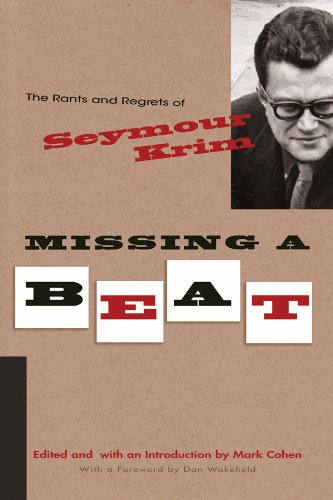
Now we have a newly gathered collection of Krim’s essays—from, of all places, a Syracuse University Press series called Judaic Traditions in Literature, Music, and Art—and a fresh generation of readers can find great pleasure and sobering cautionary lessons in ’50s personal journalism at its most excessive. Taken altogether, the collection offers the reader a roller-coaster ride of rising and falling spirits, as the prose excites with its insight and dismays with its naked self-absorption. “What’s This Cat’s Story?” is an insanely vituperative description of the New York intellectuals whose mandarin criticism, Krim now sees, was out to destroy him; “The One and Only Million-Dollar Jewboy Caper” is an over-the-top, insincere apologia to the journalist Jimmy Breslin, whom he had “inadvertently” accused of holding anti-Semitic sentiments; “Norman Mailer, Get Out of My Head!”—well, the title says it all. On the other hand, there is the series of remarkably penetrating essays, written out of Krim’s own experience, on what it meant, in the ’50s, to be a white boy prowling Harlem for sex and music. Today, these pieces are as wise and moving as they were on the day they were written.
And then there is the stand-alone “For My Brothers and Sisters in the Failure Business.” This, the star piece of the collection, is a brilliant (yes, brilliant) essay in which Krim pulls together the subject he has made his own with a rare power that does everything he ever wanted his prose to do and ensures him a permanent place in the history of American essay writing. Here’s a taste of its engaging introduction:
At 51, believe it or not, or believe it and pity me if you are young and swift, I still don’t know truly “what I want to be” . . . in that profuse upstairs delicatessen of mine I’m as open to every wild possibility as I was at 13. . . . That’s because I come from America, which has to be the classic, ultimate, then-they-broke-the-mold incubator of not knowing who you are until you find out. . . . It is still your work or role that finally gives you your definition in our society, and the thousands upon thousands of people who I believe are like me are those who have never found the professional skin to fit the riot in their souls. . . . I think what I have to say here will speak for some of their secret life and for that other sad America you don’t hear too much about. This isn’t presumption so much as a voice of scars and stars talking. I’ve lived it and will probably go on living it until they take away my hotdog.
The pleasure of the piece (and the profit as well) lies in the rich, sure speed of its street-smart, slangy intelligence successfully mimicking the whole preoccupation with youth—both Krim’s and America’s—as a middle-aged writer cries out, in a voice forever young, “I’m no longer young!” Inscribed in the rhythm and structure of the essay is all the deep downward movement of Krim’s (America’s) yearning, as well as the sweet sad stoppage of their mutual arrest. For both the man and the culture, this translates into an adolescent longing that life actually remain filled with untested promise. As Americans, Krim here insists, we are nostalgic for promise even while we are young, as though we are born with romantic regret for not being permanently able to begin again.
It is impossible, reading “For My Brothers and Sisters,” not to feel compelled by a sense of hard-won truth. Here, at last, we have essence of Krim: a mid-twentieth-century essayist whose writing persona, an embodiment of the condition itself, has been working tirelessly to persuade us of the lyricism of failure, American style. Coming out of a body of work so often marked by noisy solipsism, the crystal clarity of the piece gives it a visionary power that demonstrates more than adequately that all along Krim, like many others in those countercultural years, had something profound on his mind.
Vivian Gornick’s biography of Emma Goldman will be published by Yale University Press next fall.