

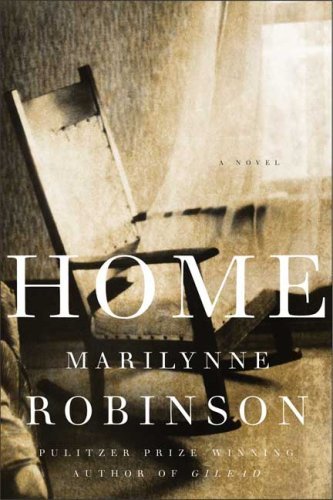
For Marilynne Robinson, crafting a novel is a way to consider both the work of divinity and that of human obligation. The word craft has for her its Old English meaning—strength—and is intended to be not merely painstaking but expressive of understanding. The odd beauty attained by Home, its method of fitting together with her Pulitzer Prize–winning previous novel, Gilead (2004), the moral discoveries that her characters seem almost to demand of themselves—these are in fact also matters of craft and can be studied in the lathing of the novel’s planks, the jointures of its corners.
In conceiving Home, Robinson set herself a problem one might have thought insurmountable, and the way she surmounts it turns out to be crucial to the book’s meaning, as well as to be one of its great pleasures. Home and Gilead take place in the same town, with the same characters; even the time frames correlate precisely. Gilead’s first-person narrator, the aging Reverend John Ames—a diagnosis of a failing heart having brought him into closer contemplation of death—writes a series of meditations addressed to his young son. Ames has a boon companion, known to him since prams and short pants, who is the Presbyterian minister of Gilead, Iowa (in Gilead, Ames refers most often to John Calvin), and this is the Reverend Robert Boughton, in all ways a contrast—his family copious and ebullient from the beginning, while Ames has long been solitary and austere. Boughton, too, is unwell in his late age, and two of his children return to care for him. Home is set among the Boughtons and told in a watchful third person; its primary characters are these adult children, Glory and Jack, and its perspective is Glory’s. Robinson’s challenge, then, was to find a new way to recount the story of these characters and their interactions through the eyes of a woman with sorrows of her own.
The Boughtons have shaped themselves in response to Jack, in Glory’s understanding: “They were so afraid they would lose him, and then they had lost him, and that was the story of their family, no matter how warm and fruitful and robust it might have appeared to the outside world.” Jack has returned from Saint Louis in dubious shadow after an absence of twenty years, during which he missed both the funeral of his mother and that of his out-of-wedlock daughter, who died as a young child. To Ames, in Gilead, thinking of the coming end of his own happy marriage, his namesake’s callous fatherhood seems at first reprehensible: “This John Ames Boughton with his quiet voice and his preacherly manner, which, by the way, he has done nothing to earn, or to deserve. To the best of my knowledge, at any rate. He had it even as a child, and I always found that disturbing.” The reader sees Jack differently from Glory’s viewpoint. Her hopes for marriage and children have foundered on the weak character of her abandoning fiancé, and for her, Jack’s current clandestine relationship reverberates upsettingly. Mistrustful though she is, in Home, Glory can’t help admiring how gracefully Jack helps their father, “as if it were a tribute to his father’s age rather than a concession to it,” how, when he reads aloud, he is “courteous to the page.” She knows that “Jack was a wound in his father’s heart, a terrible tenderness,” but she also feels grateful for his comradeship.
Robinson’s first novel, Housekeeping (1980), has a vaulting, astonishing language that seems to slide from the characters’ consciousnesses into the menacing landscape; Ames’s narration in Gilead is drier but still sometimes consuming, and in Home, too, images and thoughts take hold in the centers of paragraphs and become plangent. The language feels internal, as if Robinson has folded her sentences over on themselves, and they then open out when they enter the reader’s mind:
He was himself. That is what their father had always said, and by it he had meant that Jack was jostled along in the stream of their vigor and purpose and their good intentions, their habits and certitudes, and was never really a part of any of it. He had eaten their food and slept beneath their roof, wearing the clothes and speaking the dialect of their slightly self-enamored and distinctly clerical family and, for all they knew, intending no parody even when he was old enough to have been capable of it, and to have been suspected of it. A foundling, she thought, even though he had been born in that house at memorable peril to himself and their mother, alarming her two older sisters so severely that for years they had forsworn the married life. Oh, it was the loneliness none of them could ever forget, that wry distance, as if there were injury for him in the fact that all of them were native to their life as he never could be.
Robinson moves beautifully into and out of Glory’s thoughts; indeed, she works almost as if Glory were a first-person subject. We never enter the mind of another character, but from dialogue we can guess at the changes in their thoughts. The limited third person may express a kind of conviction on Robinson’s part; certainly, it accords with Glory’s heart-laboring attempt to see into the lives of others. In this, Glory is more like a novelist than either of Robinson’s two previous narrators. Both Ames and Ruth, the narrator of Housekeeping, look back to see how they have been marked by losing members of their families; they are concerned with the past, the near past of childhood, in one case, and the deep past of the Civil War in Gilead. Home is more resolutely engaged with its own time and with the future.
Two-thirds of the way into both Home and Gilead, there occurs the same scene, handled differently. The main characters are seated on the Boughtons’ porch, Jack poses the central theological questions of both books, and the two reverends fail to answer them. The scene is like a knot of energy into which both narratives flow and from which they emerge changed. Close comparison of the versions is revealing: In Gilead, when Ames reports the scene, he doesn’t remember that Jack raises the story of David and Bathsheba, with its question about the culpability of the father in the death of his baby, a reference that elicits from Glory, listening in the other novel, the thought “Dear God in heaven.” Ames hears his friend Robert Boughton pronounce, “To conclude is not in the nature of the enterprise,” whereas for Jack and Glory in Home, their father weakly refuses to give the answers they seek: “It seems as though the conclusions are never as interesting as the questions. I mean, they’re not what you remember.” All Robinson’s craft is on display: the fine touch for dialogue, how each character observes in the way natural to himself or herself, and the interrogatory prose that separates out the fibers of thought and makes of them botanical slides into which one peers deeper still.
Home begins with declarations about Jack but turns out, in a way, to be about Glory, while Ames’s story turns out, in another way, to be about Jack. Thus the two novels have a similarly slant movement. The traversal from one character to another is made under the pressures of passing time and nearness to death and acts to make a kind of torque. In each story, there are elements not known in the other; the two stories have been made to twine about each other as a skilled carpenter could make a curved handle from two kinds of wood. The care with which Robinson forms this double narrative has a powerful result: Either novel can be read independently to great satisfaction, but—how impressive this is—both can be read together, in either order, to greater satisfaction still.
Robinson attends to permanent departures, and these acts of rupture condense that condition of not knowing, of never being able to know, that she sees in all of our understandings. It is not given to us to see very much even of the life of a close neighbor, or a brother, and this incompleteness means that our understanding must reach toward the world with humility.
At the beginning of Home, Glory studies in their front yard the old oak that had in all her memory “flung its imponderable branches out over the road and across the yard, branches whose girths were greater than the trunk of any ordinary tree. There was a torsion in its body that made it look like a giant dervish to them. Their father said if they could see as God can, in geological time, they would see it leap out of the ground and turn in the sun and spread its arms and bask in the joys of being an oak tree in Iowa.” In its torsion and imponderability, the oak, like Robinson’s twined novels, argues for the importance of both what we can and what we cannot know. An author, like a carpenter, works with hewn and sawn material but loves the tree that is the greater work.
Rachel Cohen is the author of A Chance Meeting: Intertwined Lives of American Writers and Artists (Random House, 2004), which won the PEN/Jerard Fund Award.