


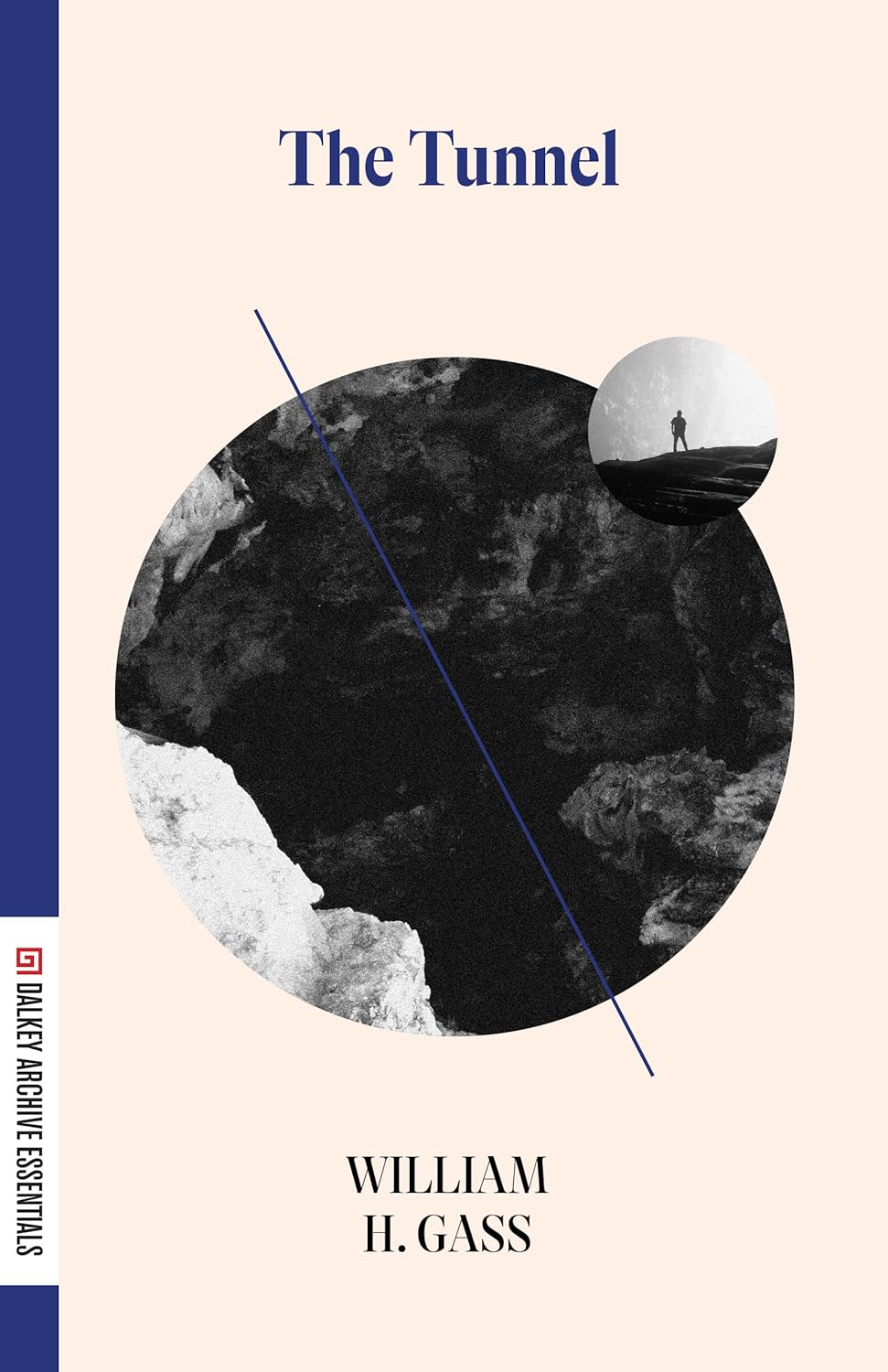
PEOPLE WHO FOLLOW the teachings of Wittgenstein, whether or not they do so wittingly, find nothing more frightening—or more potentiating—than a state of wordlessness: the end of the world. We can see this clearly in the time of live-streamed genocide, when the avowal that “there are no words” is often what passes for attunement to the state of emergency. There are people for whom the breached limit or the threatened loss of language means the necessity of making a new world. For some, it is time to propagandize for the new world by deeds. These people are often called activists sometimes actionists. Others take wordlessness as a personal challenge, a demand to pry, grind, or hammer out more words. These people are usually writers. (To write and act simultaneously is classically difficult.) Among the latter group it is William H. Gass, the novelist, essayist, and sometime professor of philosophy who as a graduate student saw Wittgenstein speak at Cornell, a fact that slightly bends time for me, since Wittgenstein seems very old and Gass, though he is dead, so new. His prose is voracious, voluptuous. He refuses to find anything unsayable. This beautiful if dubious ambition reached its expressive apotheosis in his great big book The Tunnel, first published in 1995 and newly reissued by Dalkey Archive Press, which claims it will sell more copies this year than in the three decades prior.
The Tunnel is a tale by a maddening man and historian named William F. Kohler. The plot, such as it is, is very simple. Kohler sits down to write the requisite introduction for his life’s work, a Nazi history called Guilt and Innocence in Hitler’s Germany, and, blocked, instead writes what’s in his mind; he interleaves this memoir with the manuscript, hiding his story inside history. The problem is solipsism: he’s going to run out of the latter before he stops recounting the former. The Tunnel is very long for a memoir, but not very long for a book about the Holocaust, probably the most described event of all time. Gass however called The Tunnel “the ultimate anti-novel” and “the opposite of history.” He denied that the Holocaust was its subject, saying instead that the whole “Nazi period” was “the background.” (The real subject, he asseverated, was the American “fascism of the heart.”)
The most interesting reason to enter a world where mass murder is the wallpaper comes from a different philosopher, Gillian Rose. In her 1996 book Mourning Becomes the Law she wrote about the Holocaust as a “civil religion” in an America that (she didn’t say this part) had done more than any other world power to normalize Zionism. This normalization was achieved in part through the exceptionalization of the Holocaust—by making it unrelatable, sui generis, refusing to let it be historicized. Rose balked at what she called “Holocaust piety.” She said, somewhat following Nietzsche, that the purpose of the prohibition was to mystify “something we dare not understand, because we fear that it may be all too understandable, all too continuous with what we are—human, all too human.” What she wanted instead of, say, Schindler’s List was “a film in which the representation of Fascism would engage with the fascism of representation. A film, shall we say, that follows the life story of a member of the SS in all its pathos, so that we empathize with him, identify with his hopes and fears, disappointments and rage, so that when it comes to killing, we put our hands on the trigger with him, wanting him to get what he wants.”
Kohler’s first-person gamification of language allows for the Holocaust to be startlingly, sickeningly revivified. There are Germans made to sweep up bodies “like a cup of spilled rice.” There are mass graves “as large as lakes, as long as rivers.” There are mounds made of “muscle, callused skin, and organ flesh—boneless as some hams.” Gass told Arthur Saltzman, his most attentive critic, in 1991 that all great writing is “a celebration of its subject regardless”—he meant regardless of the subject, or the subjectivity, at work. In 2009, Gass reviewed a book about the Reich for Harper’s, using even wilder language to describe the most specific and brutal crimes of the Nazis, so brutal that I found myself stupefied into remembering, as if it could ever be forgotten, how bad the Holocaust was.
The near-total supersession of individual acts of remembering with the institutional memory of the Holocaust is perhaps why Kohler struggles to introduce his subject and turns the subject to himself. He has one big idea—whether the man who dictates a thing should have to answer for the one who finally puts word into flesh. This is the oldest alibi in the book, every writer’s. It is also a reactionary capitulation to exactly what Hitler et al. needed to believe, that they were enacting the will of the people. Which is to say: Who threw the first stone at Kristallnacht?
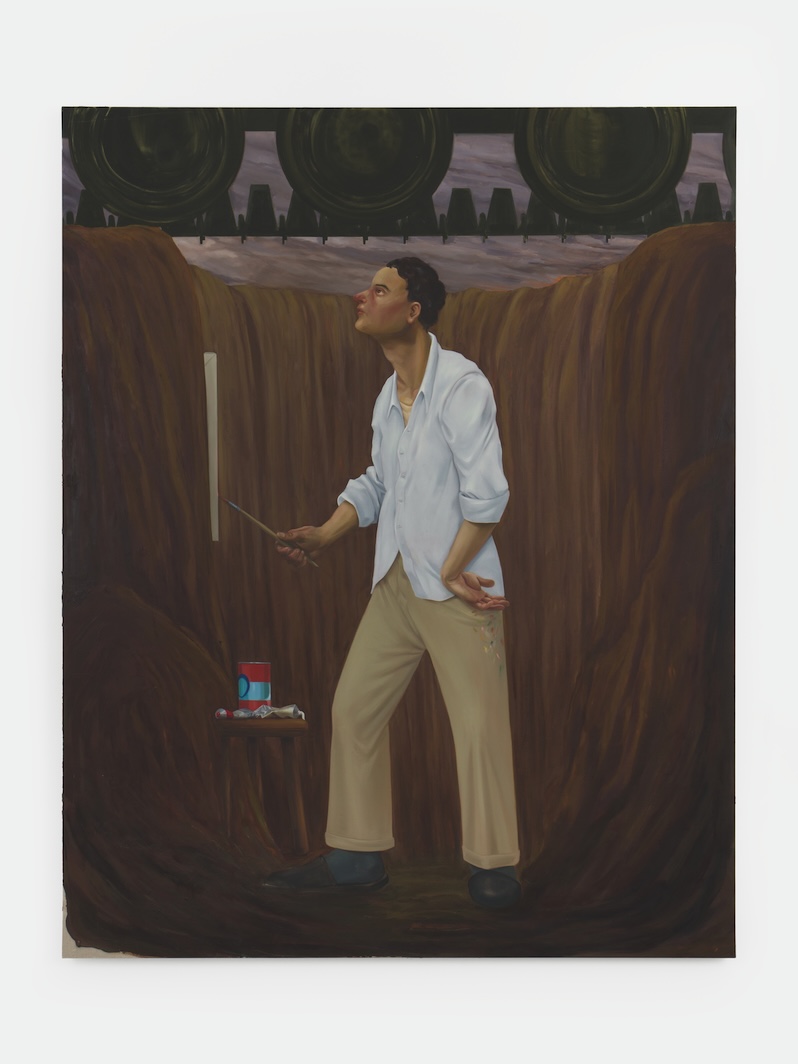
IT GETS WORSE. Kristallnacht appears in Kohler’s story not only as a fantasy but more importantly as a figure for what Henry James, in the preface to The Portrait of a Lady, called the house of fiction. The house he says has “not one window, but a million,” and a figure stationed at every one; the apertures show nothing without “the posted presence of the watcher,” that is to say the artist’s, the author’s consciousness. Gass titled one section of The Tunnel “Why Windows Are Important to Me,” explaining that his windows “provide the frame, proscenium to stage, and everything is altered in them into art . . . or into history . . . which seems, in circumstances of my kind, the same.” Mordantly, he sets the Kristallnacht section inside this disquisition.
Several of the longest sentences in The Tunnel, like the longest sentence in all of James, which is found in The Portrait of a Lady, are about history as/in a house. James opens his on the subject:
The house had a name and a history; the old gentleman taking his tea would have been delighted to tell you these things: how it had been built under Edward the Sixth, had offered a night’s hospitality to the great Elizabeth (whose august person had extended itself upon a huge, magnificent and terribly angular bed which still formed the principal honour of the sleeping apartments), had been a good deal bruised and defaced in Cromwell’s wars, and then, under the Restoration, repaired and much enlarged; and how, finally, after having been remodelled and disfigured in the eighteenth century, it had passed into the careful keeping of a shrewd American banker, who had bought it originally because (owing to circumstances too complicated to set forth) it was offered at a great bargain: bought it with much grumbling at its ugliness, its antiquity, its incommodity, and who now, at the end of twenty years, had become conscious of a real aesthetic passion for it, so that he knew all its points and would tell you just where to stand to see them in combination and just the hour when the shadows of its various protuberances—which fell so softly upon the warm, weary brickwork—were of the right measure.
In James’s sentence, according to the computational literary scholar Jonathan Reeve, the fulcral verb, right at the center, is “passed.” The house’s history unfolds toward and through it, passing from time to time into its new custodian’s consciousness, a telescoping effect. Gass, by contrast, writes sentences in The Tunnel whose lengths spiral out as if infinitely, then stop as if randomly. Take this one, which begins as follows…
I assume we all associate, if none of us do it as well, moving along old tracks from place to place in our past like a memory-driven train; but history, as I especially feel it, deposits itself inside its surroundings . . .
…and runs to nearly 800 words. We have the “I” standing at the entrance, before the digging starts. For Kohler the house is what he is trying to escape like it were prison, by tunneling out. This private and pointless dig gives the novel its name and, often, its sentences their shape. Here the fulcral verb is the first in the sentence: “assume.” Let’s not make an ass of the reader. It’s easy to feel like one, misled as the sentence slinks down the stairs away from its impetus, going on for the sake of goings-on, through freely associated objects, things, dregs, ending on the memory of a geometry teacher who opened doors with a hankie to protect herself from her pupils’ germs, much as Gass approaches cause and effect, trying to avoid being contaminated with that dirty word, “plot,” or with the sorts of personal history to which he was no more inclined than any other kind.
He had first set down his complaint about autobiography in Finding a Form:
I do not think it should be assumed that history, which had always focused its attention upon wars and revolution, politics and money, strife of every sort (while neglecting most everything that mattered in the evolution of human consciousness, such as the discovery of the syllogism, the creation of the diatonic scale with its inventive notation, or three-legged perspective, to be for centuries the painter’s stool), had found its final relevance with the inward turn of its narrative, for it now celebrated the most commonplace and cliché-ridden awareness and handled the irrelevant with commercial hands and a pious tongue, as if it were selling silk.
His own examples, it must be noted, side with history over consciousness as a motive force. Consider the first: Aristotle’s discovery of the syllogism, the form by which a conclusion follows necessarily from a major and a minor premise, like a perfect cadence on piano. Consciousness grows in leisure time: Aristotle himself wrote that in ancient Egypt it was when the priestly caste got free time that they discovered or invented mathematics. Aristotle, of course, was arguably the most free-thinking student at Plato’s academy. Would the syllogism have taken its shape had Plato not abandoned politics in the reactionary aftermath of the Peloponnesian War? Would The Tunnel have acquired its same shape and weight without technological and ideological state apparatuses, without the fellowship year at the Getty Center and the secretaries there who, said Gass, “put the first 500 pages of the text on the computer,” or for that matter without the computer?
America after the Second World War had its own academies of enculturation, many of which were funded, if not altogether directed, by state and non-state actors working to boost Cold War liberalism. Some of these artistic and literary institutions are listed in Gass’s acknowledgments: the Guggenheim Foundation, the Rockefeller Foundation—a locus of collaboration with the State Department—and the Getty Center. Gass’s design notes propose a more radical experiment in dissociation than proved possible with Knopf, his original publisher, or now with Dalkey: he instructed that these acknowledgments be set in a different typeface from the novel’s text, since, he wrote, “they do not belong to the novel.” In both editions, however, they appear in the novel’s own type, albeit half a point smaller; placed after the opening diagram, which scans as part of Kohler’s book, Gass’s thanks read as continuous with Kohler’s rants. The acknowledgments page becomes an accidental or symptomatic comment on institutional complicity.
A writer’s relation to plot may tell you his politics. Gass hated the word: “a terrible word in English,” he wrote, “unless one is thinking of some second-rate conspiracy.” A few hundred pages into The Tunnel, Kohler takes up the tale of Herschel Grynszpan, the Polish-Jewish teenager whose 1938 shooting of Ernst vom Rath gave Goebbels his pretext for Kristallnacht. Kohler, not alone among historians, reads Grynszpan’s farewell note—“my heart bleeds at the news of 12,000 Jews’ suffering”—as a forgery. He won’t allow the assassination as an act of resistance. Even first-rate conspiracies are theoretically counterrevolutionary, since to ascribe all romantic violence perforce to state actors (the CIA, the FBI, the Mossad) is to foreclose the possibility of “autonomous action,” or action taken individually in collective defense. This is not a strictly fascist position; it is also liberal, or anti-anti-fascist.
Nineteen years after Gass started writing The Tunnel and ten years before he finished, Don DeLillo’s White Noise introduced to the intelligentsia a different professor of Hitler studies. Jack Gladney has the chairmanship of a department he, quite Americanly, invented and named Hitler studies, but speaks no German. William F. Kohler, by contrast, has the background but was denied the Commager Chair in his history department, reserved for an Americanist. (Both Kohler and Gladney are remarkably uncontradictory in their positions, as compared with the star anti-colonial or anti-fascist academics in my personal firmament who, I have to admit, are sometimes suspiciously invested in what they critique. Many enlightened historians would be content to see Gaza turned into the world’s first open-air holocaust museum. What Gass called the “fascism of the heart” thrives in a liberal body politic.) Gladney, who thinks all plots tend deathward, wants to kill his fear of the end by becoming a murderer. Kohler wants to kill his father—whom he phallically calls “a little Führer”—by, more or less tragically, becoming him.
Gass I think was a kind of Method writer. He wanted to play a villain for probably the same reasons actors do: the challenge of overcoming a complicity between audience and actor—narcissistic, perhaps, or simply self-preserving disidentification with anything (back to Rose) that we claim is unrelatable when it’s “all too continuous” with us. And, like actors, he begs a question: whether performing a thing and being one are really two different activities. Is it possible for a novel’s protagonist to think something without the author thinking it first? When Kohler contemplates jam jars and prepares his toast, savors the expression “Product of France,” observes the haze on a knife after spreading butter and thinks, after all, it’s good to be alive—is that not Gass?
Gass spent decades protesting the question I said was begged. He once boasted to an interviewer that a fact-checker from The New York Review of Books had called to ask whether Gass was actually fat. “Not when I started the book,” Gass replied—ha ha. The fact-checker must have been calling about Louis Menand’s long review, “Journey into the Dark,” in which the word “fat” appears once, in a quotation. Gass’s telling lets his interviewer, the writer John Madera, believe that Menand had argued he was Kohler in body, ipso facto that the critic was a sucker for his sovereign conceit. But Menand said otherwise: “Writers double themselves all the time in their fictions.” Readers, he added, “have . . . little trouble dissociating the author from the double. Even three-year-olds know that Dr. Seuss is not the Cat in the Hat.” He also refers to “splitting” in the psychoanalytic sense, which seems more accurate: Gass takes scenes from his own childhood and gives them to Kohler in order to make them fictions, placing across the divide what he wants to disremember or wishes never happened in life. (I love when Gass tells Madera: “I used things from my childhood, but that was it.” Oh, is that all—only the reason you write.)
What divided my reactions as I read and re-read was not the possibility that Gass wrote Kohler because he, too, secretly adores a fascist, but the problem of consciousness not being where fascism forms. If you listen to the speeches of Mussolini, you notice he calls fascism “the unity of action and thought,” whereas Bordiga, or any Leninist, speaks of unifying thought and action, or theory and action, thinking first. Word order sometimes does make all the difference in the world. Kohler admits that the tunnel is “the ultimate inactive act,” then almost brags: “I can honestly say I have accomplished Nothing.” A poet—! And not a party man. On the other hand, when Gass insists his scene is America and not Germany, he implies more of a difference than there really is, since, historically speaking, it is hard to dig under the house of American fiction without slicing through the roots of German Nazism.
Why is it always separate the art from the artist? In this case, better said the other way: separate the artist from the art. Impossible. Like the profiteer warned by the Bible, the writer who ventures to restore the whole world in prose can lose, in the bargain, his psyche (what was the Greek word for soul now means mind). “You may deliberately wish to rescue the world by putting it in language,” Gass told the scholar Ildikó Kaposi in 1995, “but you’re certainly burying yourself in it. The book’s become your tomb, you know. . . . It’s all you are, and all you will be eventually.”
IF THE NOVEL OF CONSCIOUSNESS has a prehistory, it begins on an island. Around the time of the Crusades, the Andalusian philosopher Ibn Tufayl wrote the story of Hayy ibn Yaqzan, a feral child raised not by wolves but by deer, who reasons his way out of nature: “He reached the limits of the rational world and grew lonely, yearning for the familiar world of the senses, so he took a step back and completely abandoned his body” (trans. my friend Maya Shoukri’s dad). Centuries later, the story gave Defoe his Crusoe and Spinoza a model for the soul. Marx called them the Robinsonades, and mocked them as, essentially, immaterial fantasies of self-manufacture. Consciousness, Marx and Engels wrote in The German Ideology, is only conscious existence: “Life is not determined by consciousness, but consciousness by life.” Fourteen years later, in the 1859 Preface to A Contribution to the Critique of Political Economy, Marx revised this, changing “life” to “social being.” His reading tends to prevail, acknowledged or not. Most canonical “novels of consciousness,” from Goethe to Dostoyevsky to Woolf to Ellison, are novels of social being first and foremost. But Kohler’s is a kind of inside-out Robinsonade: monad, not nomad.
The most complete definition of human consciousness comes from the novelist and philosopher Sylvia Wynter, who sees the psyche as being continually produced and reproduced through the dynamic interactions between bios and logos, or bios and mythoi. In this she could be said to be resolving a long-standing conflict between the James brothers. Henry James tried to echolocate consciousness in the heartbeat, always feeling for words like “pulse” and “throb.” William James saw it in breath. In “Does ‘Consciousness’ Exist?” the elder James let the word evaporate: consciousness was a residue of the old idea that thinking was a kind of breathing, and once it had thinned to that “estate of pure diaphaneity,” it was ready to disappear altogether. Henry kept it and all but gave it a body. In a late essay on the question of life after death, he professed disbelief that the universe meant to pluck and discard the fruit of the artist’s consciousness at its ripest, and wondered whether the mind might not survive in, essentially, a body of work.
Gass, through Kohler, says in a line of dialogue that “consciousness is what counts.” (I say it is Gass speaking because, in a radio interview at the time of The Tunnel’s publication, he told the critic Michael Silverblatt that “really what counts in history . . . is what happens to human consciousness; not just what happens—the piles of bodies—but what was lost when you piled up bodies; what was gained when you decided not to.”) Fredric Jameson, in The Political Unconscious, says “history is what hurts.” Four words each, enthymematic: each a syllogism with its premises suppressed.
Placed together on a sheet of graph paper, the two axioms supply two axes: Gass’s, through signifying; Jameson’s, through suffering. Common sense puts the idealist with the heart and the materialist with the head—but the Marxist turns out to speak for the heart and the idealist for the head, the wrong way around. (Though it makes sense in America, where nothing, not even novel-writing, is more romantic than being a communist. I mean this in every valence of the romantic.) This schema places pain orthogonal to significance, which makes it hard to plot . . . trauma.
TIME, THE SUBSTRATE of both history and consciousness, is what traumatizes. There is nothing more injurious than experiencing time all at once: time stopping is time accelerating into a crash; time slowing is time dilating unbearably. Life’s central contradiction is that you always want more time, but an excess of simultaneity usually means death—someone else’s or yours—or worse.
If the Holocaust is read as an explosion of time, it becomes more understandable why it was said to set in motion history’s end, making more poetry possible (Adorno said the opposite, but he didn’t mean it — or he meant it dialectically). Auschwitz established a piety equal to the poetry that placed the event outside history, outside humanity. Nancy Fraser, one of the more conscientious academics in the West, has written that “‘Gaza’ bids to replace ‘Auschwitz’” as our symbol for the evils that humans do. But Gaza is not homologous with Auschwitz: not architecturally, not temporally, not ethically. Gaza is not Auschwitz because unlike Auschwitz it refuses a total unlikeness. Gaza is also a symbol of ordinary life and cannot be set outside time, no matter how many charlatans write books with “after Gaza” in the title; and, from outside Gaza, one task of literature might be to never again let institutional memory supersede individual remembering.
As a professor, Gass once assigned to a group of students the task of (re)designing a public place: a “tomb for the absolute,” the “national headquarters of gay rights,” or—he was not kidding—the camps at Auschwitz. No one, he told an interviewer in 2009, chose the latter. No one wanted to try replacing their consciousness with the one they might have if they were born into the same class of people, but in a different time, different place, different set of conditions. As Kohler, he took to the limit his notion of art as a means of (temporary, but entire) consciousness replacement. There were moments when miraculously it seemed to work. I would forget why Rome fell, wonder what “chair” meant in French, or try to guess who was Hitler’s favorite novelist, and Kohler would tell me pages later: “Prohibition,” “flesh,” “Karl May” (a lie and two truths). Mostly though, it was my own thoughts I thought more than usual. I thought about consciousness and how it counts—matters? tallies?—and whether the mark of non-consciousness in LLMs is that they can’t, as far as I can tell, tell time. I thought about machines and how the new ones are training us to live in a future world with far fewer people. I thought about death machines, the same wager doubled: that human life can be replaced by human consciousness, the piles of bodies by what their loss was said to gain.
Kohler is a man whose death stops no clocks. But his mind does tick. I felt a sense of loss as regards authorial death for the first time after turning the last page and reading the short biography of Gass, written, as it wasn’t before, in the past tense. Until then, possibly because no edition of the novel I have ever read or tried to read has ever been perfect, that is to say without typographical error, there was always the feeling that while you were reading, he was still writing the book. I loved that. I hate how “finished”—dead—synthetic prose gets.
Gass modeled an enlarged language, big enough to house or bury everyone. There is between writers and readers a special complicity, enabled and necessitated by the activity of reading, in contrast to the passivity of watching. This makes the novel formally well-suited to the rehearsal of social and political complicities with various relational forces, for better and worse. The Tunnel is a masterpiece of implication. It is also a nightmare of failed escape. I say this to settle one last score: the miscarriage of this experiment can only now, against the author’s will, be historicized. When the machine was invented that allowed him to complete his work of consciousness, it became inevitable that there would be too much information, too little innocence, too much guilt. Complicity would become the general condition, and dissociation the attendant pathology, of American life. Did he know this? It doesn’t matter. The time was not yet.
Sarah Nicole Prickett is a writer living in Montreal.