



IN HOUSEPAINTER’S LINGO, there is a term for a missed spot or a patch of uneven coverage: “a holiday.” As in, somebody took one! As in, make sure to get that holiday by the garage before you go home. A fleck of some forsaken color marks a gap: a slick of neglect, a tiny relic of unaccounted leisure. Originally, the word “holiday” dates from the fourteenth century, a holy day of religious observance with an accompanying pause in labor. In its most ancient sense, “holy” means whole-ness, an existence of complete integrity: the state of being intact and uninjured. In a way, the word evokes a perfectly finished surface. No missed spots.
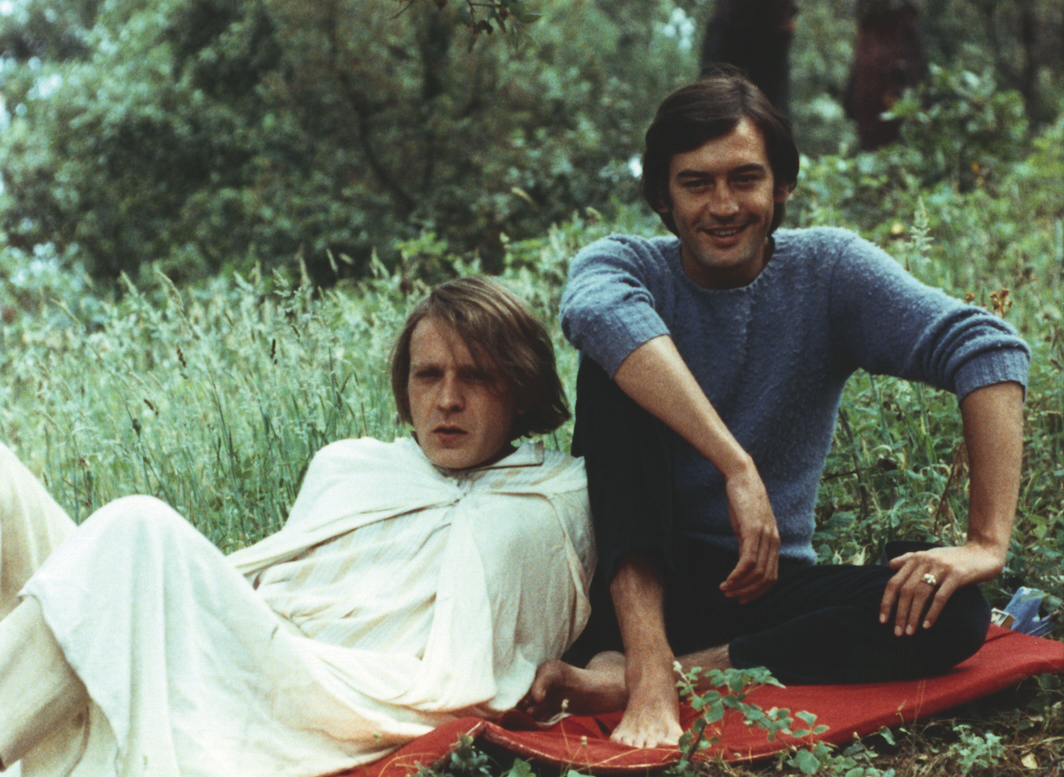
In Éric Rohmer’s films, it feels like everyone is on holiday all the time. Beginning in the 1950s as a critic and editor of the instrumental journal Cahiers du Cinéma before turning to directing, Rohmer created his own dappled shade of philosophy-laden realism across more than twenty films, from 1962 to 2007. He was the discreet, avuncular pillar of the French New Wave, a decade older than his more incendiary, politically committed peers, Godard and Truffaut. “Holiday,” in the Rohmerian sense, is a set of landscapes and a set of relationships, a place to live and a way to be, which open up a further, contained set of moral questions. It also marks a negative space: no work, no rules, nothing to do, absences that flicker in the hazy night like lightning bugs—flecks of elusive color. Rohmer’s characters approach leisure as an expertise, even a discipline, which produces its own rigor and aesthetic. As Adrien, played by the dizzyingly charismatic Patrick Bauchau, remarks in La Collectionneuse (1967), “I’ve always been sorry I wasn’t rich. But if I were, my dandyism, as you call it, would be too easy, lacking any heroism whatsoever, and I can’t imagine a dandy not being heroic.” Everything, even doing nothing, is discursive: they lounge on terraces, legs outstretched, books turned up to block the sun, gestural and flirtatious, and discuss why they are there, doing those things, not doing other things. Usually, the thing they are most conspicuously not doing is having sex with each other, but also, needless to say, exchanging labor for wages.
To produce this oeuvre of not, Rohmer merged cinema verité strategies—nonprofessional actors, improvised dialogue, loose situational directing, no music, real weather—with the knowing irony, conversation-as-plot, and elegant furnishings of a drawing-room comedy. He often surrendered to chance, relying on a single take with a script written the night before, while also wielding an extreme amount of precision over certain details. For Claire’s Knee (1970), he planted a rosebush at a particular spot a year before production began, in anticipation of its fullest bloom aligning with his meticulous shooting schedule, so the ideal rose could be picked, just once, on film. This tension—between surrender and control, chance and willpower, desire and restraint—is mapped in both form and content across his work. (And yes, he was a lifelong, observant Catholic.)
Can literature produce a similar effect? The question, perhaps unfairly, hovers around the first English translation of Rohmer’s only novel, Élisabeth, released this summer by McNally Editions. It is maybe fairer to call Élisabeth Rohmer’s juvenilia—he began sketching it when he was only nineteen. (He wouldn’t shoot his first feature-length film until he was thirty-nine, his second until he was forty-seven. After that, he didn’t stop directing, releasing a new film every year or two, for the next forty years.) Élisabeth was written during the Liberation of Paris in 1944, “composed while the bullets were still flying,” Rohmer remembered. “Flying, that is, right past my window.” The novel was published in 1946, under the name Gilbert Cordier. I almost wish I could encounter it under that name today—or perhaps under Rohmer’s birth name, Maurice Schérer. I wonder how I would read it, if I only knew it as itself: a slightly meandering debut novel with moments of woozy, verdant poetry and abrupt malevolence, an oddity of French fiction written during the Vichy regime, a tentative precursor to the Nouveau Roman, published a couple of years after Marguerite Duras’s The Easy Life, heavily influenced by American interwar fiction, like Faulkner and Dos Passos. Instead, Élisabeth cannot escape its framing as the buried beginning of something much more showy and beautiful: the prescient literary seed for a later cinematic rose.
If you are a real Rohmer-head, these pre-cog flashes of familiar moments can be incredibly satisfying, if a little aimless, like unearthing clues to an already solved mystery. I found myself vehemently underlining sentences like “The compact triangle of Claire’s knee glowed darkly beyond the sharp hemline of her dress,” thrilled to discover that Rohmer’s work had always been entranced by knees belonging to girls named Claire. In true Rohmerian fashion, the plot of Élisabeth is hard to summarize, but it is clear that he is narratively invested in the same erotic quandaries that underpin his first forays into filmmaking, circling a group of young people romantically entangled by the banks of the Marne river. The loosely defined protagonist, Michel, is engaged to an older widow, Irène, whom he secretly loathes. Michel’s cousin Bernard has a vaguely illicit relationship with his other cousin, Claire, but (literally) swims up to an enigmatic stranger, Huguette, whom he can’t help but notice. Michel, pretending to be Bernard, sexually assaults a girl named Jacqueline after giving her a ride home from the beach, but she escapes; by the end, he returns to his hollow commitment with Irène, Huguette recedes into the autumnal distance, and Claire reclaims her territory, closing out the final scene with “a sort of hectic, spindly grace, like that of a lithe young animal,” lying out in the garden, half reading an unnamed book. The eponymous Élisabeth is the matriarch who owns the country house in which all these feelings take place: she is more setting than character. It is the end of summer, 1939. An August breeze is “driving fat little clouds around the sky at a good clip, gently rocking the slender peach trees; a peach tumbles into a furrow among the cabbages; a bird, startled by the noise, breaks skyward with a little cry.” The war begins weeks later, on September 3.
The only acknowledgment of this imminent disaster is an old magazine that Élisabeth picks up in a dentist’s waiting room: “The cover of the magazine in her lap showed the German troops entering Vienna. Élisabeth looked for the date: March 19.” Inside, “A nudist camp on the Côte d’Azur.She turned the page: Interview with M. Ribbentropp.” In the time-world of the novel, the Nazis exist in the past (the ephemera of previous springtimes) and in the future (the reader’s awareness of the looming fall), but they disappear in the now, the long months of summer. Rohmer often draws his characters into a zone of exception, where tensions can build and selves are revealed at a remove from their usual contexts and larger historical realities.
The most memorable scenes in Élisabeth are situations of sudden, unplanned enclosure, although they diverge drastically in tone. In the first, Bernard and Huguette, who haven’t properly met, are flung together by a storm at the beach. They coordinate their bodies around paired tree trunks to stay dry—most of their chat is strategizing these spatial arrangements, scooting into heightened proximity. Rohmer’s language lingers on “the odor of damp leaves and rubber,” the texture of Huguette’s rain jacket over her swimsuit, her wet ringlets, the “sliver of one of her knees, caked in mud.” (Knee alert! Underline, underline!) The squall acts as an atmospheric and interpersonal force field, and although nothing really occurs between Bernard and Huguette, it feels as if something did, because sharing the negative space of temporary shelter serves as an equivalent: a private universe under the dripping canopy, a sexual experience of its own kind.
The second scene of enclosure is a total inverse of this blurry realm of tenderness, but it is written in a similar style: a detailed negotiation of two bodies in a small space. After meeting Jacqueline that afternoon, going swimming with her friends, and then driving her home, Michel, inexplicably going by Bernard, pulls and shoves at Jacqueline in the passenger seat, tugging at her belt as she grabs his arms. He bargains, “I swear, I’ll let you go in three minutes, it won’t take long.” She pleads and he hurts her before she manages to forcefully extricate herself. The violence is awful and startling but exists only for a brief moment. By the time Jacqueline has managed to get the car door open, she is laughing it off, shrugging, and they seem to chat amicably, as if nothing happened. I say “seem to” because Rohmer never plunges into the interiority of his characters; Jacqueline’s true feelings remain undisclosed, as do those of her attacker. It is almost like a written choreography for a performance, mapping every awkward sentence and desperate gesture. This, of course, risks flattening the event and dehumanizing the participants. But counterintuitively, it is through such a precise index of behavior, rather than motivation or intent, that Rohmer evokes the more nauseating subtleties of sexual assault: the necessity of smiling pacification after the fact, the bewildering comments of self-justification during. When Michel finally backs off, “he raised his hands, releasing her. She remained immobile beside him for a second, as if she hadn’t understood what he meant, then sprang out of the car and ran in the direction of the road. He started the engine and backed out of the meadow. As he passed her, she gave him a little wave.” Skimming across the surface, like a swiveling camera, offers something plain, brutal, and true.
In My Night at Maud’s (1969), the devout Jean-Louis is snowed in over two consecutive nights, in the homes of two consecutive women, who, of course, represent two distinct moral paths—another set of unanticipated enclosures. In Rohmer’s original story, which he had “carried around inside [him] since 1945,” Jean-Louis is caught in these chance sleeping arrangements (and their resulting carnal predicaments) because of the nightly curfew, enforced during the Occupation. In the translation from narrative to mise-en-scène, historical context turned into an act of divine intervention: the fascist state becomes thick-falling snow. Rohmer claimed that the “subject, such as I had thought of it, had no deep relationship with the Occupation,” calling for a shift toward a more universal experience. But undeniably it is also a shift from the amorphous to the concretely visual: we can see snow, and what luck, it is beautiful. A blank, uninjured surface, whole and holy. Curfew, in contrast, remains stubbornly conceptual. It is not even ugly; it is something beyond ugliness.
Perhaps this is the most acute tension within Rohmer’s films, the taut pull between what can be thought, and discussed, and what can be seen. The not-sex scene is the apex of this opposition, a moment when interiority (what it feels like) almost manages to swallow the optic (what it looks like). Rohmer’s missed spot—the holiday in the corner of this gleaming expanse—is the place of the political in our intimate lives. Élisabeth oftenfeels like a filmmaker’s novel, in that it persistently refuses to take advantage of fiction’s affordances, all that novels can do that images cannot. For example, novels can describe the rising tide of approaching war without showing the visual fact of a magazine headline. It is almost as if, with strange insight into his future vocation, Rohmer put the limitations of cinema onto the novel form. (We would expect nothing less from the president emeritus of the Abstemiousness and Restraint Fan Club.) But even Rohmer sometimes falls for language’s flirtation, caught in its rainstorm—artificial boundaries collapse before the wet ringlet of poetry. After the downpour, the walls of the house of Élisabeth “seem as thin as the wooden shutters, weightless and flexile as a grass blade or a leaf, or like the light itself that envelops everything without scumbling lines or softening angles, lending the objects it touches an unfinished, juvenile look, an awkward and tentative grace: the wavering intensity of something still seeking its outline, its purpose.” So too, at times, are the walls of Élisabeth, the novel.
Audrey Wollen is a writer in New York.