


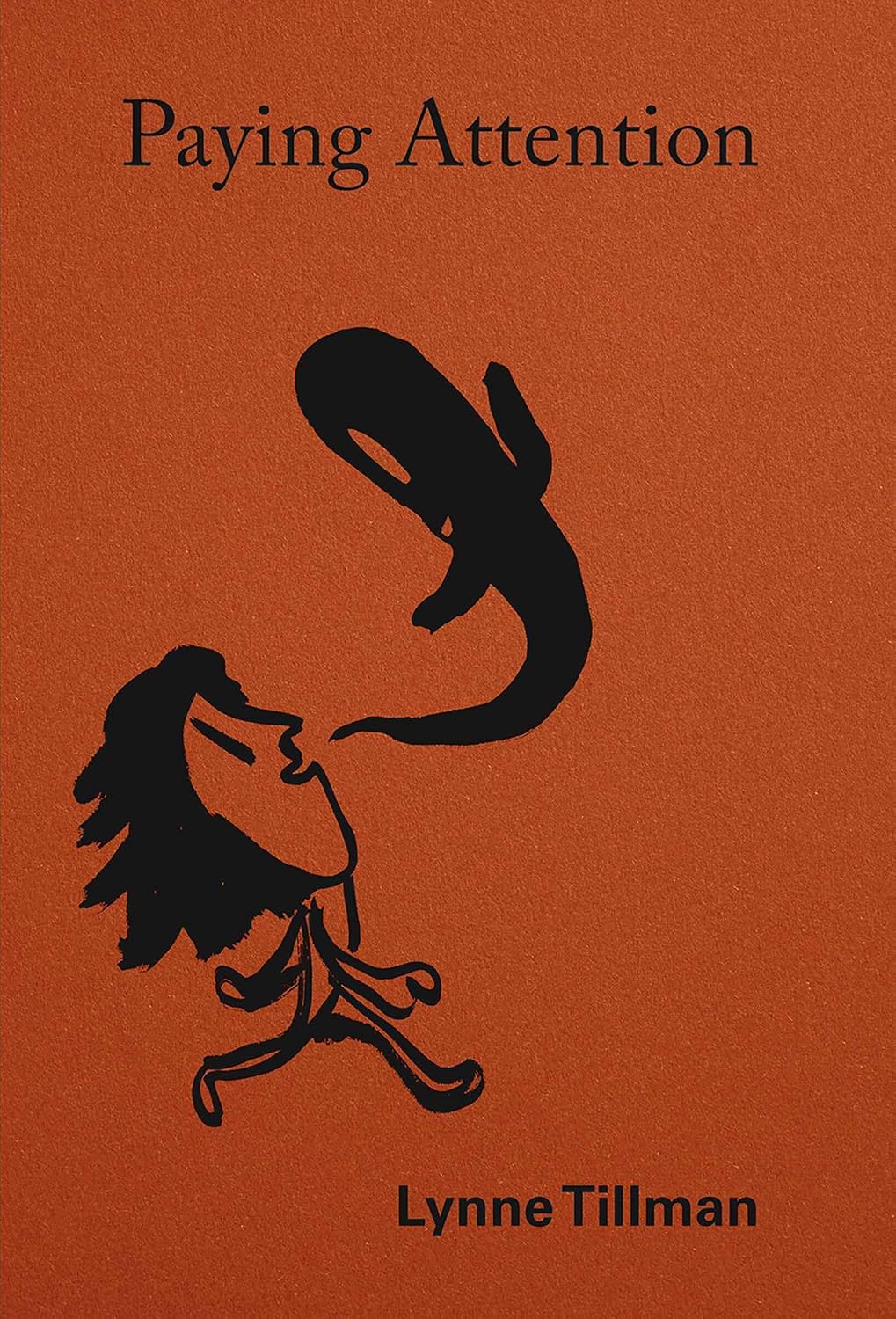
JENNIFER KRASINSKI: You had The Complete Madame Realism and Other Stories come out ten years ago, and now your new book, Paying Attention: Essays on Art and Culture (David Zwirner Books, $45), has just been published. How would you distinguish the two collections?
LYNNE TILLMAN: Madame Realism was a fictional character, and it was much more about setting her up as the narrator. It’s much more discursive—a very different voice telling those observations. Sometimes there’s no reference at all to anything, just that she’s in a situation. I thought that anthology was the end of her, but a few years ago I wrote another Madame Realism piece. Now I’ve done two more. And we put one Madame Realism piece in the new collection.
Did her voice come back to you?
I just realized I needed her. I thought she’d help me get into something interesting.
When you read these pieces, some going back decades, what do you think of this person on the page? Do you feel a distance from yourself?
Oh, yeah. But I’ve always had that distance. I think that’s part of why I allow myself to write things that might be quite different from the way I think. These essays are not me. I’m not writing auto-essays. I was interested in having a space to think. These are essays about thinking. Whatever the subject is, there’s thought brought to it.
Where and when did art come in as a subject for you?
I was certainly always interested in visual things. My mother was an amateur painter. My father was a textile designer. He and his brother would design the fabrics, send them to a mill to be manufactured, then sell them to dress or shirt houses. I loved looking at the fabrics. And in high school I had a friend who encouraged me to draw, and I remember making a drawing of my dog that wasn’t bad. Then I went to Hunter College, which had a great art department, with Ron Gorchov and Doug Ohlson. A friend who was a music and art double major said, “Why don’t you take some art courses as electives?” So, starting in my junior year, every semester I took oils or watercolors. And this really helped me, because doing art, you understand the problems of artmaking better. You’re thinking about the canvas, the corners, the relationship of colors.
It was so different from writing. You’re at your typewriter or computer, but in art class, these long tables were laid out, three students to a table. I went to the back, where no one else was. I was the only non-art major in the art department, and I think they all thought I was very funny. Gorchov said, “I want you to work first with lampblack, because I want you to get the feel of working with water.” So, I’m in the back, and it’s six weeks into the semester, and Gorchov finally comes to my desk and says, “You’re still working in lampblack?” I said, “Well, I don’t know if I’m doing it right.” He said, “Get on to color!”
That idea of “I have to get it right before I can move on” is very writerly. But I’d also say it’s very painterly of you to have the discipline to return to lampblack every week until you figured it out—or until you got yelled at.
He’d paid no attention to me until that moment! There was an old teapot in the room—that’s what I painted in watercolors for the rest of the term. He came over to me one time, looked at the watercolor I was working on, and took it from me. The lines were blurry and dripping. He said, “This is the first painting that’s been done in our class.” And he brought it to the front of the room. The same kind of thing happened in drawing class with Doug Ohlson. I could not finish anything. I’d draw a building or something, in Central Park, and I would have half a building on the page. One day in class, Ohlson saw me not doing anything. He gave me a stick and ink and said, “Use this.” And then I was able to make a drawing.
Do you think the stick and ink connected you back to—
—writing, yes!
Do you still make watercolors?
Occasionally. It’s really a good exercise for the brain and the eye. You learn to look. All of this helped me to think—later—that I could write about art, although it was never an aspiration.
Madame Realism was your first foray into art writing?
Yeah, but it was later, after college when I was living in Europe and getting into film, but hoping to write, not doing anything really. It was a slog for me; I was so insecure. In New York again, somebody called and asked if I wanted to contribute to a magazine of Surrealism. I said, “I don’t think so, thank you very much.” Then I thought about the position of women in Surrealism. So, I came up with Madame Realism, and I wrote my first Madame Realism piece.
Do you remember the subject?
It was about people at a dinner, and it was sort of about Surrealism in an odd way. I was thinking around different things, making interesting use of language. Then I had the idea to get somebody to make drawings for it, and maybe we’d make a book. I asked Kiki Smith, who was a newish friend. This was 1982 or ’83. She did the drawings. There used to be something called a LINE grant. We applied and got $2,000, andmade the first Madame Realism book, with Kiki’s cover and her ink drawings, perfect-bound. Soon after, Craig Owens, at Art in America, asked me to write about the Renoir exhibition in Boston. I said, “Craig, I’m not an art historian, I’m not an art critic.” He said, “We know. You’re a fiction writer.” So, I decided to use Madame Realism again. And because of the editor Betsy Baker—most art-magazine editors would not have allowed that to be published—I was allowed. She was friends with Harry Mathews, Kenneth Koch, John Ashbery, and she was really into writing.
What do you think Craig saw in your writing, or in your mind, that made you right for that assignment?
We had conversations about art. We saw movies together. He read my book Weird Fucks. I think he just had faith I could come up with something. And when he said, “We know you’re a fiction writer,” I was given license. A lot of non-art historians who were asked to do that would have tried to write more like an art historian. But his faith said to me: you don’t have to write like that. You can write any way you want. At that time, I think I was the first person doing a fictional essay in a well-known art magazine.
For myself, every genre, every discipline, turns on a different part of the brain or allows for a different relationship to thinking. I’m curious to hear more about how you would describe that experience for yourself.
Writing fiction, you’re making something up. There’s no object—unless, let’s say, I was writing a story about a dog, and I was very closely watching that dog. You have to make it up. But writing about art—or for art, or to art—or alongside art, which came from Craig Owens and is my favorite way of thinking about it.
“Alongside art” is his term?
Yes. He recognized that he was part of this world of artists and culture, and that he didn’t want to separate himself from it entirely so that he could judge it. He wanted to work alongside the art. That idea had a big impact on me. I was already sort of doing it before he wrote that, but I hadn’t named it. My idea was always to foreground writing. It’s not the handmaiden to art—it’s its equal.
A writer never writes in service of art.
That’s right. One person who was talking to me about Paying Attention said, “You have published many of these as stand-alone works.” And I said, “I wrote them so they could.” When you make sure the writing is not subservient, you’ve got something fuller that can stand alone.
The collection is a kind of a portrait of you, the author, as your mind arcs through and over—alongside—various artists. It’s interesting. While I was reading, I could feel my focus shifting, watch the subject receding while you, the author, came into the foreground.
Because you’re seeing a movement of thought, a movement toward certain things I want to think about, ideas that come back.
I don’t know another art writer who addresses the relationship between writer and artwork quite the way you do. You are very aware and open about the responsibilities of one to the other. You write about all the approaches one may take when writing about a work of art: explanation, interpretation, description, association, narration, etc. And you wrestle with those approaches in very different ways. I wonder if we can talk about how you decide what approach works best to articulate the experience of a particular work of art? For example, in the Dana Schutz essay, you spend a lot of time describing a single painting.
Her painting just completely absorbed me, and I thought, “What can I say about it?” There’s Wittgenstein’s saying “don’t explain, describe.” When you describe, you also theorize, because of how words work. Words include an explanation: why would you use this word rather than that one? But it’s not in the way that I’m telling a reader what to think about a work. After describing it very closely, you can begin to think about what it might be doing.
In every essay you seem freshly on the page. Sometimes you disappear into a more traditional critical “I”; other times you, Lynne, make yourself very present. Are those conscious decisions you’re making? Or is it, say, between you and a work of art to figure out what voice you’ll use?
I think different objects require different approaches. And I’ve been thinking about how criticism has come up against a big wall. I’ve been thinking a lot about—well, what is theory for? Theory is a form of explanation. But are the theories we use now in line with the art that’s being made now? And if there’s no relationship, is there a reluctance to change how you write about something, or how you see something? For instance, Andy Warhol comes along and changes what we’re looking at on gallery walls. Some writers hated it, thought it was the downfall of Western civilization. But others became interested in Pop as a different way of thinking about art, and so their writing changed. I think there may be a big gap now. Work like mine has spurred on some writers—fiction writers or others—to apply themselves to art writing, maybe because they see something different. But a lot of it is so terrible, because they don’t know anything about art.
I might add: there’s also a lot of terrible art, which doesn’t help anyone who wants to learn about art or art writing. Such a conundrum. I noticed that there are two subjects that recur most across the collection: Andy Warhol and Gertrude Stein. Why do they stalk your pages more than any others?
I read The Autobiography of Alice B. Toklas—I think in my sister’s library—and I loved it. When I was about seventeen, I wrote a story about my oldest sister walking down the stairs in our house, and I used repetition because I was so taken by it. It’s not that I love all of Stein’s work, though she wrote “Composition as Explanation,” one of the great art essays. She really challenges you as a writer to think about how you use words. And Warhol just tipped art over for me.
Do you remember your first encounter with Warhol the way you remember Stein?
Seeing a Campbell’s Soup Can painting, and asking myself “why,” and then the question of the ordinary being extraordinary. He was an iconoclast, and she was an iconoclast, and I liked that.
Can I ask about your relationship to the “I”? You have a first person that’s quite supple, porous.
Because “I” is a shifter. It’s like “you,” like “he,” like “they.” Why a writer uses “I” sometimes, or often, is that the reader immediately slips into that “I.” When I use it, that’s what I’m doing. I am a voice writer in my fiction—I have different voices. But I think because sexual prejudice still exists, when a woman uses “I” it’s felt to be more about her than when a man uses it. As if women can’t write about anything but themselves.
I once did a reading of a story I wrote, in which a woman’s house is besieged by worms, and she begins to transform, devolve, into a horrific, smelly, miserable monstrosity. A man came up to me afterward and picked up on one part of the story in which this character describes her grief over the loss of a loved one, and he said to me, “I’m really sorry that happened to you.” I had no idea what to say. I just couldn’t believe he thought what I’d read was autobiographical! But it’s what you’re saying: there is a general disbelief that women can make things up.
We don’t have enough distance. It must have happened.
I want to return to your comment that criticism has hit a big wall. I agree, but I’d like to know what that wall is as you see it.
There used to be schools of criticism. There are none anymore. It’s not like we don’t reach for Barthes or Benjamin, but these people lived a long time ago. It’s not that their work isn’t worthy or shouldn’t be read, but there’s no contemporary movement that writers can join or feel part of. It’s a much bigger art world than it’s ever been, and in these past twenty, thirty years it’s just exploded. What is the school? How do you judge, if you need to judge? With me, I’m responding to something. I’m seeing something, I might want to talk about its formal attributes to better grasp it. But I’m not judging, I’m trying to figure it out, how to think about what it’s doing, not “Is this good art?”
Do you have any repulsions when you look at art? And if so, do you choose not to write about it?
No repulsion, although certain things can disgust me, can actually roil my gut. Which would not be uninteresting to write about. But again, the “why” that precedes making is interesting. The problems of making a poem, a painting, a sculpture—there are huge issues in making art, and you can’t simplify those.
I’m going to ask the dreaded question: why write something?
“Why write something” is always the problem. I don’t know why. I’m right now trying to get behind a novel I started. I feel that there’s a reason to write it, but I’m trying to feel passion for it.
What compels you to sit down on those occasions when you’re not feeling that passion?
I want to write beautifully. It’s less about discipline than desire. The criticism that stays around is usually beautiful writing. Whether it’s Freud, or Virginia Woolf’s essays, or Barthes, or Benjamin.
As for Wittgenstein’s command to “describe”—description is more complicated than people think. It telegraphs the presence of perception because invariably it’s the author’s eye shaping the reader’s experience.
While every word has an attitude—many meanings—still a description comes closer to neutrality, even if someone would describe it better.
Why would neutrality be imperative in criticism? Most people think of criticism as a hotter form.
Maybe that’s the wrong word. But it’s different from explanation. Even though there’s always subjectivity—I’m using this word, you might use another—it’s still trying to look at the piece without a theoretical idea of what should be there. That’s why it’s important to be as exacting as you can be.
Jennifer Krasinski is a writer, a critic, and an editor at Bidoun.