


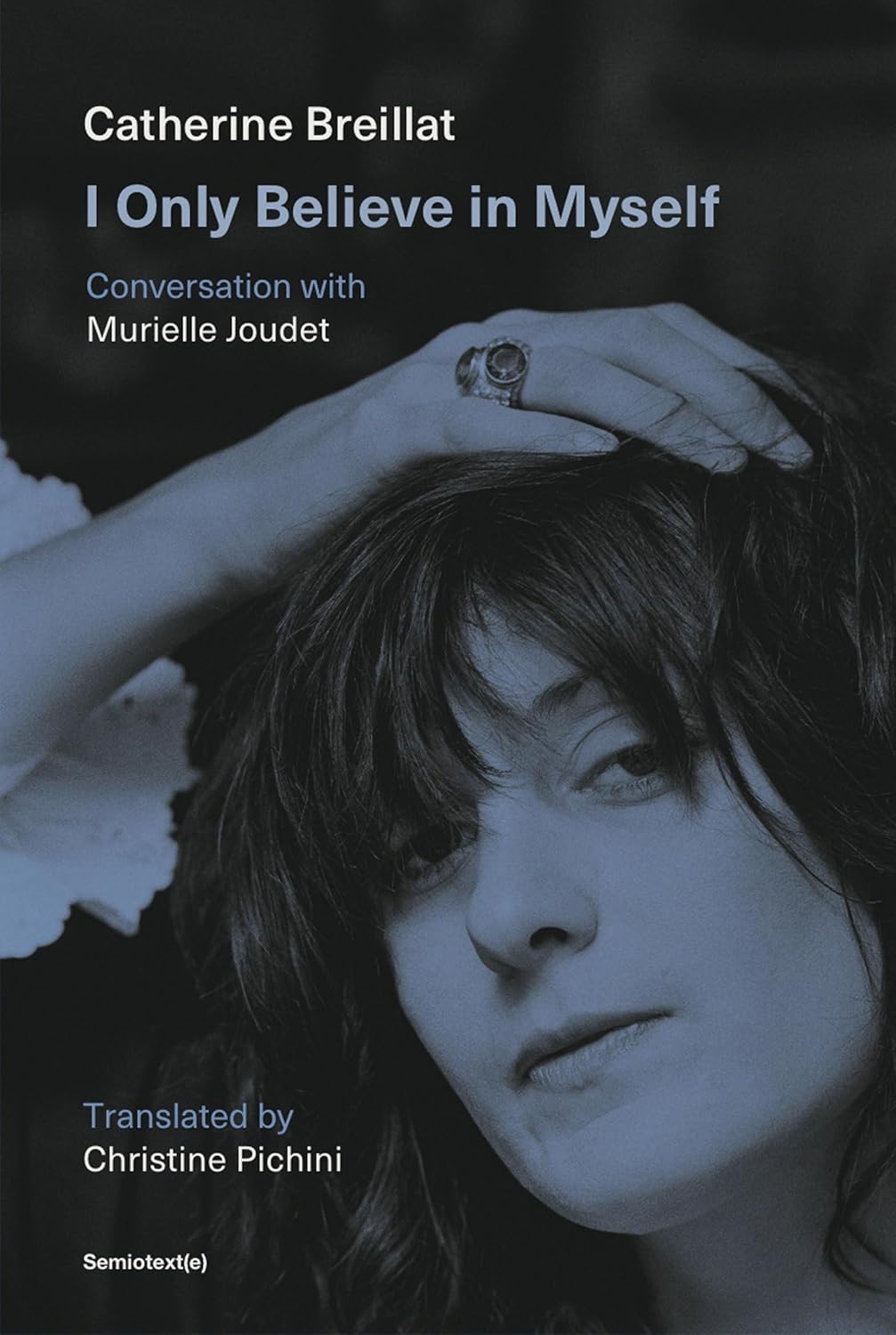
CATHERINE BREILLAT HAS THE HOTS for Rhett Butler. The French novelist and film director mentions the conceited cad played by Clark Gable in Gone with the Wind (1939) no fewer than three times, always in the context of attraction, in I Only Believe in Myself, a book of interviews conducted by Murielle Joudet in 2022 and 2023, now appearing in an English translation by Christine Pichini. It might be unexpected for an auteur closely associated with transgression to so frequently invoke a character from classical Hollywood, a cinema hemmed in by the Hays Code in what it can say or show. When Breillat elsewhere declares her debt to the “absolute violence” of the Comte de Lautréamont’s iconoclastic poetry and asserts that “beauty ought to be cruel and frightening,” it feels more in keeping with the spirit of an oeuvre that has been celebrated, censured, and censored for its fearless depictions of sexuality. From her first book, L’Homme facile (1968), which she published at seventeen only for it to be banned for readers under eighteen, to her most recent film, Last Summer (2023), which presents without condemnation the story of a lawyer’s affair with her teenage stepson, Breillat has gone where few would dare. The breasts of an overweight twelve-year-old, lipstick traced by a stranger around a suicidal woman’s asshole, chopped bits of live earthworms dropped onto the vulva of a teenage character: “I’m not ashamed to show every kind of depravity,” she says. “I’m familiar with it. I don’t glory in it, but I know that it exists.”
It does exist. But Hollywood, in 1939 or now, would never put it on-screen—which only makes Breillat’s cinema more important and her repeated mention of Gable’s character more interesting. In this ungentle man, whom most would deem a rapist, she discerns the allure of the “domineering chauvinist” who is loved and hated for the same reason. She knows that desire and disgust are intimate kin, mingling in the “attraction to the person who covets you and will inevitably humiliate you.” Butler exemplifies the masculine archetype to which Breillat and many of her characters are fatally drawn: the man who doesn’t ask but takes, freeing the woman from the burden of confronting a lust that she cannot extricate from shame, while exposing her to the possibility of violation. As Joudet puts it, Breillat has “a big appetite for brutes.” The film Perfect Love (1996) and the book Bad Love (2007) end in acts of femicide, while Fat Girl (2001) concludes with rape and murder. The director mentions Rhett Butler in the same breath as Christophe Rocancourt, the con man she sought out to star alongside Naomi Campbell in the never-completed film version of Bad Love,andwho scammed her out of 700,000 euros in the aftermath of the debilitating stroke she suffered in 2004. Recounting the experience in Abuse of Weakness, published as a book in 2009 and adapted for the screen in 2013, she writes of how, after the nightmare of her cerebral hemorrhage, his virility, charm, and arrogance enraptured her, even as she recognized that he was a manipulative predator.
A big appetite for brutes, yes. But Breillat’s hetero-pessimist cinema is a cinema of women and girls, populated by female protagonists who are hardly like Scarlett O’Hara. The director is obsessed with adolescence, which she treats as a condition of potentiality unbound by age. As Joudet observes, “Even when Breillat films Isabelle Huppert or Léa Drucker”—actresses born in 1953 and 1972, respectively—“she captures absolute adolescence.” The Breillatian girl is an initiate, existing in the muddled middle between one state and another, thirsty for experience and ready to engage both in quests for self-knowledge and acts of patent self-denial. The director gives her female characters freedom to roam, to try things out, even when it means relegating considerations of morality to the sidelines. Consider Lili, the fourteen-year-old protagonist of the novel-turned-feature 36 fillette (1988), whose holiday encounters in Biarritz are modeled on Breillat’s own experience of attempted rape as a teenager. She pursues an older man with a precocity that is as striking as her ambivalence, putting herself in situations of risk and excitement, less out of acute desire for anyone in particular than in the hope of shedding all vestige of virginal ignorance. Breillat says that she should have given the film the subtitle “or, How Young Girls Ask for Their Own Rape,” a statement that may make it sound as if punishment awaits those who stray from the path of irreproachable behavior. Lili, however, skirts harm and evades this fate—an outcome sadly rare for girls in the movies.
Breillat tells her stories in ways that escape the trivialization to which girls, young and old, are so often subject—which is not to say in ways that are pleasant or even believable. On this front, there is something else to be gleaned from her multiple mentions of Rhett Butler: he is a figure from another time, drawn from the universe of myth, sketched first on the page and then in light and shadow, all the more true because he is so patently unreal. Breillat does not seek sociological truths; in modern fables in which morality and desire are irreconcilable, she courts abstraction and artifice. Whereas other filmmakers fabulate alternatives to crushing norms, or search for those places where these have already become eroded or fissured, she uses the palette of fiction to paint the damage of the rule in lurid strokes, showing how we are shaped by it and how we chafe against it. For all the fleshy intimacy of these films, there is nothing straightforwardly realist about them. It is worth recalling that Breillat is an adapter of fairy tales—Perrault’s Bluebeard (2009) and Sleeping Beauty (2010)—and that several of her films swerve into endings that verge on fantasy, as in the sudden, spectacular violence that erupts at the conclusion of Fat Girl, a film Breillat describes as being about “someone who isn’t seen and who, as a result, sees.” On summer vacation, the twelve-year-old Anaïs overindulges in food and watches her pretty, fifteen-year-old sister Elena be coerced into sex by a university student. When the girls’ mother decides to drive them back to Paris early, this coming-of-age story seems to be coming to an end. Yet before the credits roll, a brief episode of contingent horror jolts the film into a different tonality: while the family’s car is stopped on the side of the road, a man appears out of nowhere and murders Elena and her mother, before raping Anaïs in the forest. She is no longer in the shadow of beauty, no longer invisible. She insists to the police that she has not been raped, and Fat Girl closes with a freeze-frame of her face. This ending, which has nothing to mark it out as “merely” dream or fantasy, strains at the limits of plausibility. As the realization of the young protagonist’s darkest wish, however, it enjoys absolute coherence.

The personal nature of Breillat’s output, often noted, is amply affirmed by the director’s statements in I Only Believe in Myself, beginning with the origin story of the attempted rape that spurred her to become a writer and formed the basis 36 fillette. “Disasters, heartaches, strokes, all of it must be used to create an oeuvre, everything must be sublimated,” she says. Yet even if she relates the trouble that resulted from basing Nocturnal Uproar (1979) on her own love affairs, Breillat emphasizes the transfiguration that occurs when experience becomes art. She calls Abuse of Weakness her least autobiographical film, citing Nagisa Oshima’s notion that “the more a director hides behind fiction, the more she reveals herself. And that inversely, the more she desires to present herself, the more she hides.” To sublimate, after all, is not to confess or transcribe, but to distil and transform, to take distance. “Nothing is truer than parables,” says the thirtysomething Alice in Brief Crossing (2001), as she and the sixteen-year-old she has just met and will sleep with that night sit in the bar of the ferry from Le Havre to Portsmouth, watching a male magician plunge swords into a box into which his female assistant has just disappeared. It is one of many instances when Breillat reflects on her approach to creation, as well as one of many instances when she can be heard speaking through the mouth of her character.
IN THE ANGLOPHONE WORLD, Breillat is closely associated with the tendency that James Quandt dubbed the “New French Extremity” in 2004. Although Quandt admitted that the differences among filmmakers such as Breillat, Philippe Grandrieux, and Gaspar Noé were great enough to disqualify any possibility of unifying them as a movement, he was roundly dismissive of a “growing vogue for shock tactics in French cinema over the past decade.” While Breillat’s subject is always sex—“My oeuvre is coherent from beginning to end; I’ve never made a film that doesn’t deal with it,” she declares—many of her works are in fact not especially explicit at the level of what is shown; their provocation resides more in the shamelessness of her gaze. Nowhere is this more clearly evidenced than in the stark difference between the Danish film Queen of Hearts (2019), in which the woman is depicted as a haggard, hypocritical abuser, and Breillat’s remake of the same scenario as Last Summer, in which Drucker’s character basks radiant in the light of her stepson’s passion for her. There are, however, moments of electrifying extremity littered throughout Breillat’s filmography, and it is undeniable that her reputation to this day rests principally on her most notorious titles, particularly the cluster released around the time of Quandt’s article: A Real Young Girl (1976), Romance, Fat Girl, and Anatomy of Hell (2004).
A Real Young Girl, Breillat’s directorial outing, was shelved at the time of its completion owing to the bankruptcy of the producer—and not because it received an X rating, as is sometimes asserted. It was distributed only following the succès de scandale of Romance around the turn of the millennium, when Breillat was able to pay off the debt at the lab holding the materials; together, she calls the films her “alpha and omega.” Her debut is a work of erotic fantasy and disgust, made under the sign of Bataille and based on her 1974 novel Le soupirail, in which she sets herself the tasks of “destroying entirely all that is corrupt” and writing “from now on with a mixture of blood, excrement, and sweat.” Set in a pre-pill 1960s summer and filmed in a candy-shop palette reminiscent of comic strips, it follows a bored girl who is unable to stand the proximity of her face to her vagina. She dreams of sexual encounters with the near-speechless Jim, her father’s employee at the saw yard, while getting close with all manner of base matter: crushed raw eggs, dead insects, vomit, urine, cyprine.
None of Breillat’s subsequent films, even the otherworldly Anatomy of Hell, exists so fully on oneiric terrain as this one, but the sense of unreality with which Breillat depicts her “real” young girl never entirely leaves her cinema; it simply finds more nuanced articulation. In Romance, it is present in the story of Marie, a woman who wanders through the night as if in a waking dream, in search of the sex her good boyfriend will not provide. Clad in pure white, she wants to become “a hole,” “a pit.” All the perverse pop of A Real Young Girl vanishes in Romance, as Breillat opts for a clinical serenity that distances the film’s graphic and sometimes violent sex from the language of pornography while simultaneously increasing its unsettling, hallucinatory quality. Joudet asks, “What was your heroine seeking?” Breillat’s answer: “Herself. My heroines are rarely seeking the other.”
After having the urge to make Romance for twenty years, Breillat finally found that the time was right in the late ’90s: “all of a sudden” the notion of including real sex in art-house fare “was in the air,” and casting Rocco Siffredi, an Italian actor famous for his appearances in rough porn, in a “normal” production was a gesture sure to attract attention. Just as pornography was about to breach the ramparts of home video and flood online spaces with a harder iteration of hardcore, Breillat sought to break its monopoly on the representation of ultra-intimate corporeality. “Sexual acts have never been filmed other than as a show of flesh, without ever giving the act any meaning,” she says. “But when you sleep with someone, it’s always a search: it could be depravity, denigration, simple pleasure, or even unconditional love. It’s thinking, fiction in motion. And the hallmark of porn films is the absence of fiction.” In Romance, Marie gets tied up, pinned down, and probed; she collapses in a torrent of tears and snot. And amid all this, in voice-over, she expounds her philosophy of the heterosexual predicament. The much vaunted unsimulated sex in the film is of interest to Breillat only insofar as it is accompanied by these lofty verbal reflections, creating an internal antagonism on which the film feeds. No simple exercise in shock, Romance is structured by the fault lines that make Breillat’s cinema so troublesome and so riveting: head and body, discursivity and corporeality, what one should do and what one wants to do.
For Breillat, there is more at stake in sex than mere pleasure. She is not trying to turn anyone on, and Marie’s journey does not lead anywhere light. By the end of the film, she is a murderer, a mother, and a widow. Breillat’s intransigent refusal of “positive images” has at times led her to be the object of feminist opprobrium—and long before she began to speak, disappointingly yet unsurprisingly, of #MeToo as “a nightmare” presided over by “mini-Savonarolas” who seek to enforce a “ruthless moral order,” as she does in I Only Believe in Myself. “I’m a woman who started making cinema in an era when they talked about ‘women’s films’: delicateness, modesty, and feminine refinement,” she reflects, evoking a vein of filmmaking still alive today, and far more common than films like hers. Breillat’s determination was to pursue the opposite, to usurp the territory that had always belonged to male artists. In Pichini’s translation, she says, “I’d like to say that I’m a man,” but it is more complicated than this; the self-declared feminist in fact says that she would like to call herself “une homme,” a man defined by the feminine article. In other words: a chimera.
ROMANCE, A FILM IN WHICH Breillat set out to “prove that nothing is ever obscene,” is now over a quarter century old. “It would be impossible to remake it today,” she tells Jourdet, because it is “too intense and too dangerously innovative a film.” Yet this is not only a matter of market taste. Breillat adds that Caroline Ducey, the lead actress, “perhaps paid the price for that and I regret it.” The English translation of I Only Believe in Myself makes no mention of a notable event that occurred roughly one year after the publication of the French edition: the appearance of Ducey’s memoir La Prédation (nom féminin), in which she accuses Breillat of having organized her rape on the set of the film. Elaborating on statements made to the press as early as 2022, Ducey claims in the book that the director failed to advise her of the unsimulated nature of a scene with the nonprofessional Reza Habouhossein, in which Marie meets a man on the street who offers her one hundred francs to engage in cunnilingus and takes him back to her building’s stairwell.
The fictional, fantastical nature of Breillat’s filmmaking is an integral part of her conviction that art is a domain beyond morality. “Words and images never hurt anyone,” she insists. Her 1999 book Le Livre du plaisir, a compendium of quotations concerning pleasure, begins similarly: “Literature is the most vast and inoffensive field of experience in the world. Because there, everything can be conceived. Especially that which is not done.” A film set, however, is a workplace. To read I Only Believe in Myself is to be immersed in an attitude that has been widely invalidated today, one that sees any sacrifice as justified if made in the service of artistic creation. “When I want an image, I have absolutely no pride, no shame, and no mercy, either. I don’t care how grotesque I am, as long as I get it,” Breillat proudly says. Acknowledging that cinema is “an art form that’s made with people’s bodies,” she emphasizes the exigent demands she makes on her performers, who are the raw material of her craft. “They can’t come out of the shoot totally unscathed,” she says, “otherwise the film would turn out totally sanitized”; it is because every actor must give her their “pound of flesh” that “they get paid the most.” This stance equally comes through in the metacinematic Sex Is Comedy (2002), in which a Breillat look-alike toils and cajoles her way through the staging of an intimate scene between a pair who can barely stand one another—a situation Ducey and Breillat concur was true of the rapport between Siffredi and the actress on the set of Romance.
There are many conflicting accounts of what happened on the shoot. As her book’s title would suggest, in La Prédation (nom féminin), Ducey denounces Breillat as uniquely culpable of rape, claiming that the filming of the stairwell sequence caused her life to lurch off course into addiction and self-destruction. She frames the event as a trauma she did not fully recognize until much later, one all the worse for having occurred under the authority of a woman. At the same time, the book tells a much larger story that extends far beyond Breillat’s sphere of responsibility to encompass, for instance, the reception of Romance and how Ducey was affected by the circulation of decontextualized clips of the film on the internet. In I Only Believe in Myself, Breillat discusses the shoot extensively and expectedly offers a different narrative. She paints Ducey as someone who now regrets something she did willingly in her early twenties, without being prepared for the “real harassment from journalists” she would receive, and accuses her of making false claims, not only about the alleged rape, but also in having stated that a body double was used for all sex scenes, including those with Siffredi. Breillat describes Ducey’s denial of having intercourse with the porn star as a story concocted with the director’s initial complicity around the time of the film’s completion as a means of appeasing the actress’s then-boyfriend. By 2006, however, Breillat “was astonished to realize that [Ducey] had convinced herself of her own lie.” In La Prédation (nom féminin), Ducey admits to having sex with Siffredi, but marks out a difference between this and the stairway sequence, which was, she writes, “very different, since during that take I was subjected to oral-genital penetration by surprise and without being able to give my consent: a clear instance of rape.”
“I needed to believe that the film was a #MeToo ahead of its time,” Ducey writes. Romance is many things, but it is certainly not that. The stairway scene concludes with the stranger forcefully turning Marie face-down to take her from behind, deviating from their agreement. When it is over, she calls out, “I’m not ashamed, asshole!” With this exclamation she joins a chorus of Breillat characters who insist they are fine in the immediate aftermath of violence, voicing statements that seem aimed as much at self-persuasion as at taking away any sense of having the upper hand an aggressor might feel. In Romance, Fat Girl,Bad Love, and Bluebeard, girls and women make declarations that confirm a Breillatian axiom: when one is a victim, “it’s better to get up and consider it as nothing.” What happens when that just isn’t possible is the stuff of another cinema, not this one. But not everyone is as unbreakable as Breillat—nor should they have to be. What is fascinating in fiction can be intolerable in reality; this is why the line between the two is so important. Loving Rhett Butler on-screen is one thing. Having him—or her—in your life is something else.
Erika Balsom is a reader in film and media studies at King’s College London and the author of the forthcoming criticism collection The Edges of Cinema: Essays on Twenty-First Century Film Culture (Columbia University Press, 2026).