



IT’S NOT SAID often enough, if it’s said at all, that avant-garde American poetry is experiencing a renaissance—an overbroad, obnoxious term that nonetheless fits the scale of the moment. For the early part of the twenty-first century, unless you really paid attention to the little magazines and small presses or, later, to Tumblr, you might think that to be a poet in this country meant writing earnest, lightly confessional free verse that now and then might bring to its surface a bit of historical residue, through some reference to the Triangle Shirtwaist Factory fire or the Lost Colony of Roanoke. An occasional sonnet or sestina, showing range, might be welcome as well.
The specter of L=A=N=G=U=A=G=E poetry, with its formal aggressivity and experimentation, had largely been dispelled, even though what Cathy Park Hong incisively calls its “expired snake oil”—the “specious belief that renouncing subject and voice” is inherently anti-authoritarian—continued to circulate, especially among academics. Bay Area poets were still using the tropes and frames of New Narrative, particularly in the context of the politically engaged poetry that came out of the Occupy movement, but largely gone was New Narrative’s love of filth, the sexual explicitness that forced readers to think, really think, about fucking as a social technology.
Every generalization brooks exceptions. Even when there’s not much of an avant-garde there are still avant-garde poets—Will Alexander, Rob Halpern, Juliana Spahr, Ariana Reines, and Elaine Kahn come first to my mind, though there are many more—and not being part of a critical mass doesn’t make anyone less interesting or important. Still, as late as 2020, it was easy to feel envious of the experimental poetry scene in, say, Britain, which has a much more visible literary mainstream and thus a much more cohesive opposition to it. Although that scene had long been white, male, and floridly hetero, its temperament was shifting thanks to a generation of poets like Nat Raha, Lotte L.S., Kat Sinclair, Alison Rumfitt, Maria Sledmere, Azad Ashim Sharma, Momtaza Mehri, and the late Callie Gardner and Gboyega Odubanjo (whose posthumous Adam is for my money one of the most important books of poetry published this century).
In the past four years, though, there’s been an explosion of American poetry that is not just formally innovative, not just opposed to the aesthetic and moral pieties of the mainstream, not just published by small presses, and not just thriving outside prestigious and well-funded MFA programs—an imperfect set of criteria that might begin to loosely describe “the avant-garde” or something like it. I think that what we have now is a school, a term meant to invite neither approbation nor skepticism, and that some of the most important poetry being written right now in the US comes out of it.
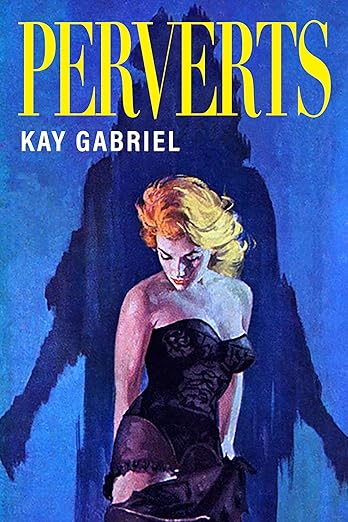
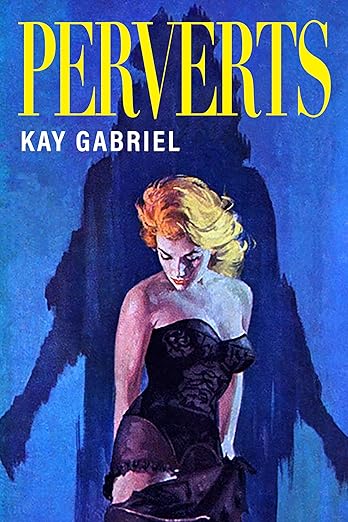
I won’t pitch a name, though it’s tempting to suggest “The Nightboat School,” after the Brooklyn–based publisher responsible for books by writers like Rosie Stockton, Imogen Xtian Smith, Nora Treatbaby, and Kay Gabriel, the Canadian-born editorial director of the Poetry Project, a venerable Lower East Side institution whose past directors have included Anne Waldman and Bernadette Mayer. Gabriel’s new book, Perverts, exemplifies the new poetry’s distinguishing features without being reducible to a narrow patch of typicals. It is queer and leftist, urbane, elegant but bawdy, erudite but steeped in popular culture, and passionately invested in forms of social life that feel distinctly contemporary—the party, the protest—but whose real history is ancient, even primordial.

New Narrative is an important lineage for this poetry, as is the New York School. Here is the candid, often graphic eroticism of Robert Glück and Dodie Bellamy and the pop-culture largesse of Kevin Killian, but with the stylishness and tongue-in-cheek oratorical gravity of Frank O’Hara, along with his flashes of surrealism; the simplicity and translucence of James Schuyler; the restless, melancholy intellect of LeRoi Jones, later Amiri Baraka; the no-bullshit politics of Diane di Prima. Heavily invested in what Lytle Shaw calls “the poetics of coterie,” the authors I have in mind treat friendship not simply as a theme but as a formal prompt. For them, the idea of a scene is itself a poetic architecture, a site of aesthetic but also, crucially, ethical and political value.
We can’t call it the Nightboat School, because these qualities are just as discernible in the work of poets who publish elsewhere, like Rainer Diana Hamilton and Shiv Kotecha, just two of the writers whose names appear in Perverts. Not just their names: the first section of Perverts (called “Perverts”) is a truncated “epic poem stitched together from the dreams of / friends or strangers,” a conceit that is harder to pull off then it seems. “Tell a dream, lose a reader,” said Henry James, but Gabriel, who has a bone-deep prosodic instinct and a sense of humor that is tart but never cruel, writes with a propulsive sincerity that instantly addicts the audience. “Rainer put me in their dogsitting dream,” she writes, “Then we taught / a class together”:
In Rainer’s dreams
I’m an icon of patience, not a Macaulay
Culkin party monster, not a bitch who
checkedGrindr instead of studying for quals and
nearly,ha ha, flunked out into a marriage fated
to crackShould I summarize? For you, Rainer, I kept
my infuriating cool.
. . .
We had our jobs, and we performed
at them. We dissatisfied only each
other. Everything ended as dainty
as if the god of marriage in a comedy
push-pinnedcheating spouses into place, and restored
the kings.
Here, the lurch between high and low—between grad school and Grindr, Macaulay Culkin and classical theater—captures the jumbled quality of a dream, in which the miscellaneous contents of the unconscious crowd into a single diegetic space. Gabriel’s voice is at once intimate and analytic. She can be the therapist translating vibes into symbols (“I’m an icon of patience,” “We dissatisfied only each other”) or a self-deprecating screwball, “ha ha,” who winds up the heroine of a romantic comedy after she’s rejected “a marriage fated to crack.”
Anyone who’s read Gabriel’s previous books, A Queen in Bucks County and Kissing Other People or the House of Fame, will see that her work is just getting better and better. The poems in those books—brash and sexy and confrontational—can have a stagy feeling (“Stephen Ira is in the bath! Stephen Ira is ten feet tall! Stephen Ira wears bright blue trunks!” one begins), and I don’t think I was wrong when, in a review of A Queen in Bucks County, I noted Gabriel’s affinity for O’Hara, who likewise loved to assume the voice of a ringmaster or radio announcer while sharing confidences or agonies. O’Hara makes an appearance in “Perverts,” as “a murderer” with drooping jowls and a “hairline recessed to his spine,” a “prematurely / elderly poet” who has to be “shoo[ed]” out of the room. The passage is too self-aware to be genuinely oedipal, but it shows that Gabriel knows her own voice—already wildly original—has become even more distinct, more directly embedded in and shaped by its own historical moment.
The second section of Perverts is an extraordinary poem called “Trannies, by Larry Kramer.” As the name suggests, it’s the most directly engaged in thinking about the contemporary state of sexual dissidence. A riff on Kramer’s Faggots, the much-loved and much-loathed 1978 novel of gay life in the era before aids, “Trannies” begins by imagining an alternate universe in which Kramer wrote a book by that name instead of writing Faggots, satirizing and celebrating and deriding and diagnosing “the modern bourgeois transsexual, / all four or five hundred of them.” Gabriel calls Kramer “a Dante / of other people’s shit,” but it’s she who displays Dante’s enargia, the rhetorical term for a visually powerful verbal description that creates indelible mental pictures in the mind of the reader or auditor. At a party (“probably at Mood Ring”), Gabriel narrates the experiences of a “you” who is also an implied “I,” a composite of first and second persons that is both generic (“the modern bourgeois transsexual”) and sui generis.
“You might have come with a boyfriend,” the passage begins, “if your boyfriend is trans, he’s probably outside peeking / at the nearby Grindr squares.” But,
if he’s cis, then you,
who never pass up a chance to peacock,
are here to peacock: you want the trannies
at the tranny party to know that you landed
a prize,say a gauntly handsome punk boy with dirt
under his fingers, or a tradey snack with
a chestpiece of splayed wings, who quietly worships
you and fuckslike a machine, and even takes a slice of pride
in appearing in the role of a party sidekick
while your charisma builds to Earth Mother
proportions.In that case the girl glancing almost
involuntarily in your direction may be
plottingwhether and how to make out with your
cisgenderboy candy, to prove that she can . . .
—testing his
particular devotion to you versus his general
attachment to form and genre, in this case of
a waifishgirl in a slip sucking his cock in a bar
bathroom without a toilet seat. In the
tranny termsof engagement this checks out, as does
holdinga grudge against that bitch forever, or
waltzingin to reassert control, and letting go of her
infractionwith an almost tyrannical indulgence.
Note the rhyme of “tyrannical” and “tranny,” working here to dramatize a milieu riven, at least in this scene, by competition and challenge, plotting and holding grudges. Kramer, Gabriel seems to say, was not entirely wrong: there is antagonism everywhere, even among people whose social marginalization might inspire them to solidarity. But antagonism is not ugliness. In the choreographed movement that unfolds according to “the tranny terms of engagement,” that follows the scripts of “form and genre,” there is also a kind of unspoken consensus, a ritual of being together that is far from perfect while also being pointed in a generally utopian direction—that is, toward pleasure and freedom.
You can hear in “Trannies” the rhythms of ancient epic, like the Ovidian description of disappointing lovers being left in “Hell’s hot sand” where “they spawned, brunched, perished and spawned again,” and you can hear its valiant modernity in lists of “inventions like insulin, running water, / light rail, PrEP, Naloxone, the moon landing, solar power, nylon rope and LSD.” This is new poetry, something you’ve never seen before. This is as good as it gets.
Anahid Nersessian is a writer living in Los Angeles and a professor of English at UCLA. She is the author of three books, including Keats’s Odes: A Lover’s Discourse (University of Chicago Press, 2021; Verso, 2022),