


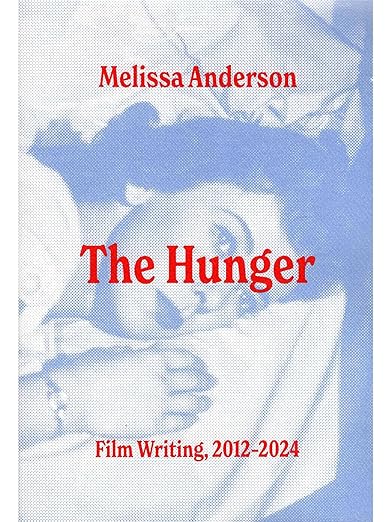
IN “THE ART OF THE ESSAY,” Elizabeth Hardwick describes what makes good critical writing: “The mastery of expository prose, the rhythm of sentences, the pacing, the sudden flash of unexpected vocabulary, redeem polemic, and, in any case, no one is obliged to agree.” One encounters these qualities—and an intricate style that has been sadly sloughed off by many critics who favor simple prose dedicated to the peddling of opinions—in Melissa Anderson’s new book, The Hunger. A collection of film criticism from 2012 to 2024, The Hunger is replete with lyrical observations, authoritative critical analysis that imparts respect and love for cinema, and personal reflections that unfurl like confessions (she considers going to the movies alone “sacrosanct”). These pieces deepen our understanding—not only of movies themselves but also of how we respond to them. Anderson delivers her sharp opinions with flair. Luca Guadagnino’s Suspiria remake is blighted with “dull-witted ostentation,” and she avers that “each new film that Terrence Malick, the once notoriously unhurried director, has made in the rash of projects since The Tree of Life evinces a further regression, an increasingly witless sacralizing of male-female coupledom.” But The Hunger is much more than a catalogue of assessments. It is a poignant evocation of the desire provoked by cinema.
“My first formative moviegoing experience involved a film that I could never recommend today,” Anderson writes in her introduction. The movie is Norman Jewison’s Agnes of God, an enervated Hollywood product designed to score awards. Anderson writes:
I am chagrined by the fact that such a middling movie held me in its thrall—and that it was [Meg] Tilly, and not Jane Fonda, playing the chain-smoking, tweed-blazered and leather-booted psychiatrist assigned to determine Agnes’s sanity, whom I ardently responded to (my Jane fascination would come later, after I saw Klute on VHS). But my experience with Agnes of God presaged what would later become my profession: trying to articulate a film’s effect on me.
Over the course of the book, Anderson maps out her evolution as a cinephile and movie critic. She says that her early work “is at once too timid and too moralizing, the sentences too baggy, the adjectives too vague.” Anderson has written for a panoply of publications with different styles and word counts—Time Out New York, The Village Voice, and now 4Columns. The variety of venues helped her figure out how she wanted her writing to be. “I tried to make my language more specific and vivid; at the same time, I tried to loosen up. (It wasn’t until 2012 that I began to feel that I was doing this adequately.)” In some ways, Anderson is the antipode to Pauline Kael, another film critic for whom desire was integral. Kael wrote long, vivacious essays with lively yet blunt sentences, paced as if they were written in bursts of mania; Anderson is just as ardent and personal, but wryer and more searching. She matches her awareness of complex longing—the way we look at actors—with striking insights and arduous control.
Anderson, who calls herself a “cranky lesbian,” states that gay film writer Boyd McDonald has been a “lodestar” since she read his collection Cruising the Movies: A Sexual Guide to Oldies on TV. McDonald, who created the zine Straight to Hell, wrote unencumbered columns about Golden Age films, television, and pop culture. Here was a body of critical work laced with desire. McDonald describes men’s bodies, their faces, their aura. He lavishes attention on the butts of models in Bob Mizner’s Athletic Model Guild, founded in 1945. About Richard Widmark, he writes: “For it is a question of the face (the eyes, the mouth) and personality, not the body and not the underpants. Widmark’s face cannot be directed or scripted (or even described).”
Anderson shares with McDonald a heightened awareness of moviegoing as a voyeuristic and erotically charged act. Reviewing Blue Is the Warmest Color, she says of Adèle Exarchopoulos’s perpetually open mouth: “That bouche appears incapable of ever fully closing. Adèle is frequently shown, often in extreme close-up, with her mouth agape. . . . This constantly ajar orifice suggests, again too obviously, Adèle’s ravenous hunger—she slurps down multiple plates of spaghetti Bolognese—and carnality, her sexual curiosity piqued when she first sees Emma (Léa Seydoux), a slightly older, soft-butch, turquoise-haired beaux-arts university student, who cruises her back.” On Jacques Durey’s La Piscine, Anderson writes, “Most voluptuously, there are the hues of the eyes of Alain Delon (sapphire) and Romy Schneider (beryl), who play Jean-Paul and Marianne, the central couple of a sybaritic foursome. Blue is the hottest color.” These characters are “obscenely beautiful.” On Clint Eastwood in the psychosexual thriller Play Misty for Me, Anderson writes: “Twice the actor is filmed in various states of undress, once without a shirt, another time in nothing but white briefs. His body is sexualized, fetishized, subject to a lubricious scrutiny usually reserved for actresses.” (Another difference between Anderson and Kael: Anderson does not virulently hate Clint Eastwood.)

About Misty, Anderson continues, writing during lockdown:
But now I must admit to other conflicting, overwhelming feelings, prompted by writing this piece. My initial viewing of Play Misty for Me, almost three years ago to the day, took place at Manhattan’s Metrograph theater, where the film was projected on 35mm and where I sat surrounded by at least 50 other people. The film has remained so alive in my mind largely owing to the conditions in which I first saw it. While rewatching it, at my dining room table as an audience of one, I couldn’t stop thinking about those strangers I’d convened with on Ludlow Street on that April day of 2017. I hope they’re all okay. I hope you are, too.
This is a gorgeous example of Anderson’s style of constellating the personal and the intellectual, always in pursuit of pleasure or honest about the lack thereof; Anderson’s style is fluid and clever, from her punctilious choice of vocabulary (“lubricious scrutiny”) to the rhythm of her syntax. Her descriptions of actors are indelible. In Cracked Actor, shot during David Bowie’s North American Diamond Dogs tour in 1974, the musician has an “otherworldly, skeletal frame, accentuated
. . . by [his] disco-dandy look—red suspenders, high-waisted trousers, broad-brimmed fedoras atop a strawberry-blond pompadour.” And consider her insightful way of talking about Kristen Stewart in Café Society: “Stewart’s steno-pool sophisticate is the luminous orb around which these men revolve, and the sole source of fire in the film.”The prose’s alliteration and rhythm carry us along.
The book offers up numerous descriptions laced with ambivalence if not outright disdain. Portrait of a Lady on Fire is “sapphically swoony but occasionally didactic. . . . [It] weighs down its love story with Linda Nochlin–esque digressions.” She calls The Substance “inane, repetitive, and benumbing.” Sofia Coppola’s pretty, empty remake of The Beguiled “teems with rich, period-exact surfaces. McBurney may suffer grievous bodily harm, . . . but Coppola’s movie never breaks the skin.” Django Unchained is “as irritating, if not quite as inflammatory, as a hemorrhoid.” (I love this line, and I mostly dig Django.)
One person you might think Anderson would abhor but whom she treats seriously, smartly, is Norman Mailer, a sage with inimitable insights into the dark parts of the human soul and a disputatious jerk with a propensity for outlandish behavior. Her essay on the documentary Town Bloody Hall, in which Mailer pugnaciously debates feminists Jill Johnston, Diana Trilling, Jacqueline Ceballos, and Germaine Greer, is the best I’ve read on the film. Anderson writes,
“D. A. Pennebaker’s restless, captivating Direct Cinema triumph . . . is a work of oceanography, documenting one splashy moment in the cresting and crashing of American feminism’s second wave.” The film “bounds with loamy, invigorating talk, even if on occasion an argument is hard to follow, if not outright incoherent.” (I read this wishing that I had thought of “oceanography” and “loamy” to describe this galvanic clash of minds.) She points out Mailer’s “overweening outbursts,” but also calls him “the event’s most excitable participant.” His vociferous tantrums are ideal for cinema. And “Pennebaker,” she points out, “was an adept at spotlighting the writer’s twitchy, hectoring demeanor.”
One aspect of Anderson’s essay that distinguishes it is her ability to situate the film in the history of gay liberation, an important focus when most writing about the film dwells primarily on Mailer’s crazy rants. Johnston, who would later write Lesbian Nation: The Feminist Solution, delivers a showstopper of a homily on the innate lesbianism of women. Anderson writes that after Johnston’s “spectacular performance,”
Johnston and her lez conspirators simply leave the stage, and the Voice writer never returns. But the subject of homosexuality isn’t banished; it lingers, whether overtly or covertly. Gay activist Peter Fisher asks from the audience whether the female panelists believe there’s a “connection between the women’s liberation movement and the gay liberation movement.” Greer’s response lays bare more fissures within the feminist struggle: “I always thought it was part and parcel of the same movement. I know this means some of my sisters part company with me on this issue.” One of those sisters was Betty Friedan, also in attendance at Town Hall that night and seen, just a few minutes before Fisher speaks, railing at Mailer. In 1969, while president of now, Friedan had warned members of that group that a “lavender menace”—that is, lesbians active within the women’s movement—would destroy the credibility of feminists, who, as she imagined it, could easily be dismissed as misandrists.
Anderson’s observations are absorbing and necessary. I never really paid much attention to the lesbian themes of Town Bloody Hall, and reading Anderson provides me with a far richer appreciation for the film and understanding of its context.
Throughout the collection, whether she is writing about Sidney Poitier, Jane Fonda, Madonna, Saturday Night Fever, To Sleep with Anger, Anderson’s prose crackles with expertise, taste, and singular perspectives. She writes with humanity, humor, and passion, expressing to us how a film has affected her, and giving avid language to how a film might affect us, too. She understands the prurience of watching people on a big beaming screen in a dark room. The critic can be a most loving paramour. Anderson reminds us why criticism exists, and why it is, like going to the movies alone, sacrosanct.
Greg Cwik is a writer living in New York.