


SOMETIMES IT FEELS LIKE THERE ARE THREE TRUE OUTCOMES FOR MILITANTS. You run, you’re imprisoned, or you die. Sometimes it’s all three. The Weather Underground (WU), perhaps the most notorious of the late-1960s American radicals, met all these fates—including, most famously, accidentally blowing up three of their own.
Born locally out of the violent splits in the Students for a Democratic Society (SDS), and internationally in the wider context of “global ’68,” the Weathermen announced themselves in Chicago in 1969. They broke from the larger student movement after getting fed up with the apparent futility of every legal mechanism of protest. In the words of Weather Underground member David Gilbert, “We petitioned, we demonstrated, we sat in.” From 1966, when Gilbert and his comrades had joined SDS, until 1969, when the WU broke from it, nothing material had changed about the issue the Weathermen thought mattered most: extraordinary, inhuman violence at home and abroad.
These two fronts—the racist violence in the streets of the United States and the American War in Vietnam—would condition the core politics of the WU, with the idea that the Black Panther Party (BPP) was the vanguard that should lead the way. WU cofounder Bernardine Dohrn argued for a “fucking white revolutionary movement” to perform concerted aid, drawing heat away from their comrades. Dedicated to what they called “Bringing the War Home,” the WU began a program of “extreme vandalism,” making a spectacle out of property destruction, including the bombing of the Capitol and Pentagon buildings. For many of the Weathermen, this meant enduring the consequences of their commitment: living on the run, and going, as it were, underground.
Around the time most members hit age thirty in the mid-’70s, with the American War in Vietnam finally over but racism no less entrenched at home, the children of the revolution found love in a hopeless place. They partnered, and many had children of their own. One by one the women of these interlocked but distinct groups—the Weathermen and the Panthers—got pregnant, giving birth to the “Weather Kids and Panther Cubs.”
Tupac Shakur, born to Panther parents Afeni and Lumumba Shakur, is the most famous of these children (Billy Garland, another Panther, was later discovered to be Tupac’s biological father). Assata Shakur and Kamau Sadiki decided to have a baby when they were held together in prison. Jennifer Dohrn, Bernardine’s sister and the aboveground spokesperson for the WU, was next; when she visited Assata, held behind prison glass, both were eight months pregnant. With both his parents locked up, Kathy Boudin’s son, Chesa, was raised by Underground comrades Bernardine Dohrn and Bill Ayers. He later returned to the legacy of his grandfather—a civil rights lawyer who had represented Fidel Castro—becoming a progressive district attorney for San Francisco (as if that’s not a contradiction in terms). The Weather Underground was a family, and it was more than family.
Some of these new parent-revolutionaries decided they didn’t want to be underground anymore. They felt that their tactics no longer worked or mattered and made plans to come up for air. Others had no choice but to stay inside; they were captives of the state. The most committed kept at it: yes, they had not succeeded in changing the material reality of racial capitalism, but that meant there was still work to do. Many of these remaining militants formed new groups from the splinters of the old and the new sparks lit along the way: the Black Liberation Army, the May 19th Communist Organization (M19CO), and Prairie Fire. Form followed content: all of these groups placed a primacy on feminist inclusion of parents in radical activities and on children as a site of revolution, providing collective childcare at events, making children’s coloring books, and offering other forms of child-centered popular education and organizing initiatives.
This chapter of radical history—from SDS to the Underground, from M19CO to Prairie Fire—has been retold time and time again: as an icon of when it all went from groovy and hopeful to scary and criminal, or in heroic portrayals of the collective in which white student militants put their money where their mouths were. The cycle commenced with the 1976 documentary Underground, before it was digested in Hollywood as the 1988 film Running on Empty, itself immediately followed by Thomas Pynchon’s Vineland (which was adapted as One Battle After Another last year). Long after the final, painful, violent instances of WU tactics, or perhaps because of them, the WU retained a kind of charisma in the American public imagination. Perhaps, as the militants aged, got locked up, and died, it was finally safe to celebrate them.
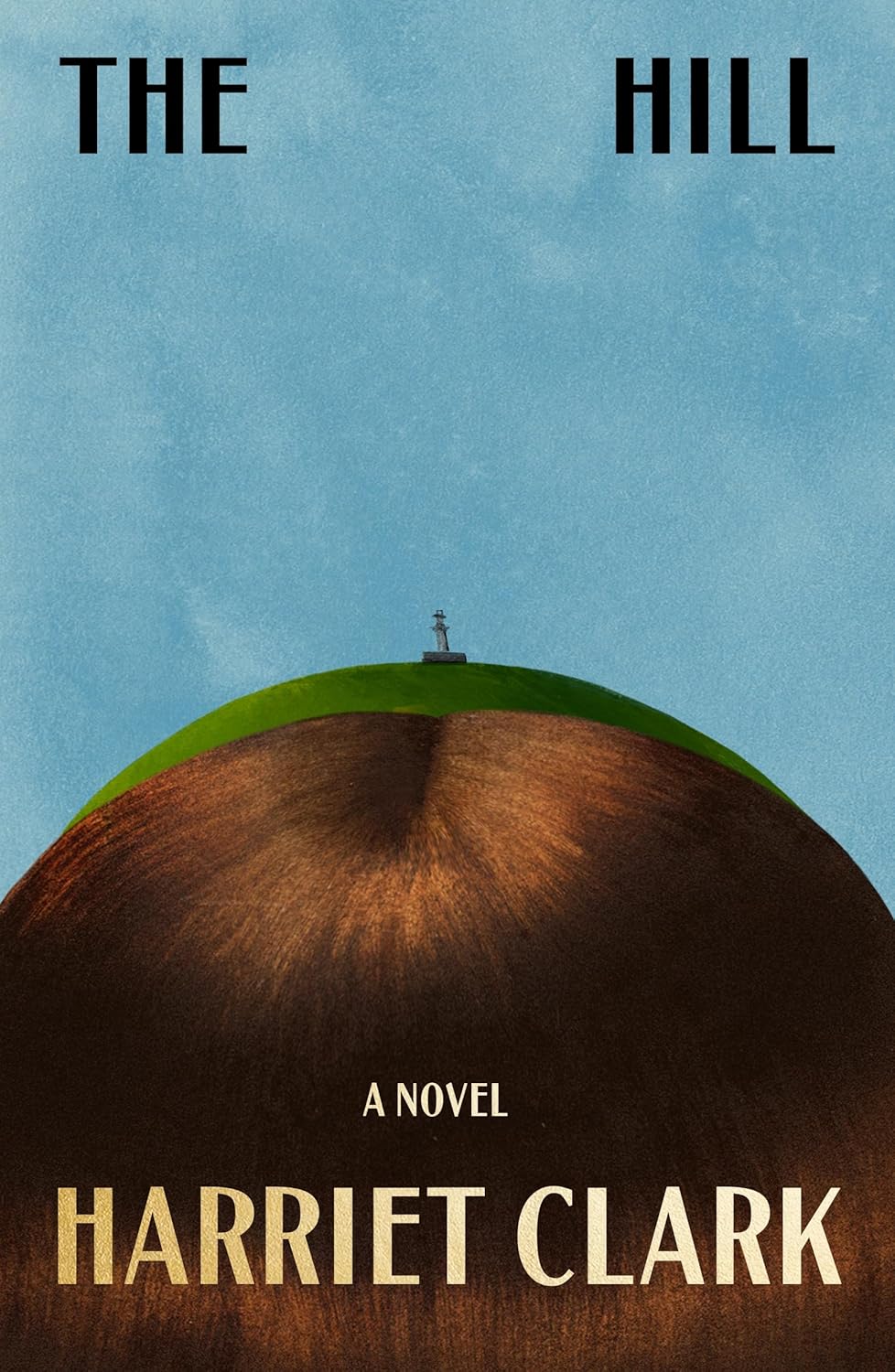
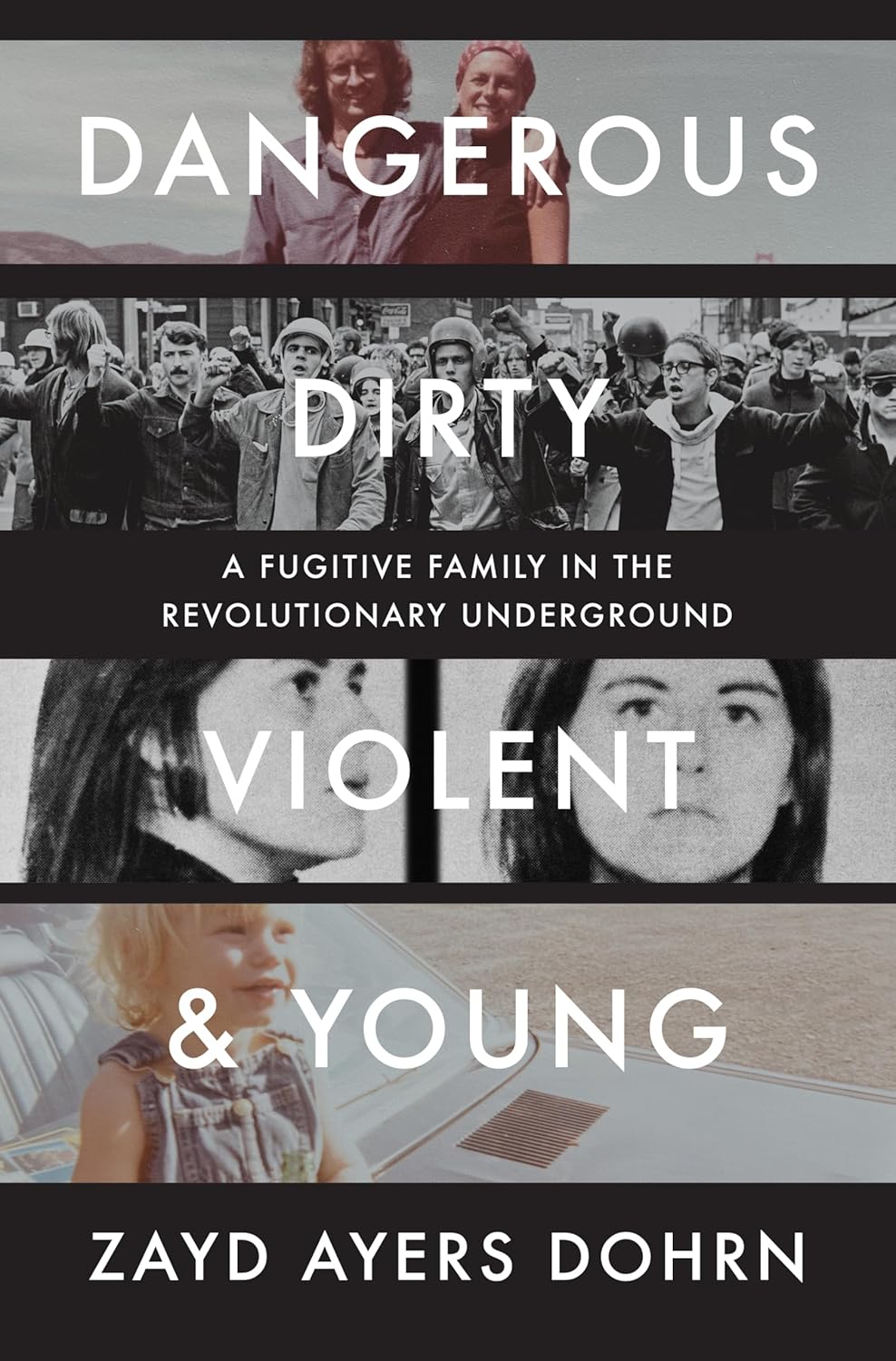
This time, our guides to the underground are not the children of the revolution but the children’s children. Now grown up, their parents either dead or freed, they’re writing new books on what it is to be raised for a revolution. This past May, just two weeks apart, Zayd Ayers Dohrn, son of Bernardine Dohrn and Bill Ayers, published Dangerous, Dirty, Violent, and Young: A Fugitive Family in the Revolutionary Underground, an extension of his beloved podcast Mother Country Radicals, and Harriet Clark, daughter of WU and M19CO member Judith Clark, published, after a decade of work, her debut novel, The Hill. Both address the meanings of collective solidarity and its possible limits, of who and what should be called “family.”
THE WU MADE THEIR DEBUT in June 1969 with the leaflet “You Don’t Need a Weatherman to Know Which Way the Wind Blows,” taking the title from Bob Dylan’s “Subterranean Homesick Blues.” Little did these young activists know that, within a year, they would be living underground. Or perhaps they did know. Bill Ayers once said to a room full of college-age protesters, “Bring the revolution home. Kill your parents.”
No patterns hold in the stories of the members’ early lives; there is no psychical algorithm for radicalization. Some members, like Ayers Dohrn’s parents, Bernardine and Bill, were the children of right-wing, even McCarthyite parents. Others were the children of leftists who just went further than their parents had. Two at least were born red diaper babies: Kathy Boudin, a child of civil rights lawyers, and Judith Clark, the daughter of Communist Party USA (CPUSA) veterans, whose father was an early contributor and editor at Dissent. (Some of these parents had left the Party in ’56 and ’57 after the revelations of Stalin’s crimes.) This form of vertical inheritance—negative or positive—was, sometime in the late ’60s, exchanged for the welcome influence of the horizontal. Comrades became family. This is most obvious in the case of the chosen surname of Shakur, which many of the New York chapter of the Panthers took, and in the Black Liberation Army’s becoming known simply as “The Family.” The WU had this kind of filial piety, too: to each other, to their comrades more broadly in the movement, and to their aims.
To arrive at this level of devotion, they had to be battle tested, first from without and then from within. Even in June 1969, when the WU formalized, it was clear the police had gotten around to bringing the war home first. In 1967 the FBI began monitoring and infiltrating the Black Panthers; as soon as the Weathermen announced themselves, they too were put under surveillance.
As the Panthers fractured into factions under the strain of constant COINTELPRO interference and horrific, often fatal, state violence, the Weathermen were repeatedly arrested and stalked in their homes, pistol-whipped, dangled from windows, and interrogated while cops held loaded guns in their mouths. One of the most active and far-left members, Terry Robbins, decided it was time to escalate. He and his comrades checked out a pertinent textbook and got to work. Their first bomb tore the Haymarket Affair memorial to the police in two. The Days of Rage, in which the Weathermen took to the streets of Chicago, facing off with the police, soon followed. Shortly after, Panther Fred Hampton was assassinated by those same police. Hampton had been the Panther comrade—and friend—of Dohrn and the other Underground members. The WU decided to escalate further.
For Christmas 1969, many of the Weathermen traveled home to see their parents for what they presumed would be the last time. Ayers Dohrn recounts these meetings between his mother, down to visit her parents in Florida, and his father, back home in Chicago. In a way, this is the moment his life begins, even if he was nine years away from being born. Or perhaps it’s fairer to say that in saying goodbye to their families of origin, his parents, still years from getting together romantically, said hello to their new family: the recently renamed Weather Underground Organization. From their homes around the country, one hundred Weathermen descended on Flint, Michigan, for their “War Council” in a ballroom where a nightclub shooting had just taken place. After an ultraleft orgy to celebrate the New Year (both calendrically and politically), they left Flint and scattered across the nation: Bernardine to California, Bill to Detroit with his then-girlfriend Diana Oughton, and, fatefully, Cathy Wilkerson, Kathy Boudin, Terry Robbins (Bill’s best friend), and several others to New York City. There they stayed at Cathy’s family’s town house while her father was on vacation (she pretended she had the flu and needed to recover at his digs). Ayers Dohrn tells us that Terry and Bill began a long-distance contest—part political, part competitive best friendship—to see who could bring the war home first. Bill almost succeeded, planting a bomb at a Detroit police station. When the bomb failed to go off, the Midwest office dispersed into the wind.
In New York, Terry’s crew began to plot an attack on Fort Dix’s dance for soldiers and their girlfriends. With spring break coming to an end, the New York Weather Underground had to get out of the town house and clean it up (Ayers Dohrn comically compares this to kids trying to hide the keg before mom and dad return home). The group also had to finish their self-assignment: building a bomb that might actually go off. They succeeded, but too soon. Terry was in the subbasement when the explosion occurred, dying immediately with Diana and Ted Gold (a Columbia University pal of David Gilbert) next to him. Upstairs, Kathy Boudin was in the shower; Cathy Wilkerson was ironing sheets. These two survived and fled the house.
In Ayers Dohrn’s hands, this is the story of his father’s trauma before he was born: both Ayers’s girlfriend and his best friend perished in that bombing. His father made him go annually to place a rose at the town house location, even while they were still underground. It was also a collective trauma for the group: The Weather Underground Organization, having gone, by their own estimation, too far and having failed, would now need to develop a program that kept the spectacle and pyrotechnics of bombings but with none of the death. They put the nation on notice by taping a Declaration of a State of War. On June 9, 1970, minutes after a warning was called in giving notice for evacuation, a police station blew up. The next day, the Underground claimed responsibility. The following six months saw target after target hit, all following this same pattern of warning, evacuation, and explosion. The WUO continued to evade capture, learning a technique they had picked up from the FLN in Algeria: send in a woman, dressed as a secretary, have her place the bomb, get out, and then send the warning call.
By fall 1970, Bernardine Dohrn was America’s Most Wanted, alongside Angela Davis and H. Rap Brown. The Feds made the notorious individuals of the group famous, not yet seeming to understand that a WANTED poster would produce, in the counterculture, a WELCOME sign. And indeed, as Ayers Dohrn points out, the Underground could only stay so successfully hidden because the overground blended with and aided those below. Rather than only being a spectacular aberration on the left, they were an edge of it, protected by it, hidden by it.
Alongside the bombings, the Underground learned the art of the prison break—first on behalf of Timothy Leary, who had been busted with a small amount of pot and sentenced to twenty years in California. In exchange for $25,000, Dohrn agreed to break Leary out; Ayers Dohrn tells us that, though she did not appreciate Leary’s politics, she hoped that it would teach the Underground how to free the political prisoners they actually cared about. (Later, when Leary was arrested again, he would turn on the Weather Underground Organization and provide information to help the Feds build their case against them.)
The revolutionary art of the bomb was only deployed more spectacularly thereafter, and often in direct solidarity with the Black Panther Party turned Black Liberation Army. Ayers Dohrn understands that the WUO’s story cannot be told without that of the BPP and the BLA. From Ayers Dohrn’s embedded perspective, we quickly learn that this is not just the story of two political families (“The Family” and the Underground), but of their families of blood and affinity who aided them for more than a decade. It is telling that leftists use the sibling formation (brother, sister) interchangeably with comrade—comrades are siblings, but sometimes siblings (and parents) can be comrades, too.
Soon, the babies started to arrive, or else activists joined the movement with kids in tow. These children had uses in the underground. One child Ayers Dohrn knew, Delia, aka Sunflower, would walk alone as the adults observed her, making sure she and they weren’t being followed before collecting her. She sometimes served as a beard, to make a pair of scouts seem like “an All-American Family, just out for a stroll.” Delia made Bernardine want a baby, and the times, they were a-changing: it was 1975. Soon, the United States would withdraw from Vietnam. If the two cornerstones of the Underground’s politics were to stop the war abroad and stop the war on Black people at home, the first had become somewhat obviated. Although the Underground kept bombing, the spectacle those bombs created was diminished.
ANOTHER OUTCOME FOR THE REVOLUTIONARY IS NORMALIZATION. Normalization can happen slowly (history stops happening, and you become history) or all at once, as a decision made, as in becoming a snitch. Both paths were open to the members of the Underground and both were taken.
As Ayers Dohrn tells it, across 1976, the Underground began to fracture, while his mother decorated his nursery with images of Che and Ho Chi Minh. Eventually, Bernardine Dohrn and Bill Ayers were extruded from the group they had helped build for supporting an “inversion plan” to surface from the Underground, which was deemed counterrevolutionary. Within four months, those who were still Underground were mostly captured.
With the WUO seemingly at their backs, and normal family life as their future, Bernardine, who had just given birth, and the family left the San Francisco scene. Ayers Dohrn remembers his mother, from the jump, as profoundly unhappy. He doesn’t think she had postpartum depression but “postrevolutionary” depression. She had been kicked out of the group she had started and, in the process, turned on many of her comrades, self- and other-denouncing. The Ayers-Dohrns broke up for a time; eventually they came back together. Along the way, Zayd was trained for life on the run.
Being on the run makes, apparently, easy sense to a child: “We were part of a rebel alliance, like Luke Skywalker and Han Solo, fighting an evil empire. . . . We were bandits and outlaws, stealing from the rich and giving to the poor, like Robin Hood.” Ayers Dohrn’s parents drew on the culture of the very empire they were fighting to impart the particular political education they had to give their child—not just the whys but the hows of being on the run: “In our circle, pretty much everyone we knew was a fugitive.” That his mother changed names at least six times, that his parents changed cars and jobs, that Ayers Dohrn himself knew how to identify undercover cops and lose them before most children know how to read was, in essence, unremarkable.
These stories are, for those who have wanted to find them, largely known, but Ayers Dohrn still might have contributed to a deeper understanding of childhood on the left as it was lived. But he falls short by adjudicating the WU members’ errors—as parents and militants. Like Lady Justice, he weighs the purported success of their actions over and against the strain on their domestic life. Ayers Dohrn reminds the reader, periodically, from his liberal-progressive vantage, not to have too much fun with the charismatic stories of his parents: there were costs. Fair enough. Those costs become the emotional core of the book.
Because the book is not a history but a son’s chronicle, there are moments when the telling seems by turns proud and disapproving—the way many grown kids might feel about the activities of their own parents’ youths. Ayers Dohrn isn’t trying to analyze his parents on the couch of this double genre, but he does want to make sense of what he experienced as a fundamental betrayal: his parents’ dual loyalty to their children and to the revolution. Ayers Dohrn wonders if this duality is even possible to negotiate. Often, it seems the answer is no.
If, as Ayers Dohrn asserts, the Weather Underground is his inheritance, he certainly did not inherit their politics. Instead, he took the so-called revolution personally. With the reversal of that famous axiom, he has turned to the lives of his parents and their comrades, which were determined by a devotion to insurrection, to make sense of his own life, but his own politics remain uninterrogated. At the height of the George Floyd uprisings (which he glosses as marching against violence in Charlottesville and in Ferguson, which were three and six years before, respectively), he began interviewing his parents, scared rightfully by the specter of COVID (soon Bernardine Dohrn would be diagnosed with Alzheimer’s). The following year, Ayers Dohrn and his father debated the relationship between insurrectionary groups like the Weather Underground and the fascists that stormed the Capitol building—the same place his mother bombed—on January 6, 2021. Bill describes these two formations as having opposing politics; Ayers Dohrn sees them as united by violence. During another such interview, Bill offers that they are now living through an insurrectionist “peak,” and Ayers Dohrn again expresses ambivalence: “revolutionary change just brings us back around to where we began. . . . If nothing ever truly changes, what’s the point of fighting at all?”
IN 1979, AYERS DOHRN’S FAMILY SETTLED IN HARLEM, now getting ready for Malik, Bernardine and Bill’s second son, to be born. Bill worked at Zayd’s preschool under a false name. Bernardine was a salesclerk at a bougie Upper West Side children’s boutique. That’s when the BLA came calling asking for aid, as did clandestine members from a Weather quasi-offshoot, associated with what was now called the M19CO. Kathy Boudin, herself pregnant with her first son, Chesa, would visit with Bernardine, and take all the information of the expectant and young mother customers from her at work to forge fake IDs for her comrades. In turn, those IDs were used to rent a series of cars deployed in bank robberies and heists in the tristate area.
As the BLA and armed clandestine organizations associated with the M19CO began to perform principled expropriations of assets, these IDs helped them avoid capture for a while. No one thought that the rental cars connected to these rich new mothers could possibly have anything to do with bank robberies conducted by what M19CO called “the white edge” of a panracial resistance. Meanwhile, Bill Ayers was tapped for driving one of the getaway cars in the 1979 prison break of Assata Shakur, who was liberated without a single casualty. After this success, the M19CO and the BLA would soon be back on the front page, but this time for a spectacular, violent failure: what is simply referred to as the Brink’s robbery. On October 20, 1981, the BLA, with the M19CO acting again as the white edge, stopped a Brink’s armored truck carrying cash. For the first time, one of these expropriation attempts ended in death. First, that of the Brink’s security guard, and then later, when the M19CO getaway drivers were stopped, two police officers in Nyack, New York. Sam Brown, who had only recently connected with the BLA, long-standing WUO members David Gilbert and Kathy Boudin, and M19CO organizer Judith Clark were arrested before an hour had passed. Soon, two more BLA members were pursued, with one dying as he fled the scene and the other surrendering. The police tortured all political prisoners but saved the worst violence for the members of the BLA. This was only the beginning: many others were arrested—including Bernardine Dohrn. For seven months, Dohrn refused to testify against her comrades. Eventually, she was released. She was one of the few lucky ones. When she got out, she adopted the child of her comrades, Chesa Boudin, and raised him as her own. This itself might be a lesson of the revolutionary family.
The Brink’s robbery left nine children orphaned—and many of the children of the revolutionaries now had incarcerated parents. This included Chesa, who had just been left with a babysitter for the day; Bernardine Dohrn, who had aided but not abetted, was home with her two sons, who soon lost their mother for nearly a year. And Judith Clark, too, left her baby daughter Harriet at home, before walking out, never to return, or at least not for nearly forty years. As historian Dan Berger puts it in his masterful book, Outlaws of America: The Weather Underground and the Politics of Solidarity, “To say that it is difficult to write about ‘Brinks’ is like calling the Grand Canyon a pothole. . . . People died that day, and three days later, and others received long prison sentences. Personally, politically, it was a disaster.”
Rather than take on the Brink’s robbery, or the militant activities of her mother, it is that decades-long separation that becomes the backdrop for Harriet Clark’s stunning debut novel, The Hill, which is told over a decade of visits between Suzanna and her mother (whom we can take to be a fictionalized Judith Clark), in a women’s prison called Hillcrest (a fictionalized Bedford Hills, where Clark and Boudin were held). From the beginning, the novel—flush with minute particulars—is invested in offering up an individual not for its own sake but to further solidarity with political prisoners in the United States and with the children separated from them by the state.
Clark opens her novel with a catalogue of those who get out “in strange ways. No stranger, I suppose, than the ways they got in.” Likewise, she notes those who stop being visited, and thus disappear, the guards who change jobs, the babies wrested from their mothers, and even the stray cats who are there one day and gone the next. Suzanna observes, “To stay or to go, that is a question. But on the Hill it wasn’t a question. Anyone who could leave left.” “To stay or go” is the revolutionary’s question of nerve, before that nerve lands you in jail; on the Hill, that question is in the past tense for the incarcerated. For those who climb the Hill, the live question is how to maintain a family when the state tries to make it impossible.
Suzanna becomes a child-ethnographer of a place she has grown up visiting to see her mother (her father is absent and basically never discussed). Raised by her grandparents, former CPUSA members, Suzanna is highly attuned to the fact that visiting is a collective endeavor: children cannot get up the Hill without aid. At first, supervising these visits falls to her grandfather, who takes Suzanna weekly. While his daughter and granddaughter visit, he sits and waits nearby. Suzanna’s grandparents have disavowed their own daughter’s actions. Suzanna is finally told, in a roundabout way, what her mother did one day as she and her grandfather drive away from the prison:
A misguided attempt, he called it, to steal from the rich and give to the poor. Then an elaborate explanation of the insurance mechanisms of banks and further clarification that many people had money in banks, not just the rich. When this lecture got into the weeds, he shifted gears into another, regarding imperialism, racism, militarism, also materialism—all the things, he said, that he and my mother opposed, and that, he assured me, I opposed as well.
Three generations agreed politically, but only one took up arms. As the grandfather puts it glumly, “She took it too far.” Although he preserves the link between his daughter and his granddaughter, his wife (Suzanna’s grandmother) refuses to support the visits to the Hill. The grandfather covers their visits in meaningless errands; the two drive and run out the day. Clark writes,
when he could think of nowhere else to go, we pulled off the road and I climbed into the trunk and pretended to be locked in. . . . I could hear him say, “Now where did she just go? Wasn’t she just here?” and “Oh Suzanna, why won’t you come to me?” This used up a fair amount of our time together: simulations of my disappearance and reappearance, simulations of his concern and great relief.
This is the fort/da game of the child whose mother is incarcerated for driving a getaway car. As Suzanna literally pretends to be smuggled, to go underground, or to vanish from family, grandfather and granddaughter playact the very disappearance of Suzanna’s mother. The car, formerly the scene of the crime, becomes the conduit of connection and the space of playing through the separation toward repair (after all, Suzanna’s last name is Klein, perhaps after Melanie, that great theorist of repair).
Once Suzanna’s grandfather dies, she no longer has a ride. Suzanna’s grandmother declares: “What’s done is done and can never be undone,” and refuses to visit. What remains undoable is the Brink’s robbery, and before that the radicalization of her mother. Suzanna’s unwavering commitment to her mother and to the ritual of visiting her on the Hill is both filial devotion and a site of her own resistance to a state that would keep her apart from her mother. To make sense of it, the child turns to mythological and biblical allusion. Clark writes, “At the prison considerable fanfare surrounded departures. But to not depart, it struck me then, was as great a feat as any. To stay by choice, not by curse. To return each week and rise again, to do this forever and ever. This was a feat I saw nowhere applauded and this was the challenge I set now for myself.” One must imagine Sisyphus as a mother and child.
Suzanna’s grandmother attempts to break this vow, not just by declining to drive her granddaughter to the prison but by trying to horrify Suzanna out of wanting to visit at all. Her grandmother takes her to the scene of the mother’s bank robbery under a strange pretext: depositing checks from a network of elderly CPUSA veterans. Suzanna is told to gather all the checks she can find (most are issued by dead comrades from the CPUSA). She drops Suzanna off and leaves her there. Eventually, when she returns, the grandmother unleashes her anguish:
I’d help her get any job—she knew that. All the time I said, “You have a baby now, no more fucking around, no more revolution. How will you eat? How will you afford a doctor?
What about piano lessons?” Like I was an idiot, a joke. That’s how she looked at me when I asked about piano lessons. You were only a baby, but still. One day you wouldn’t be a baby, you’d be you, and then what?
The “and then what” is Suzanna’s life. Her mother did not get a job, did not give her piano lessons. She refused to have mothering separate her from her work as a revolutionary—and she and her daughter and her parents paid the price. Suzanna’s life is marked by this constitutive absence: how one is shaped by someone who is there, and then someone who isn’t, but also by what it means to fight that absence, to find presence where one is instructed to relinquish it. In her grandmother’s telling, that absence is also an instruction in what it means to fight injustice. Soon, the grandmother delimits Suzanna’s world further, blocking her visits and pulling her out of school: “I became for my classmates what I’d become for my mother: someone who was there, then wasn’t.”
Suzanna finally gets back to that cohort, that ever-shifting collective of child visitors, and back to her mother. She does so via yet another devoted collective: the nuns who ferry children up and down the Hill to see their mothers (so it is at the real Bedford Hills as well). The sisters too have taken up vows, ones that the grandmother similarly belittles. These nuns come and go, as do the service dogs that her mother eventually trains while Suzanna grows from child to teenager (Suzanna is ambivalent about her mom’s dog; it draws from the limited reservoir of attention). Suzanna learns that the only people who stay right there on the Hill are the incarcerated, and sometimes their children, even when they move from the special children’s room to the normal, surveilled space of adult visitation.
As Suzanna gets absorbed into her grandmother’s world, she is able to study two generations of militants. She learns that this missing generation—her mother’s—only comes to “terrible woes.” This was the dropout generation—dead by misadventure or their own hands. Suddenly, it makes sense why Suzanna is the only grandchild among the aged communists.
Suzanna’s present-tense life narrows: less school, fewer friends. Instead, we see the expansion onto the forever past (of the prison, which holds you to the person you were for eternity) and the dying future (the sickbed, the plans the widows make with their pensions). All Suzanna has that is properly her own is the present tense of observation, a tense, she admits, with which she has never “been particularly enthralled.”
The future comes to the now. Her grandmother, dying, demands that Suzanna burn all of her effects. A letter comes from the prison, a final attempt to reunite before death. But this is not to be: the grandmother seeks to erase herself, to destroy time, to undo the chain of generational evidence and, thus, the very inheritance left for Suzanna. Now, her grandmother hopes, she will be only herself. On their little balcony, history is what burns.
After the grandmother dies, Suzanna can’t imagine a future lest it take her from her first vow: to visit her mother and never stop inhabiting the dailiness of family within the carceral context. Clark writes, “There were times still when the prison was extraordinary to me but my mother and I were ordinary to each other and if I left, we wouldn’t be.”
Suzanna soon goes to see her mother for a two-night visit, their first overnight since Suzanna was a baby. Clark is at her very best in these scenes: the story of someone rolling back time, making breakfast for a grown child, watching that child sleep, enjoying the banality of the childcare of which she was deprived. The mother says to her daughter, “I never know what I did to you and what’s just you.” This statement is both so ordinary—what many parents feel when looking at their children—and immense. What the mother did was more than mothering: she acted against the state and ended up in prison, there and not there. Annoying, cloying, exasperating—as mothers tend to be to teenagers—but only on Saturdays and only in an observed room. One day, the train fails to take her there. Like all infrastructure, it announces itself in disrepair. Not long after, another, greater breakdown: the prison is closed. Her mother is reduced to a letter, sent to prison after prison in the middle of the country she tried to end.
ALL CHILDREN ARE COMRADES, but children, once grown, may not remain so. Zayd Ayers Dohrn writes, “Over and over, you can see this same pattern, repeated: asked to choose between solidarity and family, revolution and romantic or familial love, my parents and their comrades chose the cause every time.” This would be unremarkable if he too were on the inside of it, but Ayers Dohrn is ambivalent about this; “it still bothers me,” he writes, “as a son and as a father.” But, like a good progressive, he also understands, from the revolutionaries’ point of view, that the revolution was also for all children everywhere. And we can understand why, from the near side of revolution, this might hurt a child: to have sibling rivalry extended past one’s brothers, biological and adopted, to every real and abstract child on the planet. To lose a parent—by choice—rather than for that parent to lose a comrade.
Losing your parents—even momentarily—is a pain no child should experience. So is losing a child. The Underground fought to stop the latter and accepted that their own children would suffer the former. For some children contending with that result, joining with their parents politically would be a way out of this ambivalence and the wound beneath it. The Hill is a clear-eyed defense of the collective that won’t suppress the pain of separation, the violence of the state in keeping children apart from their parents, but Clark does not spectacularize her own fate, even in fictionalized form. If most political writings focus on the doing—the clandestine meeting, the bomb—and stop the action at the point of splinter, death, or capture, The Hill chooses to tell the story of the unhappily ever after when one becomes a political prisoner, tracking radicality through its consequences and the demands they make on everyone involved, by choice and by birth.
For Ayers Dohrn, despite invoking and speaking to the many other children of the underground, the focus remains decidedly on what he and his brothers went through in its specificities. Every childhood memory seems to be doubled—an early camping trip with cousins was really a stakeout at the Federal Prison Camp at Alderson, where Assata Shakur was held after her confrontation with the police that left the author’s namesake (Zayd Shakur) dead. These events—what he thought was happening, and what was also happening—are not simply evidence of an adult revising his own personal history in the light of new facts. Instead, they express a conjunction of the domestic and the insurrectionary that the author sees as a betrayal. In researching the book, Ayers Dohrn discovered that while his parents had said they were done fighting the government after his birth in 1978 (although necessarily still underground due to their status as wanted fugitives), this was an outright lie. He had accompanied them to perform the earliest labor that led to jailbreaking Assata. He glosses this as “Bill and Bernardine were still desperate to be part of something larger than themselves. Larger than their relationship. Larger, even, than our family.”
These concentric circles of commitment extend too far: Ayers Dohrn had been told that his parents had settled down when he was born, but “my brother, my friends, and I were not just born into the underground, but into the midst of an ongoing guerilla war.” One imagines that enough time has passed to give some level of detail (without saying everything) about political actions of the preceding century, although there is no statute of limitations on arson in the first degree: property is king. But the immense pain of those actions for the author crystallizes around the time Bernardine Dohrn served; however comparatively brief her sentence, it was too long for a child. That pain extends also to his adoptive brother Chesa, who was not reunited with his parents until he was fully grown. Ayers Dohrn’s book is about struggling to understand how his mother and her friends could love the struggle as much as or more than their kin. We might hear Ayers Dohrn’s early description of writing up his family’s history anew: “My own little rebellion—petty and insignificant, maybe, compared to theirs, but still primal and painful, still potentially destructive.” Ayers Dohrn tries to have it both ways: to make this a personal recounting of growing up on the run and a political accounting of the Weather Underground—did they succeed enough in their aims to justify their commitment to trying (itself an ouroboros)? Given how we’re living now, and what we’re up against, there’s something almost perverse about this question, which implies that only the ends justify the means rather than the moment justifying a wide swath of tactics.
The Hill gets out of this trap—not because Suzanna, as a fictional proxy for the child of the political prisoner, didn’t suffer, but because the novel is ultimately for all children of all prisoners in the United States. As of this writing, that’s something like 14 percent of all children in the nation. By going to structure, by understanding where the violence is, Clark’s political novel never loses sight of what, rather than who, caused the pain.
Revolution and reproduction are often held out as antonymic. There is no good reason for this, even as the proximity of children (“innocents”) to calculated acts of violence or expropriation might make some queasy, to say the least. For many revolutionaries, there are no “strangers”: loving someone you don’t know is an extension of loving those you do, and vice versa. Children in Vietnam witnessed mass destruction and were killed. Children in the United States witnessed their parents being gunned down or arrested. The Weather Underground and the M19CO saw how these fates were connected. This is what is meant, most basically, by solidarity. And yes, that cost was borne by their own children, who could not and did not elect into their politics.
The stories of the Weather Underground are often told as fringe, without wider support, born and then dead by the middle of the ’70s. We know that is not the case: that it takes a whole movement to protect its edge. Today, saboteurs and arsonists have returned to these tactics, once again bent on stopping the war at home and the colonial genocide abroad. As with the Underground, many are meeting the hardest edge of repression, are captured, on the run, or dead. From Prairie Fire to Prairieland, it may be time to go back underground, and to sit, however uncomfortably, with the costs and contradictions of the revolutionary moments behind this one.
Hannah Zeavin is an associate professor of history at UC Berkeley. She is at work on her third book, All Freud’s Children: A Story of Inheritance for Penguin Press, for which she won a 2026 Guggenheim Fellowship.