



NEARLY EVERY MILLENNIAL WOMAN I KNOW carries with her a bone-deep knowledge of the same frightening folktale: a girl-child, blonde and beautiful, is born in Nowhere, USA, and becomes public property by virtue of her talent. She turns sixteen, and as the clock strikes midnight a transmogrification occurs, turning her into a plastic thing, an idol—a symbolic, hollow effigy of sex, all tits and abs and white, bared teeth. At the same time, she is asked to insist on her own purity, a modern vestal virgin with the weight of America’s morality resting on her shoulders. This strange and contradictory bind, like a curse or a spell, warps her very understanding of herself, making her crazier and crazier, more and more disconnected from the world. She is further deranged by the influence of a bogeyman or bogeymen—a daddy, a manager, a boyfriend, a husband, a blogger, an invasive paparazzo, who despite their different faces are all representatives of the same unfeeling, masculine force—and breaks down like a malfunctioning machine. She attempts to escape by destroying her image: she gains weight, snarls, shaves her head, and turns into that scariest of monsters, an un-fuckable woman. She is subsequently captured and trapped, like a beast in a zoo, or a princess in a castle. She can no longer choose what to do, who to be, or which handsome prince to marry. Her children are snatched away, as if by Rumpelstiltskin. She must work, and work, and work, bitch, executing the same routines and rituals night after night, in a city built on cash and made of gold.
What is the lesson we are meant to absorb from this story? Not to let our daughters grow up to be pop stars, for one. The legend of Britney Jean Spears is one of a meteoric rise to success, swiftly followed by a one-two punch of media hazing and imprisonment so cruel that court transcripts from the legal case surrounding her ordeal have an air of the slasher film about them. It is in some ways a stylized fable about womanhood itself: a warning from extremely recent history about the maddening impossibility of playing both the virgin and the whore, and the perils of believing that men in positions of influence are capable of seeing a girl who makes them money as a real human being. “Do you think you were destined to become a star?” a journalist from V magazine asked Spears in 2011. “If not,” Spears replied, “then God definitely has a strange sense of humor.” It is somewhat surprising that by 2011, three years into the crushing conservatorship that forced her to surrender almost all financial, bodily, and professional autonomy, Spears would mention God at all, since one has to assume it must have felt as if more sinister forces were at work. Her survival has made her the Final Girl of pop: bruised, terrified, honed by her trauma into something as off-putting and jagged as a weapon.
A new novel by Candice Wuehle, Ultranatural, takes the Britney Spears story and dials up the horror factor, making an already harrowing narrative into something nastier still. Our heroine has a new tripartite birth name, with the same buoyant scansion as her predecessor’s: Lacey Dove Bart, those first three syllables destined to be shortened to “Love” once she mutates from a girl into a brand. “Most stories are tragedies,” Love tells the reader in the book’s first sentence. “This one isn’t, but it does start on the steps of an abandoned asylum for the insane.” Abandonment, madness, and imprisonment will quickly become prominent themes in Ultranatural, but for now, we remain safely in the realm of the tabloid origin story: Love and Carrie-Anne, two adolescent girls who are best friends and soulmates, are practicing a song-and-dance routine, fantasizing about stardom. That they are rehearsing the steps in the courtyard of an empty mental health facility is an early indication of Wuehle’s interest in gothic symbolism and fate. A poet as well as a novelist, she has a natural feel for the cruel edge of beauty—the rot at the heart of the teen-girl American dream. When Love sells out for a chance at success, leaving Carrie-Anne behind, their paths diverge. Carrie-Anne, a witchy philosopher with a mad, woo-woo mother, does not get to be a pop star, though she does go on to be something just as sexy and exciting: a poet, critic, and essayist, who occasionally produces cool, highfalutin prose about Love and her music. Here, Wuehle—who also maintains a pop-culture theory Substack called, what else, Bimbo Summit—pokes a little fun not only at herself, but at highbrow poptimism in general, the result at once familiar and deeply embarrassing for those of us who also earn a living by, e.g., comparing the lyrics of a brain-dead pop song to the contents of Das Kapital. In a sense, this distant professional relationship between Love and Carrie-Anne is every bit as symbiotic as their childhood friendship, the critic and the artist bound together by each one’s need for the other. (One party, of course, tends to be better compensated than the other. “Carrie-Anne had gone to graduate school in New York, where she’d gotten a degree in poetry,” Love notes. “When I saw that, I knew that Carrie-Anne still did not understand money.” Reader, I laughed—primarily to keep myself from crying.)
When Love is riding high in the charts, Wuehle plays with celebrity cliché in a way that is often dryly funny, with many of the more conventional beats of the novel suggesting a Lifetime movie about a musician—a villainous super-producer, for instance, is given the name “Jimmy Coins,” so that when Love eventually marries him, the sly suggestion that her name is now “Love Coins” hangs unspoken in the air. Love is not really in it for the money, but like Spears in real life, she is a cash cow for others, a resource to be mined, drained, and divvied up for parts. Her appearance is constantly shifting, embodying several archetypes whose inauthenticity will feel, paradoxically, all-too-authentic to a pop-literate reader. She has a Marilyn phase, à la Madonna, her hair bleached platinum and swept into waves; later, she undergoes a “G.I. Jane” reinvention, the better to telegraph her fashionable desire to be strong rather than skinny. She’s a remix of a remix, a pastiche of a pastiche, and Wuehle has a dark kind of fun with this, too: the titles of Love’s singles, for instance, are full of amusing, extremely 2000s parentheses: “I Got It (U Take It),” “I’m Your Property (Baby),” and so on. “While onstage in Japan,” Love observes, flatly, “I see a middle-aged white guy, his bald head shiny and obvious amongst the sea of black hair and neon wigs. I think of the chicken-skin white of a flaccid penis tip, fumbling against a zipper.” If she is a pop star marketed to teenage girls, she is also a product designed by—and surveilled by and fetishized by—fully grown men. When a male assailant with a knife storms the stage at another of her concerts, she is pilloried for smiling and waving at the cameras as instructed, instead of looking adequately scared. “I couldn’t even fucking get attacked the right way,” she spits—a perfect nod to the media’s perpetual requirement for famous female victims to be victims correctly.
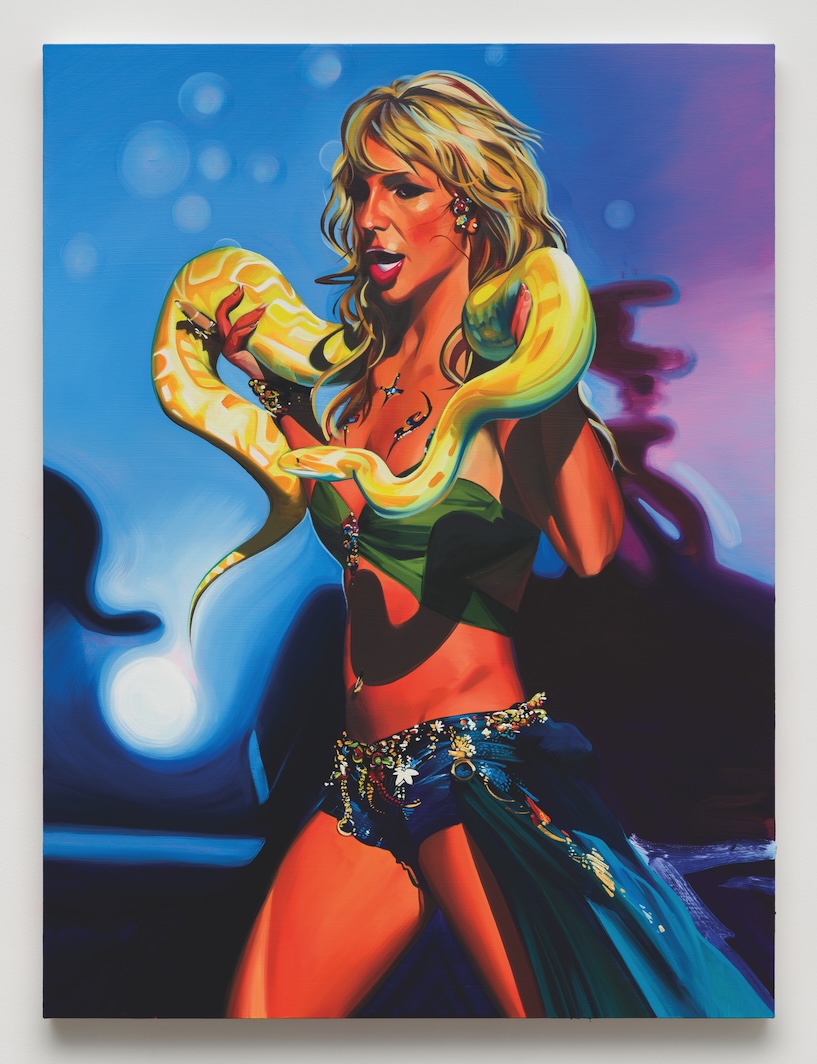
Ultranatural, in effect, presents fame the way that Don DeLillo describes it in the opening lines of his 1973 novel, Great Jones Street: as an inescapable process of being “absorbed into the public’s total madness.” As Love’s world is made smaller and smaller by those who treat her body, her face, and her soul as a commodity, the nature of this destruction becomes literal, even surgical: like Spears, she is held captive in her home, and as was the case for Spears, too, her reproductive capacity is judged to be a company concern, with results that tip over into outright body horror. Too late, we realize we are also the monsters in the story—spectators, co-conspirators, and gossip consumers, well versed enough in the beats of the real-life tragedy her story is based on to appreciate its terrible nuances. Like I said, the actual Spears biography has always suggested an evil and paranoid myth. Little wonder that it makes good material for a book that leaves you shivering with horror and prickling with feminist rage. Spookily—one might even say fatefully—I myself have threatened for years to write a novel inspired by the mysterious death of the actress Brittany Murphy, in the very same house where Spears once lived: a fable with a similar spirit, offering a divergent take on the same dread cautionary tale about women and stardom, men and power, commerce and the cunt. Perhaps now I will have to come up with a different idea; or, perhaps, the elevation and subsequent cannibalistic destruction of the female star is the defining women’s story of the age, meant to be repeated and tweaked in the same way that a campfire story changes shape as it leaps from mouth to mouth.
Philippa Snow is a critic and essayist who lives in England. Her books include It’s Terrible the Things I Have to Do to Be Me: On Femininity and Fame (Virago, 2025), Trophy Lives: On the Celebrity as an Art Object (Mack, 2024), and Which as You Know Means Violence: On Self-Injury as Art and Entertainment (Repeater, 2023).