


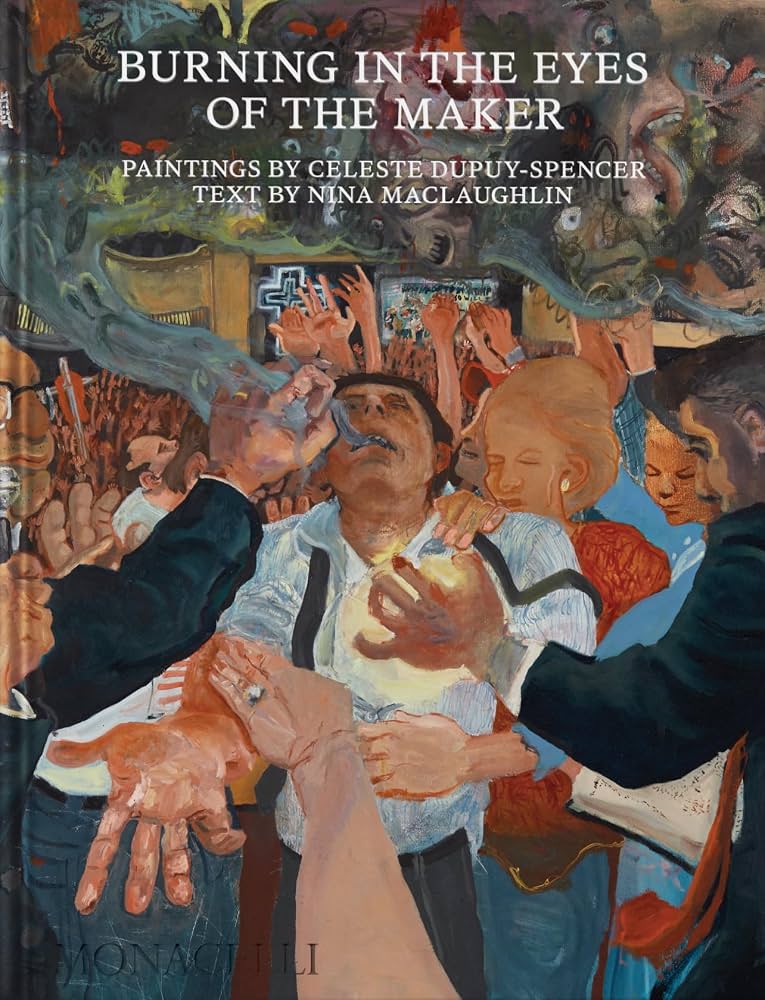
CELESTE DUPUY-SPENCER KEPT ODD HOURS. Before she died in April, Dupuy-Spencer, a prominent painter—commercially successful, critically acclaimed, and about as famous as a contemporary artist gets—was habitually nocturnal. “Even at the best of times,” her father, the novelist Scott Spencer, told me, “she would go into the studio at three or four in the afternoon, and keep painting until six or seven in the morning.” Nina MacLaughlin, a writer who authored a series of essays accompanying the artist’s work in the new book Burning in the Eyes of the Maker: Celeste Dupuy-Spencer, wrote of the endeavor this way: “Celeste Dupuy-Spencer stays awake for days when deep into work on a painting. . . . Forty hours. Sixty hours. Decentered. Hallucinatory.” It was a feat of concentration and physical endurance that evoked religious mystics or marathon runners. A 2021 profile said that Dupuy-Spencer had placed shag rugs around her Los Angeles studio, so that she would fall onto something soft when she finally collapsed.
In the years before Dupuy-Spencer died, those long nights were often difficult. She received threats for months. Since 2023, as the genocide unfolded in Gaza, Dupuy-Spencer had begun to speak publicly and fervently in favor of Palestinian freedom. Her work changed, too. She started making pieces that depicted world leaders as moral grotesques, dwelling on their responsibility for the genocide. An Egon Schiele–esque drawing of an addled, open-mouthed Joe Biden shows him with a devil on each shoulder. A late painting features the Golem of Prague—a monster from Jewish folklore that destroys the community of the rabbi who created it—as an arms dealer, sitting down with politicians. She began building miniature models of the rubble in Gaza: crumbling apartment buildings and underground tunnels strewn with sand and debris. At Jeffrey Deitch, Dupuy-Spencer’s Los Angeles gallery, the Iranian-born artist Cima Rahmankhah, one of the artist’s closest friends in the last years of her life, led me into a back room to show me two of the Gaza dioramas, shocking in their realism and tiny scale. Rahmankhah plugged one model into a wall outlet, and the little plastic tank that roamed a destroyed street lit up with the red of an explosion.
In response to her stance on Gaza, Dupuy-Spencer was subject to a campaign of harassment and professional retaliation that friends say terrified her. She was placed on a public blacklist by a Zionist group calling itself “Jew Hate Database,” which in 2025 posted her name, social media profiles, and photo to its 140,000 followers on Instagram under the caption “ENABLER OF JEW HATRED.” The post featured a (thankfully incorrect, she would tell friends) claim about where Dupuy-Spencer lived. The fallout was swift. In the comments below the post, the major art collector Scott Lorinsky called Dupuy-Spencer a “miserable anti-Semite.” Another prominent collector, Carole Server, called for “deasession” [sic] of her work—an apparent reference to deaccession, the effort to remove art from museum and private collections and dump it at auction, tanking its value.
Advocates for Palestine are understandably reluctant to emphasize their own suffering at the hands of the Zionists who aim to make their views unspeakable. “Celeste would always bring it back to Palestinians,” said the artist Stanya Kahn, a friend who shared Dupuy-Spencer’s dismay at the art world’s complicity in the genocide, when I asked about the harassment. But it remains true that opposition to the Israeli genocide in Gaza is an opinion that you can ruin your life by having. Dupuy-Spencer was punished for her outspokenness. In the final months of her life, she was alienated by major art institutions, increasingly socially isolated, wounded by harassment, and worried about money. Meanwhile, she had also been watching what we all were watching: video after video of bombed homes, maimed grandmothers, and barefoot children in plastic tents, pleading to the camera for food.
Some people can compartmentalize this unfolding horror; Dupuy-Spencer couldn’t. Friends told me that she felt a sense of profound responsibility regarding Gaza, one that compelled her to watch every video of the genocide that appeared on her phone. “I would tell her, an hour, two hours, then you have to put it down,” Rahmankhah said. “But she couldn’t.” When friends speak of Dupuy-Spencer’s politics, they emphasize that she felt moral pain in a physical register. “It lodged in her body,” Mariah Garnett, Dupuy-Spencer’s lifelong best friend, told me; she, and several others who spoke of this pain, clutched at their torsos, miming a wound. Dupuy-Spencer’s health deteriorated. According to her father, she had been in the midst of a flare-up of her long-dormant multiple sclerosis. Her legs were painfully swollen; it was hard to get out of bed; at times she couldn’t even hold a paintbrush. One of her final paintings is of a skull-like face in grayish blues, surrounded by flying shrapnel, staring down at the fiery-orange screen of an iPhone. You can think of it as her last self-portrait.
Dupuy-Spencer died at her home in Los Angeles on April 10. In the initial aftermath, the Deitch gallery, which announced her passing to the press, did not disclose a cause. As a result, many assumed that Dupuy-Spencer, who had struggled with heroin in her youth, had overdosed. I learned of the painter’s death when I saw a New York–based video artist post a picture of her to their Instagram story. “Another life lost to addiction” was the caption. Except that it wasn’t. “Celeste,” a friend of the artist corrected, “chose to leave.” She was forty-six.
FOR ALL THE RETALIATION that she had faced for her support for Palestine, Dupuy-Spencer was on the brink of a new professional peak. A solo show, “Burning in the Eyes of the Maker,” was just eight days away from opening at Jeffrey Deitch; the book of her work with the same title, featuring MacLaughlin’s essays, was set to be published by the Monacelli Press just a few weeks later. She was considered one of the most important painters of her generation, with works like Father, Don’t You See That I Am Burning—a massive, dreamlike, and terrifying painting of the January 6 riot—demonstrating a relentless, politically radical moral vision and a willingness to implicate her audience.
But Dupuy-Spencer was ambivalent about her success, unnerved by the disjoint between her political commitments and the realities of the art market. “The art world is an economy first, a social sorting mechanism second, and a meaning-making structure only when convenient,” she wrote in an essay that doubled as a press release for the Jeffrey Deitch show, included in the book. “Whatever I thought my paintings could be, it collapsed as an idea under the weight of transaction.” This discomfort was part of what led her to eschew the traditional roster of art critics and historians and instead select MacLaughlin—a prose writer she hadn’t previously met—as the author of her book.
MacLaughlin is the author of the memoir Hammer Head: The Making of a Carpenter, the long, lyric essays Summer Solstice and Winter Solstice, and Dupuy-Spencer’s favorite, Wake, Siren, a feminist retelling of Ovid. She is a verbally virtuosic and intellectually serious writer whose work, like Dupuy-Spencer’s, is morally ambitious and frequently mythic in scale. “When I encountered her writing, it wasn’t just admiration, it was clear recognition,” Dupuy-Spencer wrote of MacLaughlin. Her prose, she said, was written in “the exact same register that was coming off my walls.”
Part biography of Dupuy-Spencer, part meditation on her work, and part guide to the painter’s oeuvre, Burning in the Eyes of the Maker traces Dupuy-Spencer’s evolving relationship to politics and myth. It is a deeply felt collaboration between MacLaughlin and the painter, with pieces sometimes narrated by the figures on the canvases, exploring the narratives they find themselves in, and sometimes told from MacLaughlin’s point of view, recounting her experience confronting the works. By design, MacLaughlin’s writing is more of an encounter with the paintings than a statement about them. Her great virtue as a writer is a clear-eyed moral realism, a willingness to see her own complicity in the histories of violence and systems of exploitation that Dupuy-Spencer’s work depicts—a challenge inherent in the paintings for which not all viewers are prepared. MacLaughlin and Dupuy-Spencer alike seem alert to the burdens of this kind of knowledge: many people, after all, respond to this analysis of American life by trying to excuse their own role in it. “The great theme of her work,” MacLaughlin writes of the painter, “is denial.”
BORN IN 1979 TO BOHEMIAN PARENTS, Dupuy-Spencer grew up in Rhinebeck, New York, in a pre-gentrification Hudson Valley. Dupuy-Spencer first met Garnett, both age three, at a local day care. Garnett, now a filmmaker, describes their friendship as the kind that structures a life. “It was like a third person emerged when we were together,” she told me, flipping through a stack of photographs of her and Celeste as chubby-faced teenagers. Later, when they were both twenty-nine, Garnett hooked up with someone who had a best friend tattoo, and when she told Dupuy-Spencer about it, the painter was seized by a kind of fraternal chauvinism. “She was like, ‘That’s bullshit. No one is better friends than us,’” Garnett told me. “And she marched me down to a tattoo parlor.” The pair were inked with each other’s names; Garnett pulled up her sleeve to show me the blurring “Celeste!” in cursive on her wrist.
As teens, Dupuy-Spencer and Garnett used to spend evenings at the Rhinecliff Hotel. Now a pristine wedding venue, back in the 1990s it was a dive bar on the banks of the Hudson, with live music and an indulgent attitude toward underage drinking. Dupuy-Spencer’s younger brother, Jacobin magazine publisher Asher Dupuy-Spencer, remembers the bar as “an economic cross section” of the Hudson Valley, where the area’s old-money gentry and artists displaced from the city mixed easily with drifters and the downwardly mobile. Celeste reveled in this company. In 2017, she would make a painting of the bar, a glowing basement in a teetering Victorian under moonlight, with patches of melting early-season snow in blobs on the ground.
In adolescence, Celeste fell into heroin addiction. Her teens and twenties were spent working odd jobs, hitchhiking, and dropping out of art school. In 2003, she enrolled in the art program at Bard, just up the road from Rhinebeck. Broke and estranged from her parents, she wound up homeless and was briefly sleeping in the boiler room of her student studio building. But Dupuy-Spencer’s teacher, the painter Nicole Eisenman, saw promise in her. One day, Eisenman and another teacher, the abstract painter Amy Sillman, pulled Dupuy-Spencer aside. “They were like, ‘What the fuck? You’re a really good painter and you’re queer and you’re a feminist. It’s your responsibility to take this seriously,’” Dupuy-Spencer recounted to Los Angeles magazine in 2021. “No one had ever spoken to me like I had potential.” In 2007, Dupuy-Spencer left Bard and moved to New York; through Eisenman, she was introduced to a milieu of queer artists working in Williamsburg. Dupuy-Spencer felt ill at ease in the scene, maybe because her addiction was careening toward its final bottom. As MacLaughlin writes, heroin “took her over, and put her in its dim feathered cave.” She was lying, stealing to finance her habit, and fighting with her friends. It is painful to see yourself acting this way; it is scary to realize that you can’t stop. After a suicide attempt in 2012, Eisenman brought Dupuy-Spencer to the hospital. Celeste’s father called his children’s mother, the artist Coco Dupuy, who was living in Louisiana. “I said, ‘Coco, she needs her mom.’” Dupuy brought Celeste to a rehab in New Orleans, and she stayed there for eight months.
Like many in recovery, Dupuy-Spencer worked in the rehab she had attended after completing her own treatment, answering phones in the men’s halfway house. There she was surrounded by Southern men of hardscrabble backgrounds and unpretentious dispositions, the kind whose company she had found formative at the Rhinecliff Hotel. She developed a respect for what she saw as the honesty of Southern rural life—for its pragmatism and guilelessness, for its unglamorous suffering, and for its clear-eyed proximity to America’s original sin. By then, Garnett was living in Los Angeles; in 2014, Dupuy-Spencer moved out there, too.
Sobriety seems to have loosed something in Dupuy-Spencer. Her work became more original, more ambitious, and more acutely observed. Critics compared her to Eisenman less and started citing names like Kerry James Marshall and David Hockney. But Dupuy-Spencer was developing a style and set of preoccupations all her own. When Trump came into office, she was forced to confront the clash between the world of Trump-supporting white rural poor, among whom she felt such affinity, and the coastal liberals—like the denizens of the art world—among whom she made her living.
Soon, Dupuy-Spencer was painting the political upheavals that accompanied Trump’s ascent. The painting Durham, August 14, 2017, shows a crowd gathering around the Confederate monument that they have just pulled to the ground, their legs and sneakers in the background before the crumpled metal. Not Today Satan shows a cop car in profile, speeding through a city at night, a dense crowd of demons above the cruiser’s decal reading “Protect and Serve.” In the context of this moment, Dupuy-Spencer’s political radicalism led her to quick and dramatic commercial success. One standout was her 2016 painting Veterans Day, a meditation on war; the painting is a still life that shows what appears to be the home of an old man. Images of romantic or noble encounters with violence have been tacked up against the floral wallpaper—a framed newspaper cutting announcing Muhammad Ali’s refusal to go to Vietnam; a portrait of the Abraham Lincoln Brigade from the Spanish Civil War; what looks to be a taped-up postcard of Picasso’s Guernica. In 2017, the painting was one of several of Dupuy-Spencer’s works included in the Whitney Biennial, where it was so striking that it managed to cut through the controversy over Dana Schutz’s Emmett Till painting, Open Casket.
Often it was the white poor that Dupuy-Spencer chose to depict. In 2016’s Trump Rally (And Some of Them I Assume Are Good People), a pair of Klansmen smile goofily in their hoods behind a white crowd grinning and giving thumbs-up signs to the viewer. In St. Tammany Parish, also from 2016, Louisiana rednecks stand outside their homes on a flat and swampy back road. Two women fight while onlookers stare; MacLaughlin writes that one of the women, a figure in blue shorts, is based on someone Dupuy-Spencer met in rehab, a young addict who had been sexually abused by her father. In the foreground, a shirtless man is covered in tattoos; across his chest, one reads, “Family Over Everything.”
In the late 2010s, Dupuy-Spencer stood out for the unique moral posture her work assumed toward Trump’s base. She refused to separate herself—or her fine-art audience—from the moral pathologies of Trump and his supporters. Instead, Dupuy-Spencer offered an anxious, shamed, even compassionate identification with the Trump voter, where others could only muster mockery or disgust. Dupuy-Spencer was never smug or distancing in her depictions of American whiteness, even when she unambiguously condemned its pathologies. Her project, she told MacLaughlin, was to make sure she was “not stuck thinking I’m one of the good guys.” “It is deeply moral, not to look away,” MacLaughlin writes of this impulse, “not to disown or deny or dissociate, but to look . . . and not to cower under the false protection of but not me.” An uncanny feature of Dupuy-Spencer’s work in this era was her use of skewed perspective. In her paintings, it’s often difficult to tell precisely where the viewer is standing in relation to the figures on the canvas. It’s difficult to know where we’re looking at them from, how far away we really are.
Not long after the Biennial, Dupuy-Spencer had a solo show at Marlborough gallery, her first in New York.One of the works included there was Sarah, a 2017 self-portrait in which the artist reclines, mostly nude—a few pubes stray from her tighty-whities—in the lap of her then-girlfriend, who massages her head atop a mussed bed. The couple wear calmly delighted expressions. In the art world of the late 2010s, which was preoccupied with identity, maybe it was inevitable that this subject matter would lead some to pigeonhole Dupuy-Spencer. Amid the show’s success, it served to classify her almost immediately as not merely an artist but a queer artist, a distinction Dupuy-Spencer found discomfiting. “I don’t think about myself as a queer person when I’m painting,” she said. “To look at my work through only that lens is presumptuous, even kind of violent.”
Dupuy-Spencer used she/her pronouns professionally but avoided being referred to by gendered terms like “sister” or “woman.” Years ago, she injected testosterone for a period before quitting it. She identified as trans but seemed content to leave it in question precisely what that meant. This, too, could be a political stance: Dupuy-Spencer once called identity politics “narcissistic.” But it might be more precise to say that the impulse to reject her label as a queer painter was part of Dupuy-Spencer’s relentless drive to cast her lot in with the mainstream of humanity, and to avoid any of the hierarchies or taxonomies that divide people into us and them. To look at Sarah as a lesbian painting would be to miss, after all, the universality of what it depicts, which is less about anything bound by the particularities of identity than a kind of mute, creaturely happiness.
Sarah is an easy painting. Others are harder. Success created a sense of conflict and obligation for Dupuy-Spencer, an ambivalence about making work that critiqued hierarchy and exploitation, only to have it be bought and sold by wealthy collectors who were agents and profiteers of that violence. After the Whitney Biennial, her compositions became denser and more allegorical; she seems to have become more habituated to depicting brutality. A typical painting of this era is 2021’s When You’ve Eaten Everything Below You, You’ll Devour Yourself/Except in Dreams You’re Never Really Free. The artwork, set in a penthouse atop a flooding, dystopian Manhattan, shows a billionaire being robbed, a golden gun to his head, facing down death in the form of a floating skull with a single glowing eye. Behind him, lining his walls, Dupuy-Spencer placed famous paintings: Lady Butler’s Balaclava, from 1876, depicting the Crimean War; Théodore Géricault’s 1819 The Raft of the Medusa, showing the grisly aftermath of a French naval shipwreck; and George Bellows’s 1918 Bacchanale, in which German World War I soldiers drink themselves into a stupor after bayoneting children.
It was this sense of political urgency that fueled the works that composed her last show at Jeffrey Deitch gallery. Like much of Dupuy-Spencer’s work, the paintings in “Burning” are minutely detailed and heavy with references. They reward prolonged study and second looks. Backgrounds that are at first overlooked can change a painting’s narrative; little figures, hidden in a shadow or overlooked beneath a larger figure, reveal commentary, caveats, or little jokes.
They are not happy paintings; they depict a world of great suffering, great guilt, and very little mercy. In 2024’s Back to Where the Start Ended (“A Greeting to You from the Mud”), a painting of the genocide, history circles in on itself, as Israeli soldiers on the march in Gaza are greeted by a giant figure of a Zionist militia member from the Nakba, facing them down with a flamethrower that was used to burn a Palestinian village. In 2025’s My Daughter! My Gilda! Ella mi tolse il fulmine di mano, a scene from the opera Rigoletto, a court jester, his face contorted into a bellow of pain, holds the dying body of his daughter, accidentally killed by an assassin he had hired. One galloping deer tears out the throat of another; the Tower of Babel collapses into a mass of blood and viscera. You don’t see these paintings so much as endure them. The best works of Dupuy-Spencer’s career depict the horror of a fallen world not only with a steady gaze but also with wisdom and humor. Many of these later works have lost that. In light of Dupuy-Spencer’s suicide, it is difficult for me not to see the distress in these last paintings, impossible not to read them as foreshadowing for what she was going to do.
But if Dupuy-Spencer’s late work represents her descent into an unremitting darkness, this descent is in no way an artistic decline. For all their grief and anger, they are extraordinary paintings. At the center of the show is an altarpiece, The Shape of the Rock That’s Hurling Towards the Sea. Across four panels, Dupuy-Spencer summarizes the whole history and destruction of the earth, and the grief, terror, and rage are acute. A kaleidoscopic array of plants and animals evolve and bloom on the left, contrasted with scenes of climate destruction and human greed on the right. In the center, an apocalyptic scene unfolds, presided over by a demon with the face of Aileen Wuornos, the rape-revenge serial killer who was executed in 2002. Nearby, an accompanying canvas shows the bloody face of Christ, staring into the dead eyes of Judas, blue and stiff from his suicide in the gospel of Matthew.
Staring down the altarpiece, I was reminded of something MacLaughlin had told me over the phone: that Dupuy-Spencer’s work was difficult to write about in part because the scale and brutality of its assessments exceed language. “It lands on the nervous system,” she said. After looking at the piece for a while, I began to feel hot, then dizzy. I became aware that my heart was beating hard and fast. I stepped outside to collect myself and blinked into the traffic on a shadeless Santa Monica Boulevard. It is among the most accomplished and undeniable paintings of her career.
Like all suicides, Dupuy-Spencer leaves behind people who loved her deeply, for whom her death has made a crater in their lives. In my interviews, the grieving veered wildly between laughter and tears. Everyone spoke of the expansiveness of Celeste’s mind; her shocking capacity to study something to exhaustion and to remember everything she read; the way that they would drop by her house and would wind up talking for hours, losing track of time, realizing with a shock that it was 4 am. They were eager to spend time with her then; they are broken and diminished now. Many of them seem very, very tired. Leafing through a box of Dupuy-Spencer’s things at her home in Los Feliz, Garnett appeared liable to shattering, like she was made of glass. Distracted, she told me that she’d taken a leave of absence from her job, and then a few minutes later, she told me again. On the phone, telling me about the collectors who had turned on her friend, Kahn’s voice brimmed with a rage I could hear her trying to control. Rahmankhah, a woman with her hair in a triangle of curls around her ears, spoke with a kind of frantic awe at Celeste’s intellect, her generosity, her gentleness—and then stopped abruptly as a gasp of tears caught in her throat. Each of them had the distant air of someone who is not quite paying attention to you. A part of them was wherever Celeste has gone.
Death does not end the suicide’s pain so much as transfer it to those who loved her. Rahmankhah copped to resentment. “I’m so angry at her for leaving,” she told me of Dupuy-Spencer’s suicide. “I needed her.” You can think of the suicide as selfish, maiming her loved ones with grief. But you can also think of those loved ones as generous, taking on the pain she could not carry on her own. Like nearly everyone I talked to, Rahmankhah also spoke of trying to make peace with Dupuy-Spencer’s choice. “My task now,” Celeste’s father told me with stiff determination, “is to maintain my respect for her decision.” “I guess I have to respect that she knows what’s best for her better than I do,” said Garnett, shaking her head as if at the grim ridiculousness of the task. All of them refused to let Celeste’s death become a verdict on her life.
When I saw the show at Jeffrey Deitch, I was struck that the things Celeste’s friends say that she exemplified—compassion, humor, mercy—were conspicuously absent from the work. You can’t say that Dupuy-Spencer was wrong in the assessment that these final paintings make of the world. You can’t say that she was wrong about its brutality or its injustice; you can’t say she was wrong about its violence; you can’t say she was wrong about the way history repeats itself, the way people do not atone for their cruelties, do not learn from their mistakes. But you can say—indeed, Celeste’s own life seemed to show—that this view was incomplete. When I said as much to Rahmankhah in the gallery, she gestured at the walls with a hopeless expression. “She couldn’t see it,” she said.
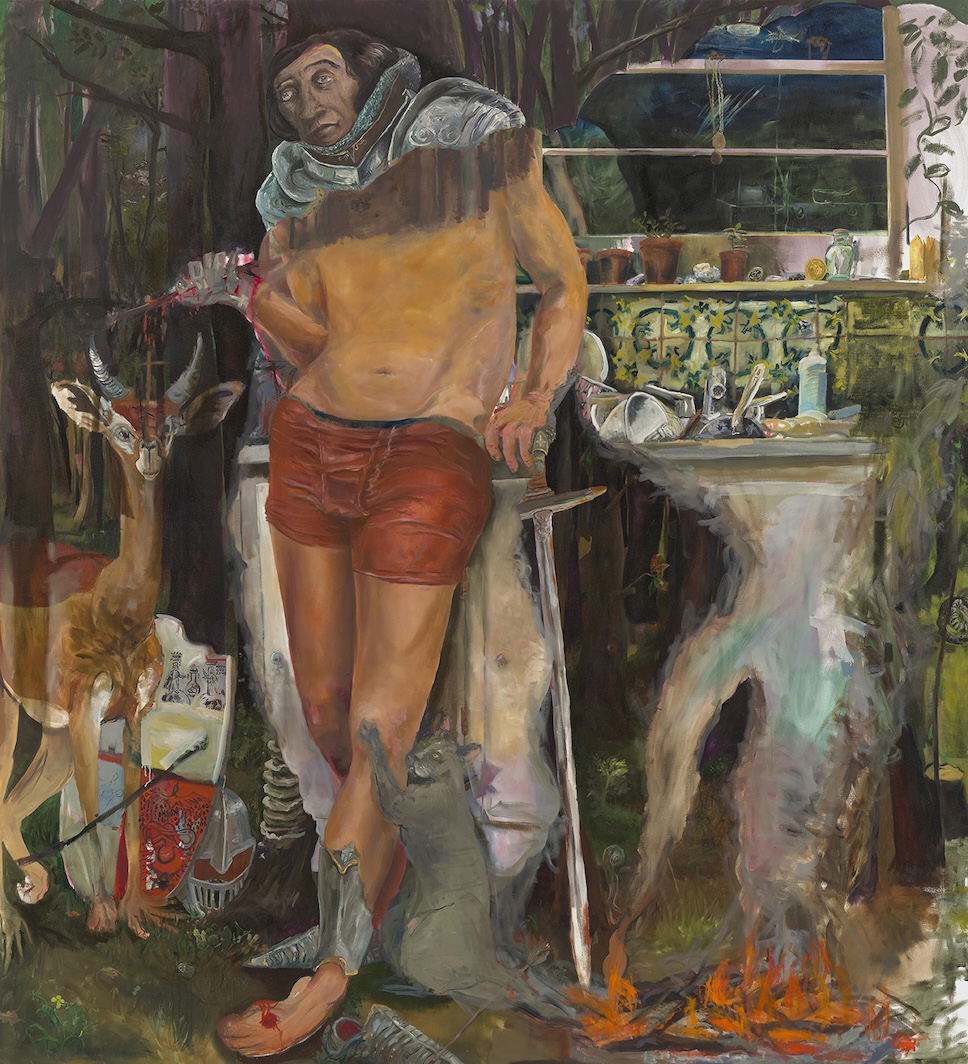
ONE OF MY FAVORITE PAINTINGS of Dupuy-Spencer’s is And the Dawn Don’t Rescue Me No More, from 2020. A figure in red boxer briefs stands between two worlds. On the left, in a fantasy forest, a deer emerges from the darkness of the wood; a shield decorated with a coat of arms stands upright on the forest floor, propped against a metal knight’s helmet. A suit of armor stretches across the person’s shoulders before fading into the flesh of their chest; one hand holds a bloody dagger, and the other leans against an upright sword. On the right, the scene fades into the unmistakable mess of a Los Angeles kitchen. There’s a tiled backsplash in blue and yellow, a sink full of dirty dishes, a windowsill with succulents. A gray cat reaches up toward the figure’s knee. Outside, the sky is beginning to take on the turquoise color that means the sunrise is coming.
When they were kids, Garnett told me, she and Dupuy-Spencer used to play in another world. Their fantasies were darkly allegorical and vaguely medieval, influenced by movies like The Secret of NIMH and Labyrinth. In these games, Dupuy-Spencer would evoke a recurring character she called the Knight with the Broken Arm. “He would greet us at the gates of this fantasyland,” Garnett explained. “And he was kind of a tragic figure.” I began to think of this character as a stand-in for Dupuy-Spencer—wounded but lucid and courageous, ushering the uninitiated into a stranger and more consequential world than the one they thought they had been living in. In And the Dawn Don’t Rescue Me No More,the figure seems at ease between two worlds, leaning on the counter of the LA kitchen, shrugging at the sword beneath their palm. But it must have been taxing, too, to be this kind of emissary. Sometimes, Celeste told MacLaughlin of addiction, “There’s no choice but to find solace on the other side of the veil.”
Moira Donegan is a columnist at The Guardian and a writer-in-residence at Stanford’s Michelle R. Clayman Institute for Gender Research.