


THE DANISH WRITER Tove Ditlevsen divorced her fourth husband, the tabloid mogul Victor Andreasen, in 1973. They’d been together for twenty-two years. Andreasen was then in his second stint as editor in chief of Ekstra Bladet, the tabloid he’d saved from financial ruin. Soon after their divorce, Ditlevsen published the following anonymous personal ad in the paper:
Having escaped a long, unhappy marriage, I feel lonely in this world where everyone is coupled up. I am 52 years old, 172 centimetres tall, slender and blonde. I have an eight-room apartment in Copenhagen and a lovely summerhouse. I have no lack of money, only love. I’ve made a name for myself in literature, but what good is that when I am missing a loyal and loving companion of a suitable age, preferably a motorist. Interests: literature, theatre, people and domestic bliss. Please supply a photograph and details of personal circumstances.
Everyone knew who had written the ad. Ditlevsen had been in the public eye since she’d published her first poetry collection, Pigesind (Girl Soul), in 1939, when she was twenty-two. Believing, sensibly, that working held her inner chaos at bay, she never stopped. From 1939 until her death in 1976, she wrote thirty books—mostly poetry—and countless articles in Danish magazines and newspapers, including a weekly advice column called “Small Everyday Problems” in the women’s magazine Familie Journal. She was one of Denmark’s most photographed writers. Her memoirs, published between 1967 and 1971, catapulted Ditlevsen to a new level of fame.
Her troubles—opioid-accelerated breakdowns, hospitalizations, suicide attempts—were fodder for the press. So was her turbulent marriage. Andreasen had multiple affairs, which he would “leak” to the media; another inspired act of cruelty saw him start a smear campaign against state-awarded prizes for artists—shortly after Ditlevsen won the Søren Gyldendal.
If the idea of a “private life” was a privilege awarded only to other people, she would at least have her say. Moralists labeled the ad undignified; feminists claimed it as . . . feminist; literary critics deemed it clever. I know the strategy: most of my friends are divorced writers. Better to get ahead of the story, even at the expense of becoming a joke.
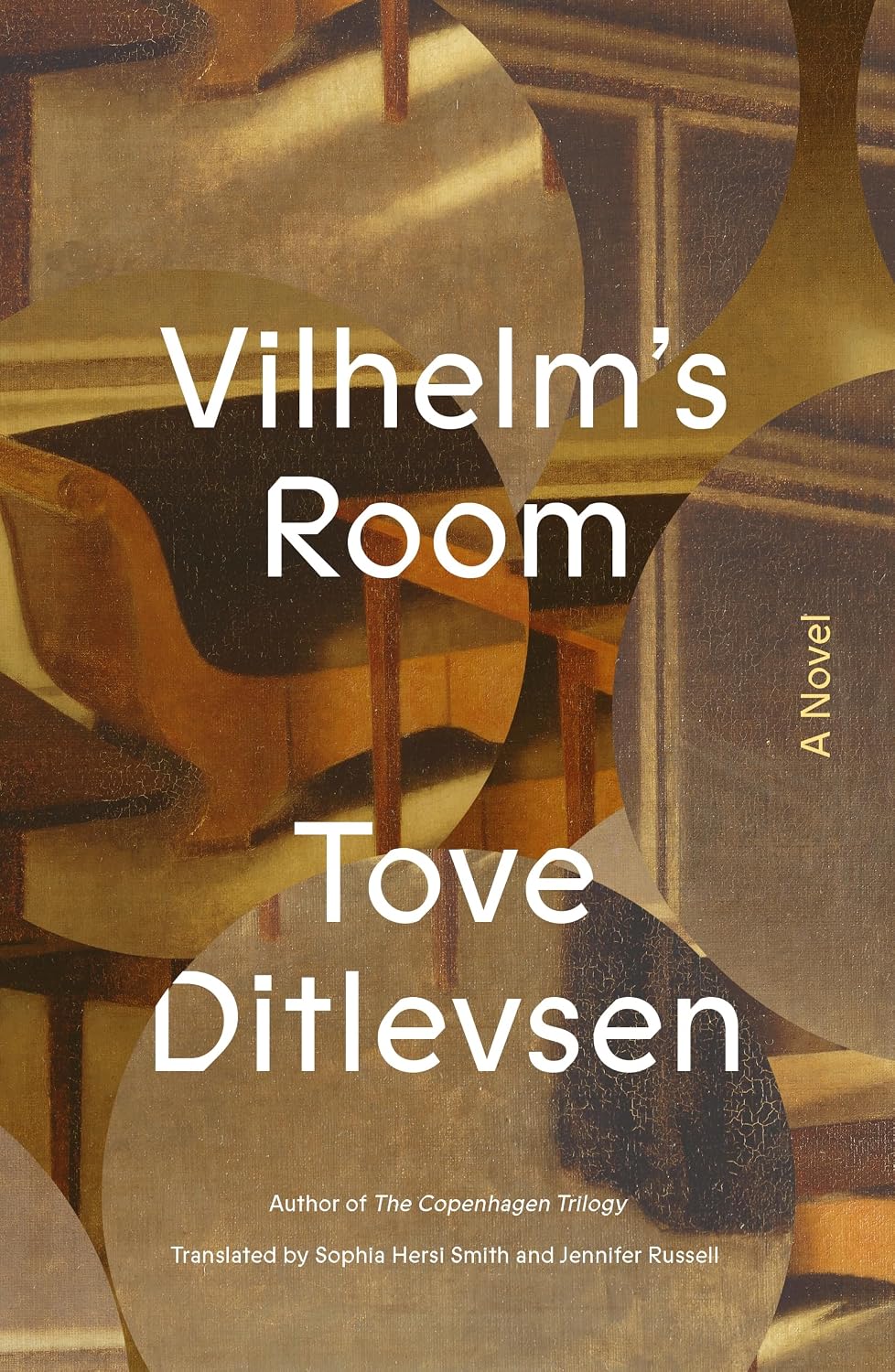
THE PERSONAL AD is a tried-and-true deus ex machina for novelists who write about desperate figures. In Ditlevsen’s final novel, Vilhelm’s Room (1975), written in the last year of her life, it’s more of a McGuffin. More than any of her previous fiction, the novel steers very close to the facts of the author’s life. (Fiction being the version of the story that is easier to look at.) Its narrator, Lise Mundus, is a famous poet married to a philandering newspaper editor. Vilhelm has recently left Lise for Mille, an old friend of Lise’s, after which Lise half-heartedly swallows some pills and is admitted to a psychiatric unit. (“The role of the patient satisfied so many of her infantile needs.”)
There she meets a fellow patient, Greta, and it’s Greta who writes the personal, on the premise that if a man leaves you, it’s your responsibility to find another. The ad appears in Vilhelm’s newspaper, where it’s seen by the widow who lives above Lise, who pushes her meek lodger, Kurt, to write a response. We see the ad through Kurt’s eyes as he scans for signs of financial security: “household literary name,” “summerhouse,” “large flat in the city center.” Arguably, “temporarily incapacitated by a nervous breakdown” also signals wealth. Lise and Kurt meet in a café and decide he will move into Vilhelm’s former room.
Out of the hospital, Lise grants an exclusive to Vera Lindblom, a journalist at a rival newspaper looking to make a name for herself. The profile runs with the headline “It’s Wonderful to Be Alone!” and a wide photograph of a wan Lise. The ensuing frenzy prompts the editor in chief’s wife to suggest that he ask Lise to write about her marriage, since “people can’t get enough of celebrities’ candid confessions.” The editor is taken by the idea, which he immediately absorbs as his own, as he despises Vilhelm, who has “a unique talent for making me feel like an idiot.” (Ditlevsen’s firm grip on the clubbiness and pettiness of the journalist tribe grants Vilhelm’s Room a place as one of the great newspaper novels.) He has little trouble getting her to agree: that same morning, Lise had received a letter from the tax authorities; she owes fifty thousand in back taxes.
Lise’s articles appear in full in the novel, introduced tabloid-style:
Follow this gripping account of a renowned author whose world is upended when her husband abandons her and their son after 22 years of marriage. Candidly and without rancor, Lise Mundus lays bare the tumultuous events that led to a mental breakdown, a stay in a psychiatric facility, and the bold marriage advertisements she placed in Denmark’s biggest newspaper—where none other than her husband is the editor-in-chief. Officially, they remain married, but the contentious editor-in-chief has moved to a new address.
What follows grants a firsthand view of Lise and Vilhelm’s domestic debris. Her account begins a few years before their separation, when Vilhelm’s admiration for her has begun to yellow with envy. He needles her about her lack of education, her hubris, and, most insultingly, ascribes her success to his influence: “You couldn’t have written that had I not opened your eyes to the poetry of Rilke!” On her end, she fears him and yet feels she has to help him, to maintain his equilibrium. (Which isn’t to say she’s Esther Perel: when he paces the flat, burdened with self-doubt, she asks why being married to herisn’t proof enough of his worth.) We witness Lise becoming a detective of her own life, impelled to retroactively collect evidence of the betrayal that was to come. They each start seeing an analyst. There are fights so major that they become part of the couple’s lore: the “Encyclopaedia Crisis,” the “Russian Crisis.” But their marriage ends with the hard-won understanding that there can be no showdown, no vanquishing, only an extrication.
Like Annie Ernaux’s A Simple Passion and Vigdis Hjorth’s If Only, this is about a woman driven almost to madness by heartache. But unlike those novels’ heroines, Ditlevsen doesn’t allow hers to survive. Lise lays out a plan to take her life. This is presented as both philosophical (“I have no freedom left but one: the freedom to die when I please”) and matter-of-fact (“Lise had never intended to wait for a natural death, or as people liked to call it nowadays, a dignified end”).
With “uncharacteristic meticulousness,” Lise packs her bag with a bottle of sleeping pills, “two half-litre cartons of milk as well as two fizzy drinks, . . . two beer glasses in case one broke, a pack of cigarettes, a big box of matches and a torch in case she unexpectedly found herself in the dark.” (She also packs a lipstick.) From there we switch to the future tense. She will hail a taxi to be driven to a street that borders a forest. The rest, she thinks to herself, will be easy. She adjusts her hat and gathers her bags. She closes the front door.
TO LOOK AT ONE’S LIFE with steadfastness and merciless acuity is a quality we (mostly) admire in others and (mostly) defer and reroute in ourselves. Who could bear to look at all that? Possibly Ditlevsen knew she wouldn’t have to. Ten months after the publication of Vilhelm’s Room, she committed suicide with an overdose of sleeping pills.
She had also planned her afterlife. In 1973, she penned “My Obituary,” which begins with cackling fatalism: “Before her untimely death, Tove Ditlevsen was able to write a score of books, of which the most important are her memoirs.” History proved her right. Her reputation rests on her memoirs, which have vaulted her to a belated recognition in the English-speaking world with their translation in 2021.
The Copenhagen Trilogy begins when Tove is just shy of six. We follow her tenement girlhood, her unhesitant sense of purpose, the beginnings of literary stardom, and the narcotic thralldom of her middle years. We encounter a brilliant poetic mind with a frightening impulse to find out what there is in this world to care about, and to understand herself without special pleading.
Born in 1917, Tove grows up during the 1920s recession in Copenhagen, a cramped world she imbues with storybook enchantment: the golden-haired Rapunzel, whose parents beat her nightly; the fleeting appearances of the prostitute Ketty, who looks like Snow White in her white fur, silver high heels, and yellow silk dress; the courtyard pervert who lingers in the shadows. In the thirty-square-meter apartment lives her father, Ditlev, a frequently unemployed stoker and trade unionist; her beautiful and volatile mother, Alfrida; and her brother, Edvin, the golden child who seems destined to have a future as a skilled worker.
Tove has an easy rapport with her father; it is her relationship with her “inscrutable” mother that rules her life. Tove fears her (her mother hits her “often and hard”), but the fear is tethered to a crushing too-closeness (and its concomitant terrifying alienation). Like all sentimental educations, it warps her: through her mother Tove develops her capacity to observe herself as if from a distance.
Dissociation brings her into close communion with language. The young Tove learns to soothe herself with the rhythms of songs or hymns: “Inside of me long, mysterious words began to crawl across my soul like a protective membrane. . . . When these light waves of words streamed through me, I knew that my mother couldn’t do anything else to me because she had stopped being important to me.” At nine she begins writing poems that she hides under her mattress. Her coping mechanism becomes her ambition.
She attends school until the age of fourteen, when she is made to stop by her parents, and takes on all kinds of jobs—nanny, stock clerk, switchboard operator. She leaves home but finds an apartment that is no less oppressive, renting a freezing room with tissue-thin walls from Mrs. Suhr, a member of the Danish Nazi Party, who likes to rhapsodize under the portrait of Hitler hung in the living room. Beyond her evening writing being interrupted by shouts of “Heil!” at party meetings held in the apartment, Tove takes little notice of the oncoming drumbeat of war. (When England declares war on Germany, her first thought is “Will my poetry collection come out now?”) She marries an editor, Vigo F. Møller, thirty-some years her senior, who introduces her to the literary world she’s dreamed of. “It probably wasn’t necessary to marry him to move up in the world,” she would later say, “but no one had ever told me that a girl could make something of herself on her own.” That passionless marriage ends in 1942; the same year, she marries the political-science student Ebbe Munck and has a daughter, Helle.
In the Liberation Summer of 1945, Ditlevsen meets Carl Theodor Ryberg, a physician and scientist who is “a little crazy” as he tells her at their second meeting. This is understatement: at that meeting he administers an abortion for a child that may or may not be his and introduces her to the painkiller that would derail her life. “Demerol,” Tove thinks dreamily, in the afterglow of her first injection. “It sounds like a birdsong.” With that, her mind becomes a host to addiction. “I decide to never let go of this man who can give me such an indescribable blissful feeling.” She leaves Ebbe and almost immediately marries Carl. They have a son, Michael, and she takes in an infant child fathered by Carl thinking that if she does so, he can’t leave her. To keep her supply coming, she feigns an earache, a lie she maintains even as an operation for the fictional ailment leaves her deaf in one ear. “It was worth it,” she says. “No price was too high to be able to keep away intolerable real life.” Carl introduces her to methadone. “The yearning for small white pills” grows inside her “like a rot in a tree, or like an embryo growing all on its own.” For five years, her path hugs the brim of the abyss. She has to inject herself in the foot because she has no viable veins. She can’t write, but lays in bed letting her fingers move “as if they were typing.”
Some instinct for life has her call her psychiatrist from her first marriage. Ditlevsen is admitted to rehab weighing sixty-six pounds, no more than her six-year-old. She describes the agony of the hospital in language so stark it sets ice in the veins. The walls move in when she rests her head. Sweat pours from her body; “the watch ticks against my ear to my frantic heartbeat.” The gothic nightmare of her withdrawal is the subject of the third volume of her memoirs, translated as “Dependency.” (In Danish its title is Ungdom (Gift)—a homonym that means both “marriage” and “poison.”) In time the doctor tells her that she has stabilized, but that she will need to learn how to live a “bare, unaffected life.”
In the final pages, she recounts meeting Andreasen, who would become her final husband: how he adored her poetry, had wanted to meet her for years; how she saw him as perfect, beautiful. She now believes in love at first sight, but rather than ending the memoirs on this note of romantic triumph, she writes plainly about the shadow of addiction: “It will never disappear completely for as long as I live.”
DITLEVSEN WROTE BOTH her penultimate novel The Faces (1968) and the first two volumes of her memoirs during a lengthy stay at a psychiatric hospital. Moving between memoir and fiction produced a queasy sensation, like that of staring at something from two incompatible planes, very far and very near. Her work had always drawn on the same material—her life—but in her late novels the parallels shift from abstracted generalizations to highly specific: Lise Mundus (Mundus was Ditlevsen’s mother’s maiden name) first appears as the heroine of The Faces and returns in Vilhelm’s Room.In both, she’s a famous writer who suffers from marital problems, an inability to work, and an inability to live in her own mind.
Neither novel carries the same charge as The Copenhagen Trilogy, which has the velocity of a thriller. Ditlevsen’s voice is strained, keyed up; the plotting is artificial and the metaphors often heavy-handed. But the lethal absurdity is a kind of feint: madness and fame have produced the subject—Ditlevsen and the book. In her memoirs, Tove described the “sad comfort” of taking on the role of the clown when her classmates or family laughed at her oddness. Here, she takes on a different kind of mask, or feint, replicating the hyperbolic, artificial style of madness and tabloid to undermine its effect.
While the memoirs were of course written to be published, they speak to the author herself rather than to an audience. They are a way to revisit the family configuration, turning it every which way, like a Rubik’s Cube, in the hopes of finding a cohesion in all the decisions she has made since childhood. But in the novel, the narrator speaks directly to the readers, inviting them to become an audience to her life. It sounds crass to use the word “mischevious” to describe a suicide plot, but there is a kind of impishness to it here, like taking a car for a test drive before having a license. What is she doing? I asked at every turn. But because the book treats readers as needed companions, it refuses to answer that question.
FOR MUCH OF HER LIFE, Ditlevsen lived close to the edge. Her last work was a prelude to her suicide, in which she asked for compassion, as if guarding her legacy. But she needn’t have worried. Photographs of the funeral processions show that thousands of women followed her coffin through the streets.
Janique Vigier works at Granta.