


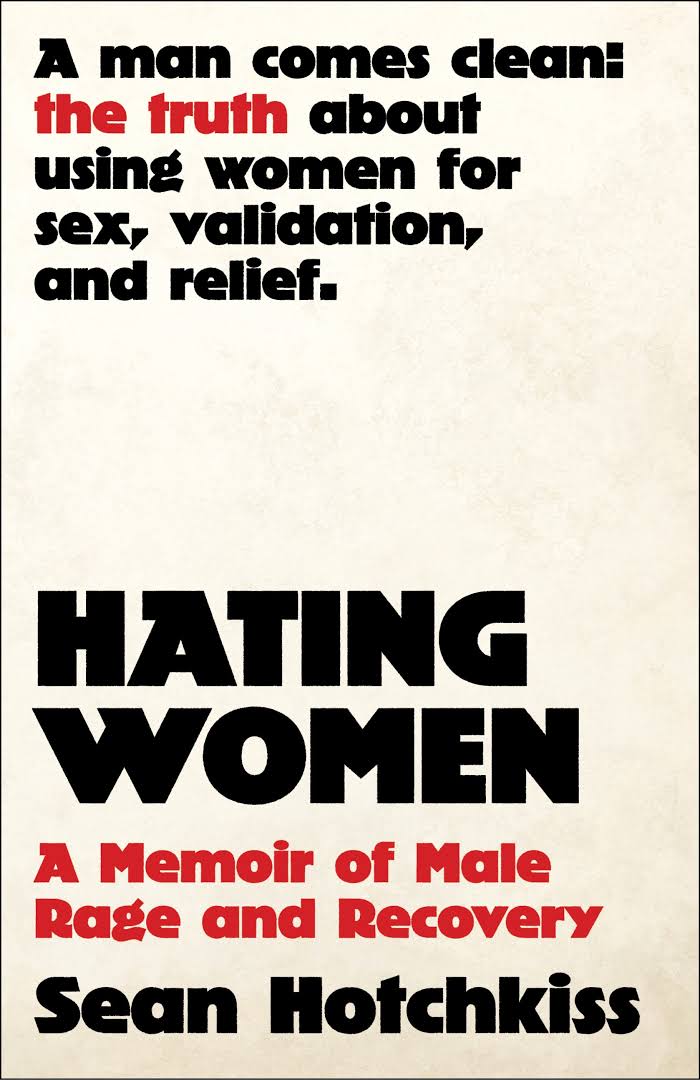
SEAN HOTCHKISS’S HATING WOMEN IS A THOROUGHLY MISNAMED BOOK. Though the title suggests the dark confessions of a reformed Andrew Tate–like figure, the work contains no acts of women-hating, nor does it truly grapple with “male rage,” a feat that would require confrontation with the terrifying reality of male violence. Instead, Hating Women is a gentle self-help guide disguised as memoir. Its true intention is to mitigate the damage wrought by paternal absence and the larger phenomenon of men abandoning one another. This worthy project is sabotaged by a marketing-minded approach that renders it incoherent. “Thank you,” Hotchkiss writes to his editor in the acknowledgments, “for presenting me with a title that I initially fought, but then caused me to dig deeper.” Her counsel, however well-meant, was unwise.
The raw material of Hotchkiss’s life is a blend of privilege and sadness. When he was four, his parents divorced. Seventeen years later, his father committed suicide, which left Hotchkiss with a considerable amount of money. At twenty-six, he entered rehab. By twenty-seven, he relapsed. He landed a gorgeous girlfriend and a job writing for GQ but continued to struggle with sobriety and a persistent sense of emptiness. He experimented with nonchemical forms of distraction, like buying a house upstate, and pursued peace through meditation, talk therapy, and psychodrama. Eventually, he quit the magazine and moved from New York to Los Angeles, where he broke up with his girlfriend and devoted himself to full-time self-improvement via intimacy coaching, vision quests, and periodic celibacy. He then became a coach himself.
Hotchkiss’s personal journey is made to serve as a road map for other men. But this tactic necessitates the imposition of redemptive meaning, even when the author’s avatar treads water or regresses. Though there’s always further to go—a better self perpetually out of reach—each chapter ends with a collective first-person review that suggests the preceding events were obligatory steps toward progress. “Let’s recap our evolution so far,” Hotchkiss writes after he has a cathartic moment at group therapy during a miserable stint of porn, pill, and alcohol reliance. “What we’re beginning to do at this stage,” he writes after joining a men’s group in LA and buying a vintage convertible, is “grow up.”
From the start, Hotchkiss stresses to readers that he was a man consumed by desire. “My fascination with women owned all the corners of my mind, body, and psyche,” he explains. “Though I wouldn’t have admitted it, women had held this incredible power over me for a long time.” Attraction isn’t exactly a crime, but it’s spun into a character flaw by flipping the dominant gender script. Rather than a woman who contorts and minimizes herself in relentless pursuit of male approval, we are introduced to a man who relies too much on female validation. For Hotchkiss’s younger, unrecovered self, women were comfort food, stress valve, and validation meter, less people than painkillers.
But it’s hard to distinguish what Hotchkiss deems his “dependency” on women from his (mis)use of other drugs. Both habits are compulsive, self-soothing, and ultimately self-harming, yet only his history with women drives the story while his drug use is, disconcertingly, downplayed. On the cusp of thirty, when Hotchkiss lists “all the terrible things” he’s done in his young life, romantic transgressions are not among them. There’s no reproductive or sexual coercion, no assault or verbal abuse, no infidelity, not even a roguish instance of lying to a woman about his regard for her, stringing along one who longs to be married, or sleeping with someone before turning to her best friend. The resulting catalogue of wrongs is instead a sad standard for millions of men and women plagued by addiction: money stolen, cars crashed, special occasions ruined by getting shitfaced on whatever drugs are at hand.
Hotchkiss claims in his introduction that “men are taught, from an early age, to hate our own vulnerability. Since women tend to be more vulnerable than us, this hatred gets projected onto them.” This is a fundamental, long-standing feminist insight into the perpetuation of patriarchy, and unobjectionable as a general statement. As a self-description of Hotchkiss, a specific male person, it rings as false as a rote apology, like a recitation forced on a child. He surely made for a poor partner, especially while off the wagon, and harbored resentment when girlfriends failed to solve the problem of himself. But these are universal, misogyny-neutral troubles. We can all be selfish and unreliable and hurt people; almost all of us misdirect dissatisfaction onto our loved ones. Children do it, gay people do it, feminist separatists do it—no woman-hating required. A misogynist will always make for a bad boyfriend, but not all bad boyfriends are misogynists.
Hotchkiss also says that his former self was sexually callous, attracting “the most desperate sort of women” and “running away when things got serious,” a depiction of noncommitment complicated by a string of lived-with girlfriends and the opposing claim that he often rushed into and clung onto relationships. People contain multitudes, but such contradictions are the whole of the book. Hotchkiss insists he hated women with no behavior to support the claim; he insists he had dramatic breakthroughs but then quickly returns to old patterns. Either significant information is being withheld, or the interpretation does not align with the facts. Possibly, it’s both. The result is a death knell for the only indispensable element in self-help, which is the author’s authority. Readers looking to better themselves can excuse rhetorical carelessness and imprecision, even outright misinformation, as long as they find themselves convinced. But a narrative so muddled can hardly be persuasive.
Far from evincing woman-despising fury, Hotchkiss portrays himself again and again as a messy but relatively unaggressive fount of self-loathing. About halfway through the book, when he references “this vile hatred inside that existed toward women,” a typically jarring and awkward formulation, it’s delivered while he makes vague amends to ex-girlfriends “for my bad behavior and, occasionally, my very existence.” Explicit self-hatred appears in almost every chapter—“I hated that fucking weakness, that neediness inside me”; “Oh, how I hated myself”—while the only woman who earns equal ire is, on a few occasions, his mother. Girlfriends, hookups, and female friends are described in bland but effusive terms—beautiful, charismatic, wonderful, stylish—and rarely impugned as people or partners. (These sketches, perhaps rendered dimensionless by an abundance of protective caution, give the impression that even recovered Hotchkiss still doesn’t see women as full human beings.)
It’s strange to find myself, as a woman, complaining that a narrator seems to harbor no bitterness toward women. It would be world-changing for all men, however nonviolent, however “good,” to squarely face their misogynist instincts and tear out those gnarly roots. But to describe misogyny as almost a mood, an occasionally flaring personal affliction that manifests in erratic romantic conduct, instead of recognizing it as a murderous, structurally supported pathology, is trivializing in the extreme. Yes, one might “hate” women for symbolizing weakness, and yes, a man might hate women because he hates himself. But there are men who openly yearn to humiliate, control, and harm women as a class, and there are men who do it. By his own telling, Hotchkiss is not and apparently never has been among them. And nothing Hotchkiss accuses himself of enacting in his past is as disrespectful to women as the wholly gratuitous use of woman-hating as a device throughout the book.
An acutely depressing feature of today’s stalemate of the sexes is that so many straight men blame women for their every unhappiness. It’s women’s fault if a man doesn’t have a girlfriend or doesn’t have sex, doesn’t make enough money or have a better job. Such sexist whining repels women further and compounds the notorious loneliness that would be better deemed self-isolation. (The refrain “men should be lonelier” comes to mind.) Yet while women rightly reject the imperative to assume custodianship of men, we still hope for their peace and fulfillment, particularly when it comes to those we love. We want men to be happy, though that wanting is painful because the wish so rarely seems reciprocal, and our support is rarely met with gratitude. “In the absence of men to initiate other men into emotional maturity, women tend to do the job,” Hotchkiss writes. “And it’s a job we understand you do not want.” His self-improvement journey doesn’t begin in earnest until his mother gives him John Lee’s The Flying Boy: Healing the Wounded Man.
Ultimately, as Hotchkiss knows well, it is not women who are at the center of his decades of suffering. It is men, or rather one man, his father, who bears the responsibility for most of his trauma. When considering his ignominious list of misdeeds, the nearly thirty-year-old Hotchkiss concludes that it “seemed to circle back to my dad’s influence. . . . He hadn’t been there when I needed him. He had lied, cheated, stolen, given me a shit example of being a man.” Elsewhere, he correctly writes, “Most every man reading this book will have a core boyhood wound of not feeling seen or tended to in some way by his father or other men.” He is just one man among the many “left unsupported by other men (emotionally, physically, spiritually) during their formative years,” who “therefore never learn how to find safety within themselves.”
Hotchkiss is at his best when he focuses on the urgent assessment that men need other men, a revelation he makes concrete by naming the action that should follow: men must “initiate each other into deeper layers of vulnerability.” Would a title advertising this insight appeal to the demographic that needs it most? Or will men only consider the truth if it comes wrapped in woman-hating? It’s a shame that his work attracts its audience by reinforcing the mutually alienating lie that women are the locus of straight male problems, even given his eventual recalibration to how men hurt each other. The bait doesn’t seem worth the catch.
Charlotte Shane is a writer, the founder of TigerBee Press, and the cohost of the podcast Reading Writers.