


IN JANUARY 1961 Bill Wilson wrote a letter to Carl Jung expressing his gratitude to the Swiss psychotherapist for his indirect influence on the founding of Alcoholics Anonymous. Wilson reminded Jung of a former patient, a friend of a friend, whom Jung had advised some thirty years prior that to treat his need for alcohol would require no further medical or psychiatric intervention but rather to “become the subject of a spiritual or religious experience—in short, a genuine conversion.” In his reply, Jung corroborated the story about “Rowland H.” and added that what he’d told their common acquaintance was incomplete, on account of feeling back then what he said was always “misunderstood in every possible way.” Jung told Wilson that a desire for drink was “the equivalent, on a low level, of the spiritual thirst of our being for wholeness, expressed in medieval language: the union with God. How could one formulate such an insight in a language that is not misunderstood in our days?” Fair enough.
The path to wholeness, Jung believed, was “by an act of grace or through a personal and honest contact with friends, or through a higher education of the mind beyond the confines of mere rationalism.” He signed off his missive with a real Latin banger: “You see, ‘alcohol’ in Latin is spiritus, and you use the same word for the highest religious experience as well as for the most depraving poison. The helpful formula therefore is: spiritus contra spiritum.” Spirit against spirit, the soul a great battlefield. So elegantly did Jung’s prescriptions of conversion and connection inform the tenets of Alcoholics Anonymous—fellowship, giving oneself over to a Higher Power—that a version of the above story is told in the “The Big Book,” its first edition published in 1935.
As a teenager Jung had experienced epiphanies involving heavenly and earthly spirits. Both came to inform major veins of his mature thought. In Memories, Dreams, Reflections, his autobiography of sorts published a year after this exchange of letters, Jung noted that his faith in institutional Christianity, the Swiss Reformed denomination that his minister father wanted him to preach, had been ruptured on a visit to the Basel cathedral. Remarking to himself on its beauty, its goodness, and the fact that God above created it, sitting on His throne, Jung was seized with the feeling that if he continued on this train of thought it would lead to blasphemy.
For two days and two nights, he was racked by fear and sleeplessness. Finally, he relented, allowing the invasive idea to reach its terminus: God above created the cathedral, He is sitting on his throne, and from under that golden seat “an enormous turd falls upon the sparkling new roof, shatters it, and breaks the walls of the cathedral asunder.” In permitting himself this sacrilegious scene, which he perceived as a grave insult he should be damned for, Jung attested to an incredible feeling of relief. In what he understood as a direct and personal experience of God, he felt he was granted grace. That was something that his father, with his narrow-minded devotion to the deity focused solely on scripture, would never achieve.
If that moment moved Jung away from a calling to the clergy, his first brush with alcohol revealed something fundamental to him about his eventual job of spelunking in the mind. Jung observed that from a young age he’d felt an awareness that, like a coin, he had two sides. “No. 1” was his day-to-day persona, son of his parents and classmate to his peers, while “No. 2” was a timeless essence that rose high above ordinary human affairs. He believed we all possess these constituent parts, which he later called the ego and the self, claiming life’s purpose was to balance them in the process of individuation. Not long after his scatological vision, Jung stole a glimpse of perfect harmony when sampling liquor at a distillery. Suddenly, he wrote: “No. 1 and No. 2 were no more; caution and timidity were gone, and the earth and sky, the universe and everything in it that creeps and flies, revolves, rises, or falls, had all become one. I was shamefully, gloriously, triumphantly drunk.” Perhaps only someone grappling with God and alcoholism can truly appreciate the potent trinity of that adverbial cocktail.
GIVEN HOW NEATLY Jung’s beliefs about spiritual conversion and sobriety, the speciousness of organized religion and the seductions of alcohol, complement Meghan O’Gieblyn’s core concerns in Will and Attention: A Memoir, it’s surprising she doesn’t give him pride of place in her deeply syncretic and profound book’s intellectual pantheon. Then again, O’Gieblyn is a surprising writer, drawn to complexity and paradox over the direct and logical. While Will and Attention orbits Jung—she even sees a Jungian therapist—it’s the idiosyncratic philosopher and political activist Simone Weil who exerts the central gravitational pull. In her spiritual notebooks, assembled and published posthumously as Gravity & Grace, Weil wrote, “We have to try to cure our faults by attention and not by will.” Printed on an index card above her writing desk, the line furnishes O’Gieblyn with her title and the book’s two-part structure.
O’Gieblyn comes across the gnomic sentence one winter while reeling from two related crises, both forms of relapse. First, she surreptitiously starts attending Mass and nearly converts to Catholicism, having left the born-again Christianity of her upbringing decades ago. “It’s clear to me now,” she writes, “that the secrecy was part of the appeal and the duplicity foreshadowed my return to alcohol a few years later, which I would similarly hide from everyone in my life.” That return breaks the eleven-year sobriety she achieved through twelve-step work. “There are a million ways to sabotage one’s life,” O’Gieblyn notes, “but I could not seem to come up with anything more original than the things that had ruined my life before: alcohol and institutional religion. The symmetry, in fact, could not have been more perfect. Within the span of a few years, I had returned to the very traps I’d escaped in early adulthood.” These reanimated traps threaten the stability of her married life, her career, and, even more ruinous for a working writer, the life story she’s been narrating for herself, her readers, and her fellow alcoholics on the page and in church basements.

Midway upon her life’s journey, having told herself she’d found the straightforward path, how did O’Gieblyn get lost again within the dark woods? A compelling setup for a memoir of addiction, faith, and healing, but she doesn’t set about answering the question in the manner of many gifted autobiographical writers. Her book neither begins with a harrowing prologue nor builds out a series of exquisitely rendered, dialogue-heavy scenes ripe for adaptation. She isn’t interested in cataloguing the self-destructive depths to which she sank along the lines of Sarah Hepola’s Blackout or Augusten Burroughs’s Dry. Nor is she interested in the etiology of her illness—backstory—only providing a single glimpse of her chaotic childhood that passes faster than a tableau from an Acela window. She doesn’t pair her journey back from addiction with a hard-won embrace of Catholicism while working the steps like Mary Karr in Lit. Where O’Gieblyn ends up, exactly, with Alcoholics Anonymous or with God isn’t entirely clear. In The Recovering Leslie Jamison was also interested in aftermath, but she wanted, in her words, “to write a book like a meeting,” to place other people’s shares alongside her own. O’Gieblyn doesn’t have much use for biography, and the writers and thinkers she enlists in her project are not alcoholics or addicts or novelists, but philosophers, theologians, and mystics.
Retracing her steps with curiosity and bemusement, even detachment, O’Gieblyn wants to fuse the spiritual and moral ideas of William James, Marguerite Duras, G. K. Chesterton, Iris Murdoch, the Desert Fathers, C. S. Lewis, Jung, and most of all Weil to compose a guide for the perplexed, for those stymied not only by their relationship to alcohol or God but to living itself. Will and Attention is perhaps less a memoir sparring with philosophical ideas than a work of philosophy illuminated by personal experience. With this ambitious aim, O’Gieblyn restores a sense of majesty and epic to what goes on inside of us, qualities often lost amid more cinematic storytelling. On how one person’s puny drama partakes of grander stuff, she quotes an ancient Syrian monk known as Pseudo-Macarius: “The heart itself is but a small vessel, yet there also are dragons and there are lions; there are rough and uneven roads; there are precipices. But there is also God, also the angels, the life and the kingdom, the light and the Apostles, the treasures of grace—there are all those things there.” Will and Attention aspires to resemble any human heart: here be dragons!
To write this way entails struggle. There are the predictable challenges—pacing, balance, synthesis—but O’Gieblyn also sees another obstacle to the telling of her story, effectively adding “new genre” to her book’s to-do list. Ever since St. Augustine’s Confessions, she observes, personal writing has worked with the formula: “I was lost and now I’m found. I was sick and now I’m well. I believed in something but that belief was hollow. And the person who believed it is dead.” Her own memoir’s starting point is: “I had lost the privilege of narrative distance. I no longer had an ‘old life’ and a ‘new life’; I had only this muddle of my own making.” Without that “perfect dovetail of conversion and deconversion narratives”—embracing sobriety, losing faith—she hits an aporia: “I can no longer tell either of those stories. My life has lost its arc, and I fear that it’s become less a narrative than one of those demented children’s songs that goes around in a circle.” That’s an unnerving prospect—for a writer and for her readers.
FOR THOSE WHO’VE READ O’Gieblyn’s previous books, the central lost-found narrative of her life—the first trap she falls back into in Will and Attention—will be familiar. In both the essay collection Interior States (2018) and God, Human, Animal, Machine (2021), an inquiry into the blurred boundaries between science, technology, and religion, O’Gieblyn writes about growing up in a born-again family on the shores of Lake Michigan. She was homeschooled until tenth grade—her social life revolving around youth groups and church, her music preferences running “the gamut from Christian rap to Christian pop to Christian rock.” For two years she attended the Moody Bible Institute, an evangelical, dispensationalist, and Calvinistic college. One day during her sophomore summer, when traveling with missionaries in Ecuador, she up and left: she moved to a town in the country’s south, started teaching ESL, and stopped going to church. An impetus had been the problem of evil: she’d recently read Ivan Karamazov’s attack on the idea of an all-loving God in a world where the abuse of children was rampant. In the early 2010s and into Donald Trump’s first term, O’Gieblyn emerged as a clear-eyed apostate observer of religious hypocrisy for magazines like Guernica, The Point, Harper’s, and n+1.
Rather than merely mounting a critique of contemporary Christianity’s myriad misapplications, O’Gieblyn often found herself trying to preserve what was good and true about the experiences and beliefs she had apparently abandoned. Take the essay “Hell.” O’Gieblyn writes that contrary to what one might expect of students at Moody—automatons memorizing the Bible as holy writ—there was often fierce debate: “Christian literalism is even more complicated than liberal brands of theology because it involves the sticky task of reconciling the overlay myth—the story of redemption—with a wildly inconsistent body of scripture.” The sentence pairs protectiveness for her subject with a desire to educate her readers. The essay comes to wax nostalgic for hell, for a time when people actually believed in it, as she attacks the happy huckster preachers and glam ministers who, in a rush to win converts and enhance Christianity’s “relevance,” have stopped invoking that ultimate buzzkill.
In God, Human, Animal, Machine, O’Gieblyn observes: “To leave a religious tradition in the twenty-first century is to experience the trauma of secularization—a process that spanned several centuries and that most of humanity endured with all the attentiveness of slow-boiling toads—in an instant.” Wry and surprising, the well-turned sentence is classic O’Gieblyn, and so too is its positioning, concerned as it is with what her story can do to help readers follow her argument. She’s explaining her obsessive attraction, after she abandoned religion, to the transhumanism of Ray Kurzweil. She first conjures up the allure of futuristic visions like the Singularity, when we humans become one with sophisticated machines, and the dead can be reanimated by an advanced technology that, while it hasn’t yet arrived, shimmers just over there on the horizon like an oasis. This, O’Gieblyn argues in the end, grants us the same sense of comfort as the Christian ideas of resurrection and rapture. (The first use of the English word “transhuman” was in reference to Christ’s rising, appearing in a translation of Dante’s Divine Comedy from 1814.) God, Human, Animal, Machine is an unraveling of the teleological and eschatological threads stitched into the bleeding-edge concepts of panpsychism, multiverse theory, and embodied intelligence to reveal their implicit, sometimes explicit, religious underpinning or function. It’s not the project of an unbeliever so much as someone shadowboxing with the meanings of God.
What O’Gieblyn has written much less about is her struggle to escape the trap of alcohol, only measuring that recovery-room tale out in dribs and drabs. She mounts a spirited defense of Alcoholics Anonymous in “The Insane Idea,” a long essay in Interior States, which only someone who has benefited from twelve-step work could or would have written. It possesses her typical record-straightening observations, such as the reminder that in AA “the primary beneficiary is the provider of aid, not its receiver. AA has often been labeled a ‘self-help group,’ but it is in fact the opposite: a fellowship for people who have utterly failed in their attempt to help themselves.” Nowhere does she mention her own experiences.
The more one reads of O’Gieblyn, the more one notices two things about her work. First, her interests have evolved naturally and in print: it’s a straight line, if an unexpected one, from her 2017 essay “Ghost in the Cloud,” about Kurzweil and others, to the core of God, Human, Animal, Machine. That book was another way to understand her relationship to faith. It was more philosophical and theoretical than her essays, and its thorough engagement with many sources came to serve as a template for Will and Attention. Second, for a writer who made a name for herself writing personal pieces, O’Gieblyn is extremely careful, even reticent, in sharing details of her own life. In the preface to Interior States,she clarifies that her form of essay isn’t confessional but rather testimonial, in the Christian sense of testifying in the presence of others about when one’s faith truly became one’s own. An act of service. She writes about herself in order “to connect my experiences to larger conversations and debates.”
Sometimes, the connection is less strong. And it’s exciting. Near the middle of God, Human, Animal, Machine, O’Gieblyn speaks of a time in her life when she found herself under the dizzying sway of Nick Bostrom’s simulation hypothesis, which argues that the reality we inhabit could be a computer program created by transhumans in the future. O’Gieblyn continues: “It might be relevant here to point out that I was existing during those years in a version of reality that was already heavily mediated.” In this passage, O’Gieblyn is not standing in for a reader, she is speaking solely for herself. She writes of alcohol at night, pills in the morning, and the hours in between “taking on the sharp and irregular plotline of a Kafka novel.” To make matters worse, she tells us, there’s a history of mental illness in her family and its onset would have been expected around this age.
The aside isn’t integral to her argument but intensifies it. The stakes are suddenly high, acutely personal. This brief section is like the traceable top of an iceberg. What exactly, and how much, lurks beneath the surface? With Will and Attention, O’Gieblyn’s first book marketed as a memoir, we may finally get an answer.
THE BOOK’S FIRST PART, “Will,” is masterful, a finely tuned balance of action and thought. O’Gieblyn examines her near conversion to Catholicism and subsequent return to alcohol as evidence of how she failed to cure her faults by will. She speculates that she began attending Mass one spring day because she’d been stricken with acedia. Called “the noonday demon” by the Desert Fathers, acedia means “lack of care,” and O’Gieblyn defines it as “metaphysical boredom.” She views it as a condition brought on by her realization that for all her sobriety, “there was no finish line, that the life I was striving so hard to live was its own reward.” O’Gieblyn stops calling her sponsor and regularly attending meetings; the best part of her week becomes losing herself in the Latin at St. Mary’s while sitting in the back pews. One ritual replaces another, the Christian rites feeling like “the more intense and authentic version of the vague spirituality” she’d been imbibing along with the free coffee. One day she hears a whisper in her ear: “God can still see you all the way back here.” It’s Father Aaron, a young Kierkegaard-quoting priest, with whom she begins to have theological discussions.
The episodic talks with Father Aaron in Will and Attention furnish O’Gieblyn with a seamless way to unspool and interweave the beliefs of her other interlocutors. Simone Weil’s koan-like statements are the golden thread: “Love everything without distinction”; “We must give up everything which is not grace and not even desire grace”; “The great trouble in human life is that looking and eating are two different operations”; “Humility is above all one of the qualities of attention.” Weil is multitudinous, unafraid of contradiction, and difficult to summarize, but I’ll give it a shot. Weil counsels against willpower—white knuckles and gritted teeth—and its attendant illusions of self-mastery. With will as our only compass, she says, a kind of spiritual gravity will pull us down no matter where we are. That’s why we always fight against the force of gravity as we swim through life in our search for the good. And yet when we’re in real danger, fighting is what kills. Flail, and you drown. Through the cultivation of our attention, a supreme concentration that does not seek to control, we can in stillness achieve buoyancy. Grace is the starfish-float in a raging sea.
The meetings with Father Aaron don’t last. O’Gieblyn breaks them off after he suggests she might find her purpose and fulfillment through motherhood. Unmoored from her recovery program and the intense allure of Catholicism, she finds that her low-level spiritual thirst slowly becomes literal. “Alcohol is the only thing that has ever allowed me,” she writes, “to nest happily in the presence of God.” “Will” gathers speed as she succumbs to a glass of white wine at the airport. Nowadays, she confides to us, when it’s her turn to share in recovery meetings, she skips ahead to when she found herself at her O’Hare layover—vomiting vodka, head bobbing, the toilet’s automatic flusher swooshing again and again. What she omits, knowing it’s romanticizing addiction, is what happened after her first few drinks: “that singularity where time dissolves, and all utterance fades into light, and which entirely consumed me that morning as I sat alone, dumbstruck in the winter sunlight, wondering how on earth I’d ever consented to give this up.” Here, everything in the universe that creeps and flies, revolves, rises, or falls becomes one. The ode is up there with Don Birnam’s in The Lost Weekend, Charles Brackett and Billy Wilder’s adaptation of the Charles Jackson novel: “It pickles my kidneys. Yes. But what does it do to my mind? It tosses the sandbags overboard so the balloon can soar. Suddenly I’m above the ordinary. I’m competent, supremely competent. I’m walking a tightrope over Niagara Falls. I’m one of the great ones. I’m Michelangelo moulding the beard of Moses. I’m Van Gogh, painting pure sunlight.”
After months and months of secret drinking, O’Gieblyn is caught in a stark lie by her husband, Barrett, and she comes clean. Neck bent between her knees, she sobs and begs, No more questions. Barrett places a hand on her head, and, in that instant, she knows she’ll be forgiven. “It is the only moment in my life when I have felt loved so completely,” she writes, “loved in the depth of my wretchedness and failure, and sometimes, though not always, I think I would choose to live through all that affliction again, to live it over just as it was, any number of times, if it was the only way to preserve this moment of grace.” The passage is beautiful and it’s an apt ending to “Will,” the acceptance of defeat giving way to surrender. It’s also the most human and humane moment in the book. If it takes two to make an accident, as Jordan Baker says in the gin-soaked Great Gatsby, then on occasion it can take two to make grace. Here’s personal and honest contact with a loved one, exceeding the confines of mere rationalism.
IT’S A SIGN OF BRAVERY or recklessness to place your story’s most moving scene at the end of the first act, and “Attention” sets itself other challenges as well. For starters, attention is quite simply harder to grasp than will, more of a gas than a solid. While O’Gieblyn shows it’s not inert—quite active, in fact—it’s trickier to dramatize or even observe. “Will” presented O’Gieblyn on a crash course: there was well-wrought drama and escalating danger. Her enlisted thinkers served to explain, like a silent film’s title cards, what was happening to her and why. In “Attention” there’s no known destination on which we can fix our sights: she makes clear that she will not be tempted again by either alcohol or organized religion. So, then, what’s the struggle? This open-endedness is a major part of her project’s gambit: to challenge our desire for most personal writing’s certainty by refusing to use an “Archimedean point” to leverage a conventional lost-found tale. (It is, she will conclude, a form of certainty that led her to relapse.) Her approach is the essayist’s, circling her prey from afar, rather than that of the memoirist who is expected to swoop down, talons out. While O’Gieblyn’s narrative doesn’t keep starting and restarting like a demented children’s song, as she worries, she runs a gauntlet that has, ever since St. Augustine’s Confessions, allowed few authors to pass through it unscathed. We all recall young Augustine stealing the peaches with his friends, pure sin’s pleasure tasting delicious, so sweet and so cold, but with a few exceptions, what happens after he lets go and lets God, and especially those exegeses of Genesis, aren’t quite as enthralling. In memoirs of conversion or addiction, the unfolding disaster holds us like the glint of a mid-air explosion; picking up and inventorying the pieces, deciding where to venture next, is a process from which we can turn away quite leisurely.
O’Gieblyn is a heady writer, sometimes even disembodied, and with so much of Will and Attention taking place in the realm of ideas, it’s critical that the philosophical sections be well integrated with her equally compelling story. It’s unfortunate we don’t get more detail about what the fallout meant for her marriage, which could’ve served as a stronger narrative ballast to the philosophy’s weight. We spend more time with her husband Barrett, but he remains somewhat hazy, their relationship perhaps protected by the author. Barrett asks that O’Gieblyn see a therapist after her relapse and also tells her that her secret drinking felt like an act of infidelity to him. The granting of personhood to alcohol, for user and abused, how it can slip seductively between a couple, is a choice site for O’Gieblyn’s trademark excavation via her book’s most ethical thinkers. We’re sadly not treated to any real digging. The role played by Father Aaron in “Will” is reprised in the second act by Dr. Nora, a Jungian therapist, with whom O’Gieblyn discusses Dante and Jung’s Answer to Job, but they have much less frisson or friction.
O’Gieblyn is interested in a new storytelling mode for the longer narrative parts of “Attention.” Or rather one of the oldest: the parable. A scene in which she helps a young woman look for her lost phone, joined by an ineffectual policeman, ends when they all give up looking for it—and there it is. The moral is, as Weil says, “We must not want to find.” The Eastern-inspired logic echoes the Christian thinking of C. S. Lewis, who wrote “no temptation is ever overcome until we stop trying to overcome it—throw up the sponge. But then you could not ‘stop trying’ in the right way and for the right reason until you had tried your very hardest. And, in yet another sense, handing everything over to Christ does not, of course, mean that you stop trying. . . . Not doing these things in order to be saved, but because He has begun to save you already.” Anything this complex has little to do with one-dimensional willpower. It’s all about attention, which is capacious enough to function, even thrive, while holding in productive tension two opposing ideas.
For O’Gieblyn, attention is understood as vigilant humility. She went awry before her relapse, she realizes, not because of her failure of will but because she wasn’t paying enough attention. She became complacent, overconfident in the story she was telling. After rationalization and self-delusion, the next stop is hubris. Humility is maybe the quality of attention, and it must be practiced like prayer or meditation to act as a safeguard. O’Gieblyn quotes Iris Murdoch, a novelist and philosopher influenced by Weil, on how if we grasp the real work of attention, “how continuously it goes on, and how imperceptibly it builds up structures of value round about us, we shall not be surprised that at crucial moments of choice most of the business of choosing is already over. This does not imply that we are not free, certainly not. But it implies that the exercise of our freedom is a small piecemeal business which goes on all the time and not a grandiose leaping about unimpeded at important moments.” The second half of Will and Attention is best read as an uneven, rich, and large-scale attempt to present what it means to dwell within the small piecemeal business of choosing to live a life that has no finish line, a life that is its own reward. A worthy goal—as vexing in life as in literature.
Bill Wilson wrote another letter in 1961, this one to Charles Jackson, author of The Lost Weekend.It wasn’t out of the blue but out of receipt: Jackson had sent Wilson the new edition of his debut novel, expressing his gratitude for what AA had given him. “To have an autographed copy from you,” Wilson wrote, “is to have a very real keepsake—a remembrance also of your demonstration in the later years of all that is AA.” Jackson worked the steps, and yet he still struggled with alcohol his whole life, relapsing shortly before his death by suicide in 1968. He also struggled to write something better than The Lost Weekend. Part of his block was no doubt due to the public’s additional adoration of the Academy Award–winning film, the neat ending of which, where Ray Milland licks his addiction and bangs out the story we’ve just seen on a typewriter, Jackson detested as a ten-cent trick. He planned a sequel that would let readers just live alongside Don Birnam, not engage in the sordid rubbernecking of benders and pickled kidneys. As he wrote of Birnam in his final manuscript: “What life means, it came to him (or he seemed to overhear), it means all the time, not just at isolated dramatic moments that never happened. If life means anything at all, it means whatever it means every hour, every minute, through any episode step, the dramatic and the humdrum alike—every fleeting second of the way.” Jackson never licked the challenge of dramatizing this story effectively. The novel was unfinished when he died.
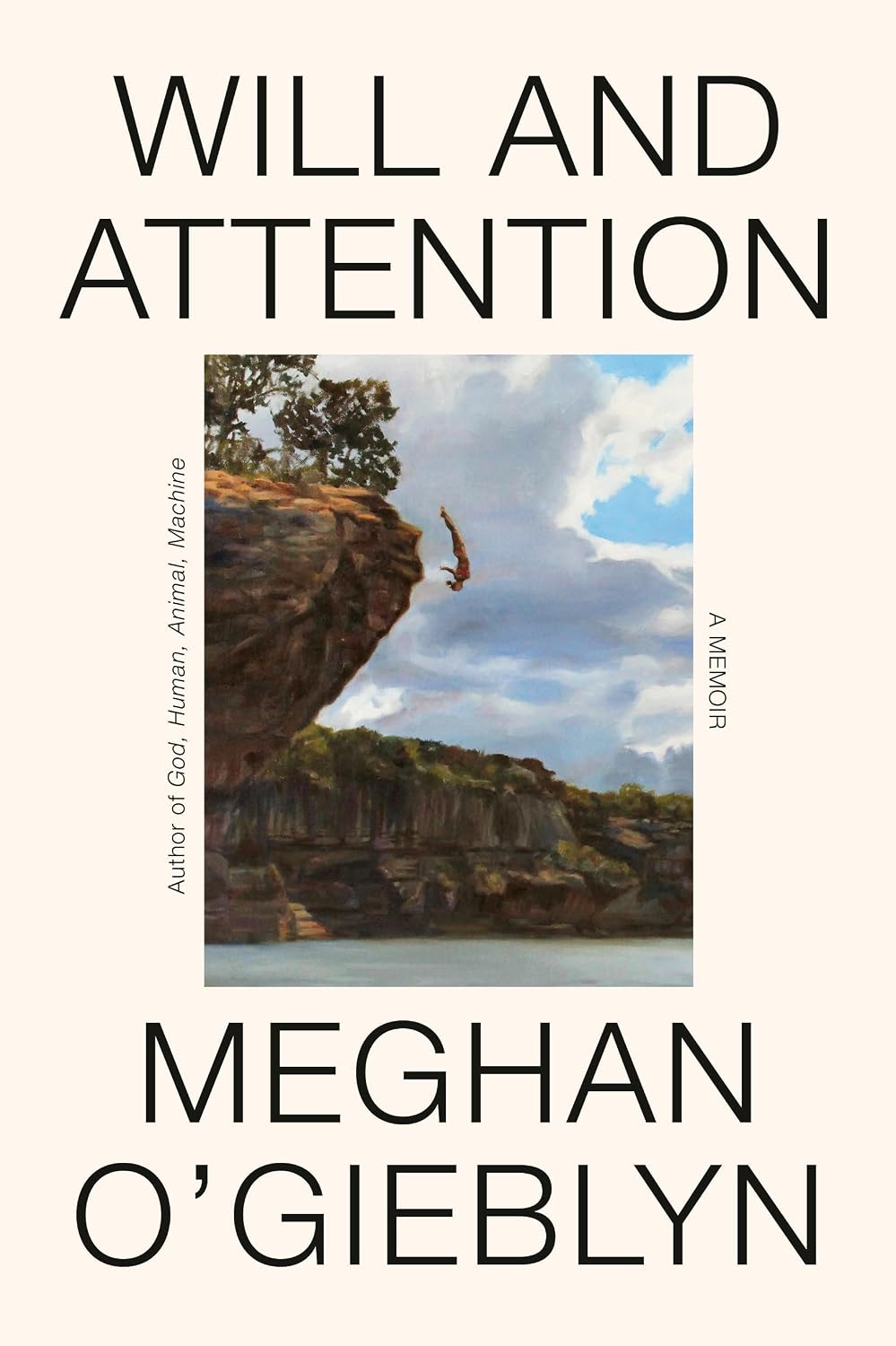
In the penultimate scene of Will and Attention, O’Gieblyn and Barrett are in Italy on the Ligurian coast. She’s been sober again now for over a year, and her senses are pricked up as she sits on the beach. She sees young boys jumping from a very high ledge, again and again, each day, every day, a very dangerous ledge, and they keep jumping. And then one boy does what you cannot do before taking a leap of faith. He hesitates, wobbles, falls. In the slapping waves, he’s swallowed—and then he emerges, shakes his head ferociously.
How did this boy survive, how did any of them survive, why do we survive in this world when you’re basking in sunlight one moment then shattered upon the rocks the next? A small episode of living, but something within O’Gieblyn finally unwinds, like the mainspring in an old watch after a piece of debris is cleared from the escapement. “The riddle was not the problem of evil,” she writes, “it was the problem of good. Beauty and goodness and order—this was the truly shocking fact of existence.” There are stars, there are caribou; there’s laughter and forgiveness, too. She doesn’t quote chapter and verse, but it’s a fitting end to all O’Gieblyn’s exploring, when she arrives where she started and knows the place for the first time, considering the lilies of the field, how they grow and toil not. Perhaps everyone needs to acquire and tend such a moment, a talisman that can be held tightly to the heart but also extended out to others, palm open.
Elias Altman is a partner at Massie McQuilkin & Altman Literary Agents.