


AESTHETIC JUDGMENTS MAY NOT be objective, but that does not mean they are subjective either. To be sure, they are always made by specific persons, and are in this sense personal, yet this fact is often taken to be the end of the argument, when it ought to be the beginning of analysis. What goes into making the person who makes the judgments that they happen to make? Taste, of course, is influenced by supra-individual identities, such as class, gender, race, nation, region, and generation; when you scratch the surface of today’s most heated aesthetic disagreements, it is usually one or more of these that is really at issue. Such categories could be described as the sociological coefficients of a more variable dimension of taste formation, one that has to do with the particular circumstances in which an individual encounters a work of art, and how people and their tastes change or do not change with time.
To take a few examples from thirty years of making aesthetic judgments about literature, there have been writers I grew out of when their formal strategies came to seem predictable or pat (Hermann Hesse), when I discovered more sophisticated and complex versions of their work (Paul Auster), or when their concerns no longer dovetailed with my own (Albert Camus). There have also been writers whose work other people found instantly compelling, whom I only came to cherish on my second or even third reading, once I had the necessary education or life experience to appreciate them (Emily Dickinson). Then there are those writers whose merits I can recognize, but whose books I read too late in life to share other people’s enthusiasm for them (David Foster Wallace). Conversely, there is a writer to whom I will always be loyal, despite his many defects, because he was the one who made me want to spend my life reading in the first place.
Somewhat embarrassingly, this writer is Edgar Allan Poe, whose stories and poems I encountered in a textbook as a solitary, self-serious, and morbid sixth grader. To this day, I remember the film on the eye of the man who is murdered in “The Tell-Tale Heart,” the axe that is buried in the brain of the wife of the narrator of “The Black Cat,” and the sequence of colored rooms of Prince Prospero’s castle in “The Masque of the Red Death” as vividly as I remember the first time I saw snow. Some of my earliest experiences of what I’d later know how to identify as intoxication came from intoning the words “Nepenthe,” “Nicéan,” “Ulalume,” “tintinnabulation.” Poe introduced me to the pleasure of looking up unfamiliar words and to the pleasure of catching allusions. When I first read Lolita two years later, the fact that Humbert Humbert knew “Annabel Lee” by heart convinced me that he was a basically sound fellow. (You live, you learn.)
Around that time, I went on a class field trip to a French bookstore in West Los Angeles. The bookseller noticed that I was wearing a T-shirt with a line drawing of Poe’s face on it—like I said, you live, you learn—and sold me a bilingual edition of Les Fleurs du Mal by Poe’s translator, the poet Charles Baudelaire. Baudelaire, in turn, was how I found out that T. S. Eliot was not merely the author of the libretto to the musical Cats; that there was a person named Walter Benjamin, whose essays about poets, playwrights, and novelists were every bit as compelling as a poem, a play, or a novel; and that in New York there was a publisher called New Directions. In this way, Poe opened the gate to modernism for me, and I walked through it too early, with all the blitheness and curiosity of youth, not knowing that the writers waiting on the other side would set the parameters of my understanding of what good literature is, much to the annoyance, as I have been repeatedly told during my time as a working critic, of people whose tastes were formed otherwise. All things being equal, I still prefer tales about extreme states, exceptional circumstances, and aberrant ideas to those that explore the normal emotions and experiences of everyday life.
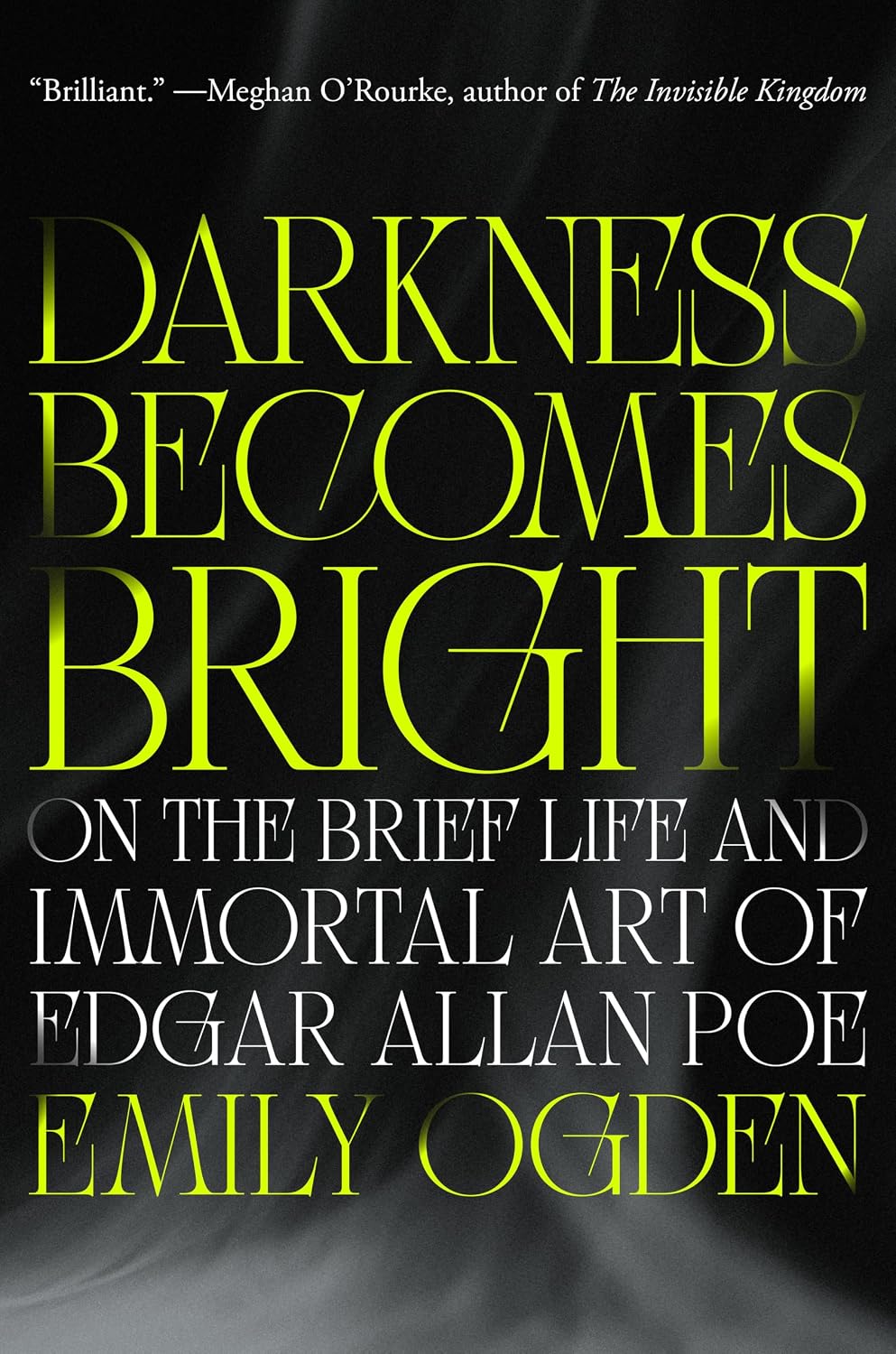
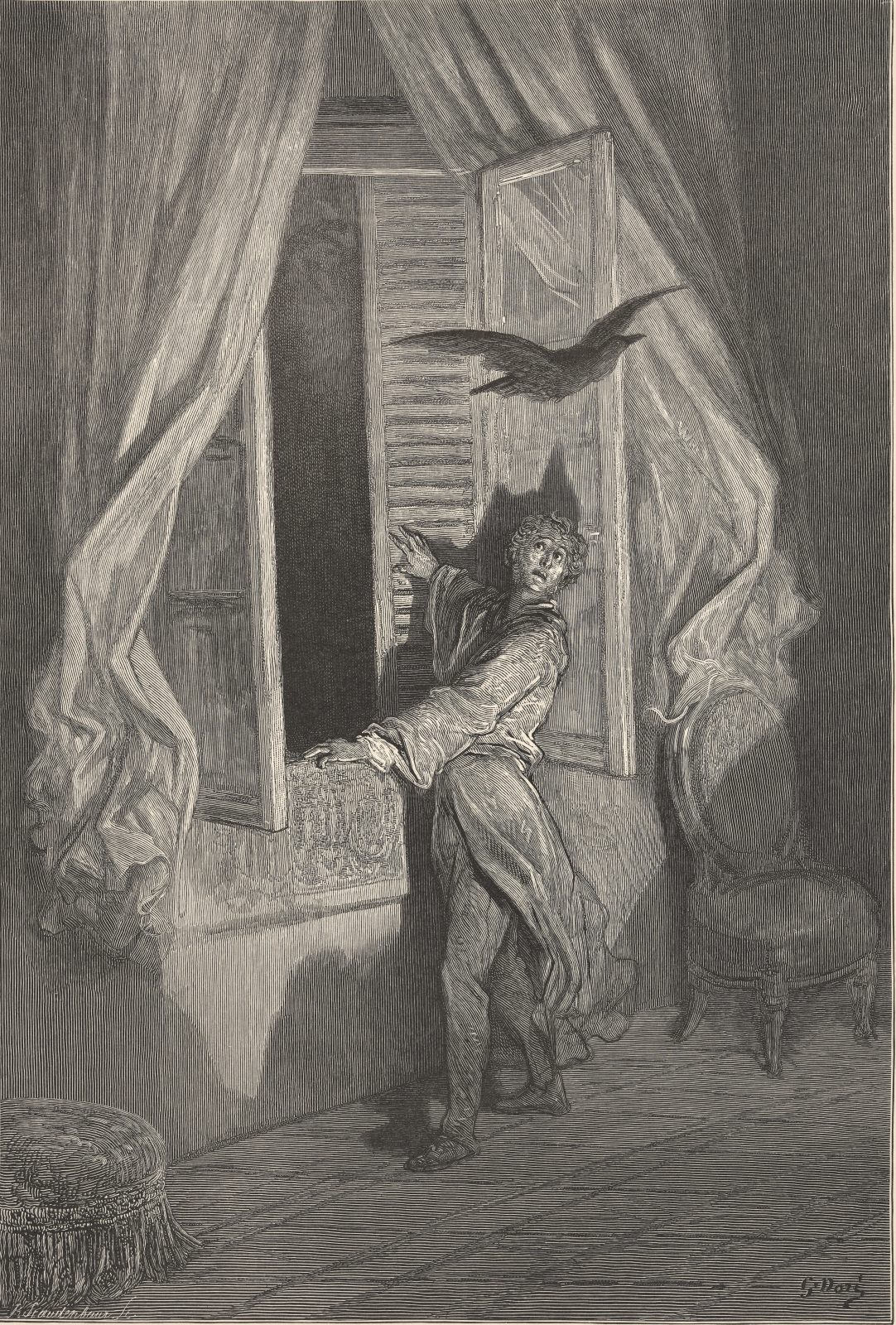
Why embarrassing then? As the Guggenheim Fellow and Whiting Award recipient Emily Ogden writes in the introductory chapter of her third book, Darkness Becomes Bright: The Haunted Life (and Afterlife) of Edgar Allan Poe, Poe is a “boy’s author.” Emotionally “stunted,” he was an “egomaniac” who arguably could not “represent anyone in his art because no one but himself counted for him in his life.” Following the compositional principle that each work of literature should produce a unique and singular effect on the reader, his monomaniacal characters were closer to psychoanalytic drives than they were to the round and thick depictions of people that we have been trained to expect by realist fiction. “Obsessed with death and frightened by sex,” in Ogden’s estimation, Poe was not above trafficking in the “cheapest thrills” of the “vulgar showman.” If his tales could be “lurid and puerile,” his poetry was full of “rhyming whizbang[s],” such as the “lattice / thereat is” rhyme from “The Raven,” though rhyming “roam” and “Rome” in “To Helen” edges even closer to doggerel.
Much as I might want to, I find nothing in Ogden’s assessment to disagree with. Nor is it exactly a minority view. She goes on to quote T. S. Eliot’s description of how Poe would have appeared to a “cultivated” American reader nearly a century after his death. It captures my own experience all too well: “Poe is the author of a few, a very few short poems which enchanted him for a time when he was a boy, and which somehow do stick in the memory.” A further three-quarters of a century haven’t moved the needle on his reputation. Poe is undoubtedly canonical, but he is canonical the way a zombie is alive. Although editions of his collected stories and poems, especially the ones that look like they are made to be the lever that reveals a library shelf to be a secret doorway, are still in print and sell well, I am told he no longer regularly appears on high school and junior high school syllabi. Cormac McCarthy’s demiurgical psychopaths and Pynchon’s paranoid detectives owe something to his macabre imagination, and Stephen King, Dennis Cooper, Marilynne Robinson, and Joyce Carol Oates have all claimed him as an influence; but off the top of my head I cannot think of a prominent American writer under the age of seventy—Ottessa Moshfegh would be the obvious candidate—who has followed suit.
Nevertheless, Ogden writes, “the extent of Poe’s influence is unusual.” It’s a truth that seems to be acknowledged everywhere except the country of his birth. Poe’s only novel, The Narrative of Arthur Gordon Pym of Nantucket, the story of a whaling voyage gone horribly wrong, was published when Herman Melville was still a landlubber; within months of Poe’s death, the former schoolteacher sat down at his writing desk in Pittsfield, Massachusetts, and tattooed a blank piece of paper with the three most famous words in American literature. In Poe’s story “The Man in the Crowd,” Baudelaire found flâneurie, just as he found l’art pour l’art in his lecture on the poetic principle, and perhaps also the idea of petits poèmes en prose in the subtitle of Eureka, a bit of speculative cosmology that was derided as the ravings of a drunk lunatic until Albert Einstein and Sir Arthur Eddington got their hands on it in the twentieth century. Through Baudelaire, Poe touches all of subsequent French literature from Mallarmé to Houellebecq.
The underground man and Raskolnikov, testaments to the psychological astuteness of their creator, are but the stepchildren of the narrators of “The Black Cat” and “The Imp of the Perverse,” just as Sherlock Holmes was hatched in a brain warmed by the ratiocinations of C. Auguste Dupin, just as Oscar Wilde caught his first glimpse of Dorian Grey in “The Oval Mirror.” Weird Tales magazine, which launched the career of Cthulhu, could have been called Tales of the Grotesque and Arabesque, the title of Poe’s 1840 collection of short stories. Poe is at the center of Guy Davenport’s virtuosic essay “The Geography of the Imagination,” John T. Irwin’s criminally underrated study American Hieroglyphics, and Arno Schmidt’s Bottom’s Dream, surely one of the most forbidding works of fiction ever written. “The Purloined Letter,” starring the aforementioned detective Dupin, is the subject of the only seminar of Lacan’s that I find remotely intelligible. I once tried to rewrite it as a gothic campus novel, though the result was more instructive than it was successful.
Ogden’s road to Poe was different from mine, which is why I trust her considered judgment about his work more than my callow intuitions. Skeptical at first—and not, as we have seen, without reason—she started to take Poe seriously when she was required to teach a course on his work at his alma mater, the University of Virginia, where she is a professor of English. Her change of mind—from antipathy to ambivalence to admiration—provides the main through line of Darkness Becomes Bright. In Poe’s “determination to confront the greatest difficulties of human experience,” Ogden finds support for her conviction that what we “share” as human beings are “demons,” as well as for her conviction that stories “let us live for a while in our knowledge of the worst.” Poe’s, in particular, show us how “horror” can be made to yield “beauty,” and in a world that is irremediably horrific, this is no slight compensation. Borrowing its structure from Italo Calvino’s metafictional masterpiece, If on a Winter’s Night a Traveler, her book is a Swiss army knife of scholarly delights: part biography, part reception history, part personal essay, and part reflection on the purposes of a life spent writing about reading.
Darkness Becomes Bright starts with a suspenseful tale of the alcohol-induced paranoid episode Poe suffered as he traveled from Fordham, New York, to Richmond, Virginia, to deliver a lecture on aesthetic theory a few months before his mysterious death in Baltimore at the age of forty. Then it circles back to discuss his miserable childhood as an orphan raised by the abusive merchant and slave trader John Allan; his education at the University of Virginia, which was cut short when his turn to gambling to pay off his student debts proved unsuccessful; his travails as an impecunious writer, reviewer, and magazine editor; and his doomed marriage to his thirteen-year-old cousin, Virginia Clemm, who died in 1847, after a long battle with tuberculosis, two years before her emotionally distraught and perpetually inebriated widower was found delerious, wearing someone else’s clothes, in a Charm City gutter. Ogden periodically breaks off from narrating Poe’s biography to tell the stories of some of his “alter egos,” the men and women who “dedicated themselves to him” during his life and after. In chronological order, they are: the Philadelphia engraver John Sartain, Poe’s friend and former colleague, who listened to him and took care of him during the paranoid episode; Charles Baudelaire, the man most responsible for his posthumous fame; Marie Bonaparte, author of a psychoanalytic study of his life and work; the Franco-Argentine novelist Julio Cortázar, who translated his fiction and essays into Spanish; and Ogden herself.
Other readers will have their own preferences, but of all the scenes from Poe’s life presented in Darkness Becomes Bright, the one I gravitated to was, perhaps predictably, her description of the publishing world in the Age of Jackson. It was a time when publishing centered on Philadelphia rather than New York and magazines flourished. Graham’s magazine, the illustrated monthly where Poe was employed as the literary editor in the early 1840s, had a circulation of 40,000. Poe also held editorial positions at Burton’s, Graham’s parent magazine, as well as Richmond’s Southern Literary Messenger and New York’s Broadway Journal and Evening Mirror, where he published his stories and essays. Regarded as an “able editor” and a “gifted writer,” his impolitic behavior, his alcoholism, his tendency to self-sabotage, and his ambition to do artistic rather than commercial work ensured that he never held a salaried position for long.
After he botched an opportunity to get himself a sinecure in the Tyler administration, which would have provided him a stable income and free time to pursue his dream of starting his own magazine, The Stylus, Poe turned to freelance writing to support himself and his sickly wife. Until the popular success of “The Raven,” he was best known as a fearless reviewer—“perhaps too fearless,” Ogden comments. He was certainly willing to make enemies by writing pans at a time when puff pieces were so common that they constituted an entire “puffing system.” Aside from his marriage, his greatest disappointment in life may have been that he never got The Stylus off the ground. One pictures his contemporary equivalent pouring himself three fingers of Fernet and turning from the rejected grant application in his inbox to his Substack.
Aside from Ogden, the “alter ego” of Poe’s that I found most compelling was Marie Bonaparte, the great-grandniece of Napoleon. Bonaparte receives a slighting reference from Lacan in his seminar on “The Purloined Letter” and before I read Darkness Becomes Bright, that is all I knew about her. Her mother died shortly after she was born; she was raised in a gilded cage in Paris by her absent-minded father and a platoon of nurses and tutors until she was married off to Prince George of Greece and Denmark in 1907. Plagued by hypochondria and anxiety, Bonaparte first read Poe in Baudelaire’s translation in her late teens; his story “Ligeia,” about a second wife who is tormented and ultimately possessed by the ghost of the first, terrified her so much that she refused to allow her own daughter to read it.
When Bonaparte traveled to Vienna in 1926 to seek treatment from Sigmund Freud, she brought her copy of Poe’s stories with her, hoping to induce the childhood nightmares that she believed would help her overcome her resistance to analysis. Bonaparte would go on to become Freud’s friend, translator, protégé, and protector. She was the woman to whom he confessed that, after thirty years of research, he was unable to answer the question “What does a woman want?” as well as the serious reader to whom he confessed that he found Poe “ridiculous.” On the second score, at least, she was able to enlighten him. An early application of psychoanalytic methods to the study of literature, her biography Edgar Poe, sa vie, son oeuvre: étude psychoanalytique argued that Poe’s writing had been shaped by the trauma of his orphanhood, which made it impossible for him to psychically detach from his mother, and which in turn accounts for the hysterical, onanistic, necrophiliac, and incestuous undercurrents in his stories. Was this projection on the part of Bonaparte? Probably. Is it untrue? I don’t think so. As she neared the end of her biography, Freud sent her a note of congratulations: “I hope that [Poe] will soon join his dead mother and that you will pronounce his funeral oration.” This may have been tongue in cheek; then again, as Ogden writes, in one of the book’s many lucid apothegms: “an essay is an exorcism.” After Freud’s death in London, Bonaparte began work on what would become her magnum opus, a study of female sexuality.
Ogden’s readings of Poe, like Bonaparte’s, seem at first to owe their greatest debt to psychoanalysis. But her real methodology is her life. “For the biographer,” Ogden writes, “the most fundamental instrument of understanding is her own life experience.” So along with interpretations of Poe’s concept of “perverseness” as a forerunner of the death drive, or his concept of the effect as a form of analytic transference, or the “everyday fantastic” scenes of his fiction as the hypnogogic soil for sudden outbreaks of hysteria, Ogden lights the matches of her childhood memories, nightmares, phobias, and experiences of death to illuminate the obscure chambers of the human mind where Poe’s tales take place.
These personal anecdotes, which reveal how Ogden became the reader she is, are in my view the most interesting as well as the most consequential passages in Darkness Becomes Bright. It is “scandalous” to approach texts this way, she admits, because it challenges the pretenses of literary scholarship to scientific knowledge. But if interpretation is ultimately an art rather than a science, it is because understanding a text does not simply involve knowing facts about it or its author or the conditions in which it was written and received. It involves having a relationship with it—knowing it, in other words, as you know the city you live in, the person you live with, and hopefully also yourself.
Method and craft may be indispensable to this relationship, but no less than with a writer of fiction or poetry, what distinguishes a good literary critic from a great one is not the climb up the ladder, but the imaginative leap from the top. Perhaps that is why Ogden chooses to open Darkness Becomes Bright with Poe and Sartain. It is after midnight, and the writer is pouring a mad tale into the sympathetic ear of the man he does not know will one day be his biographer, while they both stand on a rickety platform high above the Schuylkill River, staring down at the abyss.
Ryan Ruby is the author of Context Collapse: A Poem Containing the History of Poetry (Seven Stories Press, 2024). He lives in Berlin.