


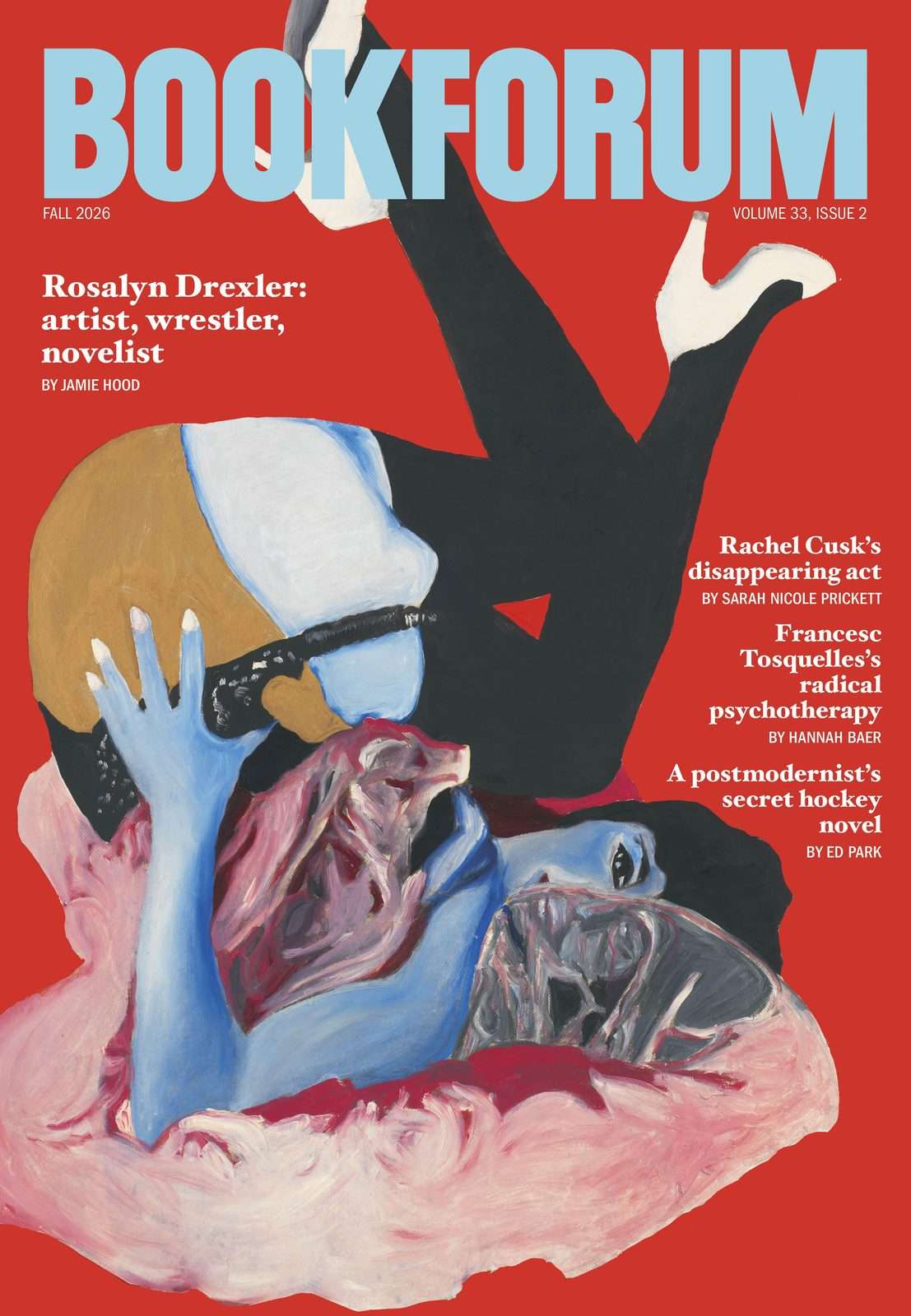
IN NINTH STREET WOMEN, her landmark group biography of Lee Krasner, Elaine de Kooning, Grace Hartigan, Joan Mitchell, and Helen Frankenthaler, Mary Gabriel insists that the power brokers of the mid-century New York avant-garde worked to refashion art as a macho enterprise. Until then, male artists in America were thought to be rather suspect: “elitist” at best, and homosexual at worst. The men of this milieu, then, transformed their sexual personae—better to be named “womanizer” than “fag,” after all—and started stockpiling cultural cachet and cheap Chelsea real estate. An aura of masculine libertinism permeated their ramshackle lofts and settled over the men’s painterly and sculptural practices. Women artists, meanwhile, weren’t even considered “worth discussing,” yet there they remained, indispensable, living and laboring and artmaking alongside the men, men whom they sometimes loved, men in whose shadows they often found themselves confined. Lee Krasner was married to Jackson Pollock and Elaine de Kooning to Willem de Kooning; until they split, Helen Frankenthaler and Robert Motherwell were known among their set as the “golden couple.” The women’s professional reputations, though, were smothered in the marital bed: they were wives first, artists second. “A wife!” Willem de Kooning told the assemblagist Edith Schloss. “Living with a woman all the time, it gets to be like this little machine in the basement, this little machine that goes tick-tick-tick all the time. It never stops going.”
By the time they’d have encountered Linda Nochlin’s 1971 manifesta, “Why Have There Been No Great Women Artists?” most of Gabriel’s women were in their late forties and fifties, some divorced, with vast bodies of work but Abstract Expressionism long in the rearview. Nochlin’s broad claims—that art history is ideological, that “genius” is a fiction conjured to consolidate the (white male) status quo, and that institutional scaffoldings are essential equalizers—sought to radically recalibrate canonicity and the frames of intelligibility through which we recognize art’s value. She imagined a world where this guiding query could set off a chain reaction, compelling paradigmatic metamorphoses across all disciplines. No longer would the response be an attempt to list or unearth “great” female painters or mathematicians or composers—I’m reminded of Tracy Jordan in 30 Rock asking Liz Lemon to “name a truly funny woman”—but to understand that the line of questioning is rigged from the jump. For its January 1971 issue, Artnews commissioned a series of responses to Nochlin’s provocation. Elaine de Kooning and creative polymath Rosalyn Drexler issued theirs as a joint dialogue. Both were wary of organizational strictures and taxonomic designations, this threat of exile to the cloistered ghetto of the Female Artist. What a laugh it was to presume that all women might share some sort of collective unconscious, a style of being in the world as women that unifies our vision or our art! As Elaine de Kooning remarked, “To be put in any category not defined by one’s work is to be falsified. We’re artists who happen to be women.” Drexler, though, tried prodding Elaine de Kooning toward a more materialist sensibility: a woman “as impetus to herself” may produce art irrespective of her social condition, but there have nonetheless always been gatekeepers, “people who manipulate the art-world” to benefit men when “they wouldn’t do this for a woman or, at least, not for many women.” Elaine de Kooning, Drexler confessed years after De Kooning’s death, “refused to acknowledge that women artists had a problem being recognized. She was married to the greatest painter of that age, which I think affected her perception.”
Drexler died in 2025. Her own aesthetic identity was less fixed, circuitously arrived at, and, ironically, has been largely effaced from the record. She was born Rosalyn Bronznick in 1926 in the Bronx, near Van Cortlandt Park, a self-described “nice Jewish girl” who broke out of the borough and onto the Upper West Side by attending the High School of Music & Art (now LaGuardia). She married at nineteen and became a mother at twenty, and it was about this time, as she told Frieze in 2017, that her education in art properly began. She and her husband, Sherman Drexler, were increasingly entangled in the downtown art scene, frequenting the famous Cedar Street Tavern in Greenwich Village, where Motherwell hosted a weekly salon and luminaries like Rothko, Guston, Ginsberg, Kerouac, and O’Hara were known to idle. Though he worked to support the family, Sherman Drexler had been trained as a figurative painter; Rosalyn Drexler, meanwhile, darted between found-object sculptures, overpainted collages, and figurative work of her own. Their friends were mostly mainstays in the AbEx movement—Rosalyn was especially close with Elaine—but the Drexlers were acquainted with Roy Lichtenstein, Andy Warhol, and George Segal, too. While lifting weights at Bothner’s gym on Forty-Second Street, Rosalyn was recruited by and briefly toured with a troupe of “lady wrestlers” under the alias Rosa Carlo, the “Mexican Spitfire” (that last bit was the troupe’s invention—Rosalyn figured it had to do with the perm she was sporting at the time). During her audition, the man in charge of the troupe asked if her “husband would allow” her to go. This “set me back a little,” Rosalyn recalled, “because I had never asked for permission to do anything.” Her experience wrestling proved fertile ground: Warhol did a silk screen of her in uniform for Album of a Mat Queen, 1962, and Drexler herself transfigured her stint on the circuit into the conceit of her third novel, 1972’s To Smithereens.
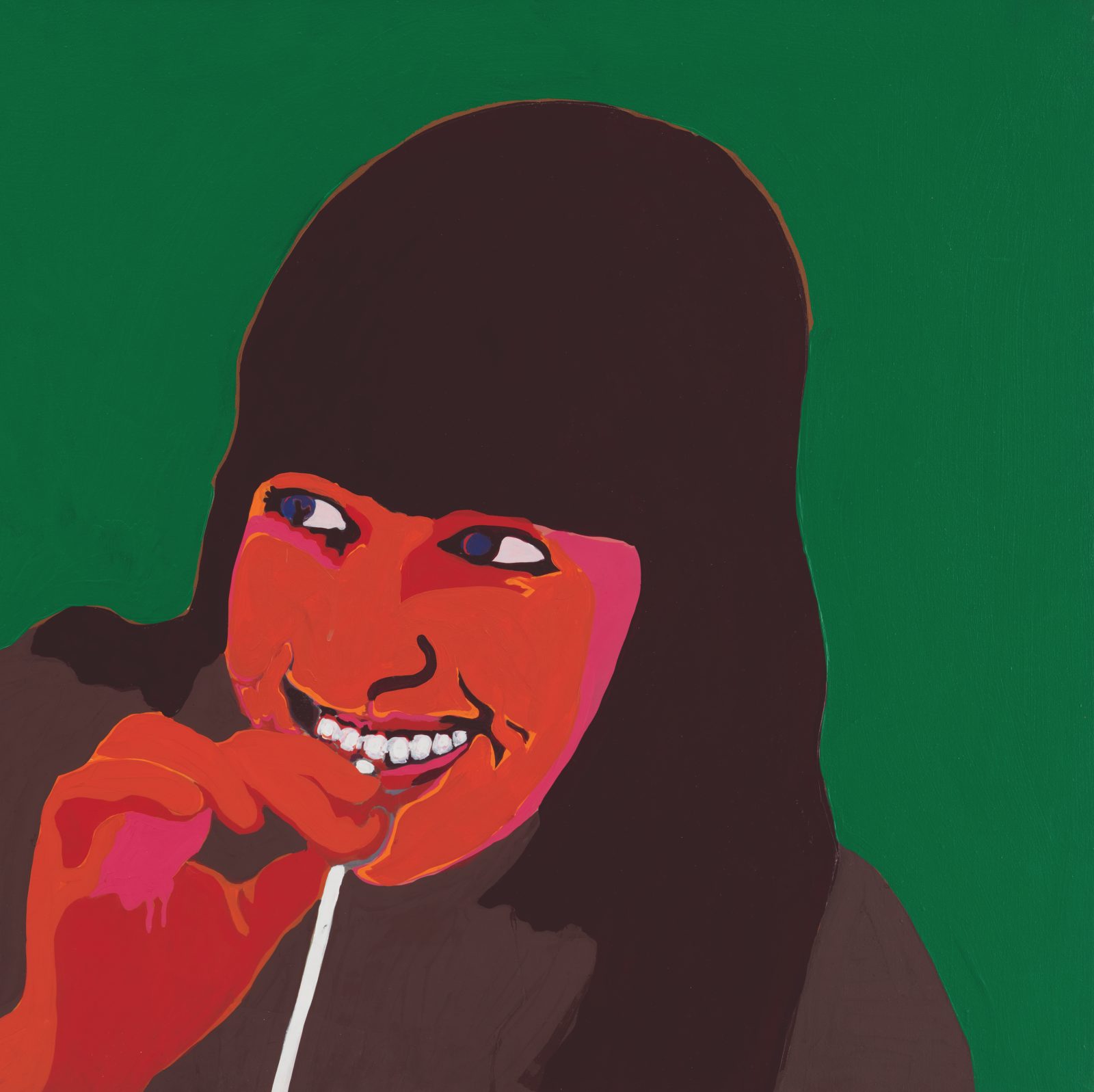
Though she worked across several media in discontinuous styles, retrospectives of Drexler’s visual art typically lump her with the Pop movement. As Barry Schwabsky has remarked, however, the Tom Wesselmanns and Lichtensteins and Warhols of the world appear “cooler in affect and far more refined in technique, [reflecting] the slick, shiny, appealing side of postwar consumer culture.” A Drexler tends to be a bit slapdash, more violently embodied. I was struck, at an exhibition of her work in SoHo’s Garth Greenan Gallery, by the pleasing imperfections of her figures, the fact that her women’s breasts and asses and thighs are sort of lumpy, casually or else seductively surfacing from garish garments. Her people generally appear unpolished and odorous; they look as if they fuck. The gallery featured Drexler’s notebooks, too; assembled inside them are daily jottings, news clippings, photographic and advertorial cutouts. On one page, the typed text “ARE YOU ASHAMED” interrupts a handwritten meditation on foundering book sales: “I am ashamed,” she admits, “as if it is my fault—important to sell, to get rich, to be out there . . . a force.” A force she surely was, but Drexler was also fringy and self-taught—her formal training, she joked, was coloring inside the lines of coloring books—while her conceptual attitude, as a woman among mainly men, had to be whetted from the outside in. A “woman artist” or otherwise, she ended up a kind of punk among the punks; her fixations leaned more narrative than those of her male colleagues and often oriented toward kinetic tableaux of womanhood’s tedious indignities, the menace and brutality undergirding heterosexual relations.
Yet her women are active agents, almost always in motion. Like the “tough dames” Drexler wrestled with, they not only acknowledge but also combat and redirect the energies of their victimization. Take a pair of 1963 works: Self-Defense, in which an incensed woman with an exposed breast bests her apparent attacker, and Marilyn Pursued by Death, a photographic collage in which we witness Monroe and Kermit Miller (usually misidentified as Monroe’s bodyguard) run from some unseen threat and into the blank, black end of the canvas. Drexler’s figures frequently creep past or fall beyond the perimeter of the frame; her visual field is a thrillingly leaky container. Unlike Warhol’s inescapable death mask of the superstar—her smile fixed, her life attenuated to its iconographic function—Drexler resurrects Marilyn as a vulnerable but self-possessed subject fighting to survive the rotten system that besieged her. (Arguably, Drexler’s figurative work parleys more animatedly with something like Willem de Kooning’s “Woman”series than it does with a smirking fantasy of American consumerism.) Drexler’s fiction, too, often finds her beguiled, rather than undone, by the hard bargains women strike with our experiences of subordination. As in the work of another Bronx native lately brought back into print (Elaine Kraf, a decade Drexler’s junior), Drexler’s heroines cultivate curiosity rather than terror when facing sexual debasement and patriarchal intimidation.
Make no mistake: in Drexler’s world as in ours, misogyny is physically and psychologically life-threatening, but it is also managed by her women as a matter of both fact and farce. Like Kraf, Drexler highlights the absurdity of hierarchical thinking, the cognitive dissonance required to live in a world where those in power compound rather than overturn inequality. For both novelists, the men who exploit and wound us are themselves understood as small, ridiculous figures, motivated by petty lusts and positioned as pawns on the same dreary, unjust chessboard. To Smithereens, for example, is drawn partly from Drexler’s life, but her protagonist Rosa’s inauguration into the wrestling world happens through a slightly different channel: she’s watching a movie in a theater when a man begins groping her thigh. She “whacks” him; he swoons; she takes him home, where he discloses his predilection for strong women and his desire to get her on the mat. Paul’s an opportunistic predator and general “creep,” but Rosa’s sort of into it. Besides, she isn’t cowed by his fetishization of her body or strength. It’s her strength, isn’t it, and his insistence on her power is another electric potentiality she has the capacity to harness. Despite Paul’s initial impression of Rosa as a bumpkinish “child-woman,” her interior life is funny, secretive, and fertile. She doesn’t have, she thinks later to herself, a “childish attitude toward sex.” She prefers the word “cunt”to “pussy,” is game for all manner of erotic experience. If she hates men, she’s uncertain about that hatred but knows for sure that she loves “being a woman . . . the regularity and rhythm of [her] periods, [her] connection to the ebb and flow of tides, to the moon before it was stepped on by men.”
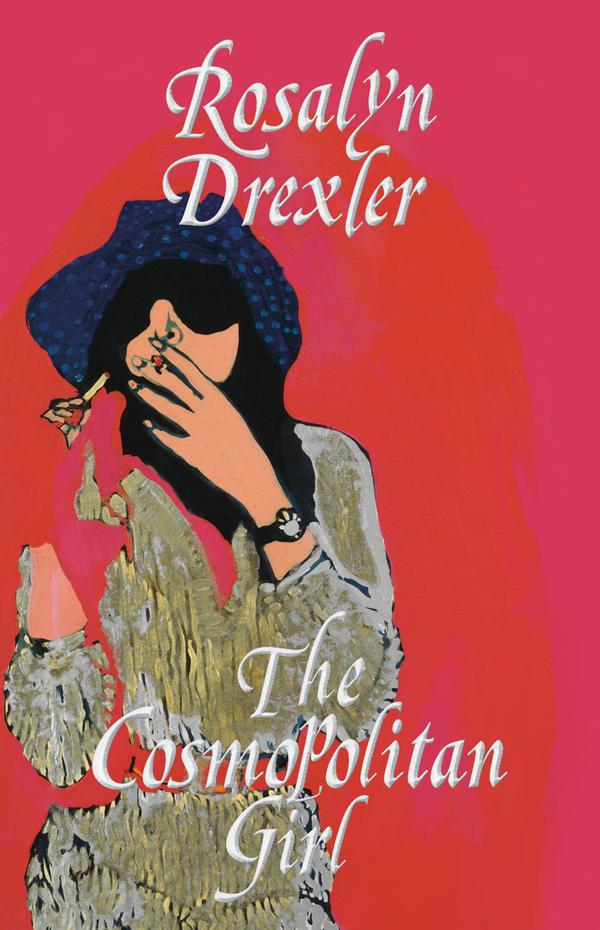
Five of Drexler’s nine novels were published in the 1970s, that electric decade of Title IX, Roe, and the ERA. Kate Millett’s Sexual Politics and Shulamith Firestone’s The Dialectic of Sex appeared in 1970, while the first stand-alone issue of Ms. launched in 1972. As was true for Henry James in The Portrait of a Lady and its reckoning with “the” Woman Question, Drexler encounters the eroto-political climate of peak Women’s Lib and asks: When granted sexual freedom, what will the modern woman make of it? The Cosmopolitan Girl, Drexler’s fourth novel and the second reissued by Hagfish, is a comic send-up of women’s magazines and sex-romp quest narratives like Erica Jong’s Fear of Flying. Helen Jones, the book’s jobless and erotically rudderless heroine, is indeed a Cosmo girl, and she lives by her interpretation of its “Anything goes” prescriptivism, which is to say she has faith that all choices and actions can prove right or good if committed to and defended with passion. The magazines Helen looks to as scripture treat female identity as a kind of belated reverberation of the images and products women are sold: “What I wear,” she tells herself, “decides who I am. I do what makes me feel good . . . but not always. It’s a hard rule to follow because sometimes I’m not sure what does please me.” Her mother Myra’s lover tells Helen that Myra, too, is “ambivalent, like all women. She doesn’t know what she wants.” On the surface, it’s a familiar Pop art critique—mass culture as the thing that precedes and produces the subject—but Drexler pushes into stranger territory. Consumerism in the novel is a stopgap measure, held alongside other ephemeral gratifications: occult philosophies, botanical healing solutions, bodywork, casual sex with guitar-strumming layabouts. Though Helen describes herself as “ordinary,” her longings are anything but: they are irreducible.
Drexler’s women are often bewildered, but they’re not vessels, and if female desire in her work is inchoate or elliptical, it is never insubstantial, never nonexistent. Freedom given to a subject not born with it can be mystifying, even immobilizing. The guidebook isn’t written; the shape of choice and its consequences has yet to be made clear. But Helen is trying, as she tells us when the novel opens, to “tie together the two aspects of my nature: the civilized and the animal.” She does this chiefly by choosing to embark on a romantic and sexual relationship with her talking dog, Pablo. Life, Pablo tells her, is exterior, it’s sensory perception: “fighting for territory, smelling another dog’s shit . . . pissing high on the tree trunk, and fucking a bitch. That’s what life is all about.” Pablo speaks like a man, walks upright like a man, and dons men’s clothes, too. By necessity, he spends his days in this disguise. The long-term-stay hotel where he and Helen live doesn’t allow pets. Pablo is also, like some men, energized by a selfishness so irrepressible that it drives him to degeneracy and outright criminality. A man, we know, may be a dog, but Drexler imagines a world in which (wo)man’s best friend is a fuckboy, a money-grubber, a thief, and a rapist. Helen falls for the hairy beast anyhow. He’s hardly worse than her human options among the Manhattan litter—a former athlete who gives her the clap, a pyromaniac who can’t get it up, and Joe Fafka, a bloviating talk-radio host and “authentic bigot.” In the eminently meme-able words of Donald Trump: many such cases!
Told in 145 plainspoken but narratively odd chapters, many as brief as a single line, The Cosmopolitan Girl is a restless, heteropessimistic picaresque, tracking Helen and Pablo’s relationship from his declaration of love on the first page to their menagerie-à-trois-style marriagewith Joe Fafka, whose help (and public platform) Helen petitions when Pablo vanishes at the novel’s midpoint. Their pair-bond, despite its unorthodox interspeciality and eventual turn to polyamory, degrades into perfectly banal rituals of boredom, neglect, and antagonism. Recalibrating straight romance through a foreign field, it turns out, nonetheless leaves all participants’ gendered conditioning intact. Even dog men, it seems, are from Mars, with all the masculinist and misogynistic baggage that entails. Helen perseveres despite Pablo’s moods and her anorgasmic experience of their sex—she loves him but loathes being fucked from behind—while he bristles against the romantic commitment to her he himself initiated. Though the novel’s premise is shocking, it is ultimately a dissection of the ways we fashion family and the compromises we make inside romantic and familial dynamics, particularly in historical periods when normative structures are being subjected to radical scrutiny. Helen’s divorced parents loom large over the novel, too: she feels tugged between their competing but similarly esoteric healing practices and residual resentments. “In everything I do,” Drexler told Frieze, “there’s something that I lived through, though I don’t really write autobiography.” In this same conversation, she remembered her earliest writings as having surfaced out of arguments between her parents: “In my poor childish handwriting, I wrote down every awful threat and insult. The next morning at breakfast, I handed the paper to my father, who tore it up and threw it down the dumbwaiter.” This taught her, she observed, the “strength of the written word,” even if it was unable to summon tenderness, respect, or love.
The Cosmopolitan Girl ends with Helen and Pablo once again united, having integrated Joe into their domestic world after cementing a contract detailing “equitably” nonmonogamous divisions of time, energy, and intimacy. But this “sexual freedom,” Helen finds, sours within the admittedly anomalous but inarguably sedimenting terms of their erotic agreement. Even an open marriage must function institutionally, and if the outline of their triadic life fails to resemble something as milquetoast as the wedded bliss of Mr. and Mrs. Cleaver, fucking under the sign of a properly marital union defangs their desire. Sex, deliberated on and dressed up in revolutionary garb, comes to feel “compulsive and no longer joyous.” Staring down the barrel of interminable sexual repetition—“We have tried every position together,” she laments—Helen feels that what she really longs for is solitude; like a monk, she yearns for a world in which she is, in the main, mercifully unbothered. In the Artnews dialogue she issued with Elaine de Kooning, Drexler—resistant in every regard to confinement—bucked against Nochlin’s call for institutional infrastructure and patronage. “Institutions and clear thought are opposites,” she observed. “The only clear thought one can have in an institution is—how do I get out?”
Jamie Hood is the author, most recently, of Trauma Plot: A Life. She’s currently working on her next two books—one a hybrid text on desire, sex work, and nonmonogamy, the other a novel. She lives in Brooklyn.