


THE BBC RECENTLY reported that Nigeria has the worst natal care in the world. “One death every seven minutes,” the headline dourly states. The reasons are as you would expect—poor health-care infrastructure and widespread insecurity, worsened by sluggish and ineffective government policy. Shortly after, the publication released an investigative report on scams in which illicit doctors inject desperate women with a “rare and expensive” drug that allegedly induces pregnancy, even though no fertilization could have occurred. Months after this injection, some women were sedated during “mock deliveries” and woke up with mysterious, cesarean-like incision marks on their lower abdomens. Others spoke of receiving an injection causing them to fall into a trance in which they believed they were giving birth. Taken together, the two stories form a violent tableau and a clear statement: in Nigeria, there is immense social pressure to have a child, and giving birth (or thinking that you’ve given birth) can lead to bodily harm, even death.
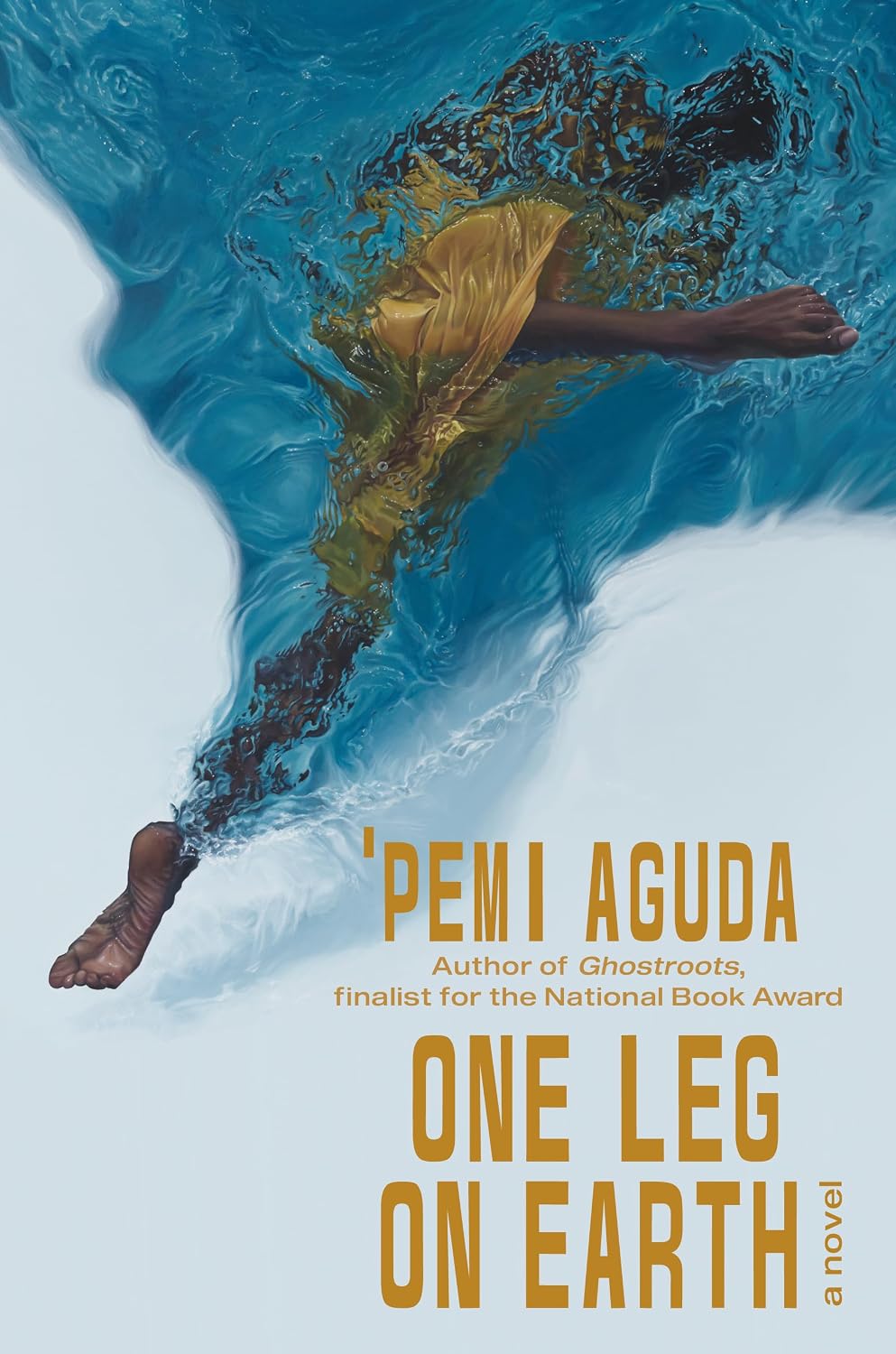
The view in Nigeria is different: pregnancy horror stories of the kind mentioned in the articles are taken as a macabre but expected part of life. These stories are frequently met with a degree of resignation, a shrug that says, “This is what it means to be a woman, to be a mother.” Refusal of these terms means rejection from the exalted club of motherhood. It is this glorification of motherhood—and the potentially gruesome results of becoming a mother—that the Nigerian author ’Pemi Aguda explores in bloody detail in her debut novel, One Leg on Earth.
The novel opens with a scene of domestic bliss. A pregnant woman, Miriam Aki, rides in a car with her husband. She has prayed for the “fruit of the womb” for thirteen years. Kneeling in prayer has caused her to suffer “thirteen years of chafed knees: blood and shredded skin staining church altars, her bedside rug, her mother-in-law’s living room tiles.” Long impatient years spent praying for a miracle, praying to end the side-eyes from women at her church and the malicious comments from her husband’s family. And then she conceives. At thirty-eight she will finally be a mother. We meet her reclining comfortably in the passenger seat of her husband’s car, basking in the full-bellied glow of pregnancy, while her husband frowns at the Lagos traffic. They are on their way to his cousin’s wedding, and the car, stuck on a bridge, hasn’t moved in twenty minutes. Miriam feels an “ugly joy” stirring deep within her and lets out an exuberant giggle. Suddenly she cannot stop laughing—much to her husband’s confusion.
She pushes the passenger door open, steps out of the car, kicks off her sandals, and wanders into the humid air—all the while ignoring the deadlocked drivers, who are staring at the spectacle, and her husband, who is calling out, “Miriam? What are you doing?” She moves recklessly, swaying, twirling. “She wanted to dance, to be free, to glide forward with the happiness surging from her womb, her baby.” She launches herself off the Third Mainland Bridge and into the lagoon below, while her husband shouts her name, unable to stop her from drowning. Miriam’s thirteen years of prayer end in a rapturous suicide, the mother-to-be leaping “like a child jumping into the arms of a beloved parent”—a sudden role reversal, an unholy baptism. She is born again in death.
It is an arresting opening, one that vividly establishes the tension between gritty realism and fantastical storylines in the ensuing pages, a fitting combination, given the context. After all, Nigeria is a country where young women are impregnated and held in “baby making facilities” against their will until they give birth, at which point their babies are sold on the black market. Aguda’s novel searches for a language capable of portraying the extremities of Nigeria’s birth culture, which appears at times as a kind of death cult propelled by a spiritualism that overtakes the bounds of science and logic. Aguda’s narrative is steeped in the symbolic, the subjective, the mythic. It does justice to the macabre stories about pregnant women that are passed around, to the experiences of mothers in Nigeria, who are beset by a need that goes beyond the body, a need that might cause one to ingest strange substances, or jump from a bridge, or purchase a “factory” baby on the black market.
One Leg on Earth is a novel about what it means to be a mother. It is less concerned with the daily struggles of motherhood—emotional estrangement from oneself and one’s child, the economics of keeping a younger being alive—than with the metaphysical: the idea that motherhood is a state of being that transcends the real, the tangible, the measurable. The title borrows language from a Biblical story. In the gospel of John, Jesus tells his disciples that they must be “in this world and not of it,” to have one foot on earth and the other in heaven, suspended between the physical and spiritual worlds. Aguda’s novel suggests that this is an experience common to all pregnant women: divine beings who, like God, can bring forth life. But unlike God, pregnant women are subject to the cruelties and injustices of this world that worsen the already fraught condition of motherhood.
After the opening scene, One Leg on Earth shifts the focus away from Miriam, but this pregnant woman’s suicide hovers over the rest of the novel like a ghost. In the second chapter, we encounter the book’s protagonist, Yosoye, in her cramped “self-contained”—the Nigerian term for “studio”—apartment on the mainland of Lagos. At twenty-three, a recent graduate, she has just moved to the big city, away from the sleepy town of Ibadan—where she grew up and studied—and from her withholding mother, Olabisi. When Olabisi calls, her photo appears on Yosoye’s phone, her “mouth slack, looking askance at something out of the frame.”
Yosoye calls it the “most accurate” photo of her mother, hence her favorite, because “this distractedness, the disconnection implied in a presented profile, was the truth of . . . Olabisi.” Her mother is not pleased with Yosoye’s decision to move to Lagos. Normally a “loose and languid” caretaker, she is adamant that “Lagos was a squat demon with horns, and the high-rise buildings were the pointed fangs of its open mouth, luring innocent people to fall down its throat.”
Yosoye was sent to Lagos by the National Youth Service Corps, part of a mandatory one-year service program for Nigerian graduates under thirty, and assigned to a fancy architectural firm, JKD, currently building a model “Omi City” on dredged land jutting out from Victoria Island. Omi City comes to represent both the false promises of urban regeneration and of Yosoye’s Lagos chapter: “On the map, [Omi city] was a seeking tongue protruding from the narrow bar of the old peninsula. A brave tongue pointing its tip into the vastness of the sea. Brave, because five years ago, all this was water.” Omi and Yosoye are linked in this way—both brave, both seeking.
Like all newcomers to a city like Lagos, Yosoye arrives hungry. The city’s unending chaos is enough to make anyone ravenous—not solely for food and drink, although she is initially lured out of her apartment by the “aroma of roasting turkey,” but for experience, adventure, the kind she could not have if she stayed at home under her mother’s absent-minded gaze and chastening instruction. She is after the recklessness, the fun, even the danger that Lagos provides and her mother warns against. She opens her mouth wide, demanding, “Give me. Give me!” Her hunger is first expressed sexually. While she is out at a local bar, a man approaches her and drawls, “Fine girl, may I join you.” Yosoye flirts back, surprised that the “script of a worldly woman” flows easily from her lips—“she who had always been a hesitant speaker, one who revised her sentences in her head over and over until her conversation partners repeated themselves, assuming she’d never heard them.” Lagos had already changed her. They leave together and head to a cheap hotel, where they have the kind of sex that for Yosoye is not about the man’s skill, not about the moment he complains about the condom and pulls it off, not about the “rhythmic smacking of his sweaty paunch against the inside of her thighs.” She is simply grateful he has stopped her from “retreating into the loneliness she was used to, the comfort of its grasping arms.” With him, she recognizes “the grander hypnotic feeling of being swept up in a current, dragged in the surge of a ravenous tide.”
One Leg on Earth is rife with water-based metaphors like this one. As the novel progresses, water becomes the presiding force—the phenomenon that every Lagosian, from the wealthiest to the poorest, is responding to or running from. Water gives life and takes it away. And the sea’s indiscriminate hunger pulls, like the tide, Yosoye into a larger story of yearning, water, and motherhood.
Aguda draws on ancient myths, art, and literature that equate women with water, and there are echoes here of Mami Wata—the mermaid, water spirit, and goddess of West, Central, and Southern African folklore, whose origins scholars trace to early encounters between Europeans and West Africans in the fifteenth century. In Nigerian popular culture she is typically figured as a seductress, drawing men to their deaths. But Aguda inverts Mami Wata’s historical association with female predation. In One Leg on Earth, the water’s temptations bypass men entirely. It is pregnant women like Miriam Aki and later Yosoye to whom the lagoon beckons, calling them toward a communion—with the unborn, with death, with something unspeakable and mysterious that precedes and transcends the known, living world. Yosoye is particularly vulnerable to this call, the push and pull of the water. She is all alone. Friendless, motherless, navigating this impossible city all by herself. Aguda addresses Yosoye’s defining character trait early: an enduring loneliness that comes to feel as much a character, as much a force in the novel, as the ocean itself. She is Lagos’s lonely mariner, searching for connection in an uncaring, truculent city.
IN ITS FIRST FEW CHAPTERS, One Leg on Earth reads as a standard realist novel about living among millions of young people in Lagos. Yosoye is surrounded by Lagosians on the move, working hard, taking buses and okadas to the commercial districts of Victoria Island and Lagos Island from the mainland ten kilometers east. Even the sex episode is a classic bildungsroman set piece: a young woman moves to the city, has her first sexual experiences. At her new job in the architectural firm, Yosoye endures the frosty welcome from “the den of designers.” The Architect, as he is ingratiatingly known, startles her during one of his rare visits as she nods off at her desk, asking bluntly: “Why do we need you? . . . My friends send me their children’s CVs every day, begging me to bring them on board. We don’t have to entertain this NYSC nonsense, do we, Gbenga?” She must justify her presence at the firm, earn her place in a city that extends no automatic courtesies to a woman like her.
The city’s shabbiness and its willful amnesia are rendered with precision: “a rubbish pile leaned against a kiosk painted in Indomie colours.” Gbenga, her manager at JKD, laments: “Lagos was better planned before. But when those military people in power moved to Abuja, they left a mess behind. Those fuckers sold parks to be converted to residential developments.” Lagos, Aguda writes, “seemed a city looking forward only, hustling forward,” a place so consumed by its own momentum that it has no appetite for reckoning with what it has destroyed or left behind. Aguda’s description of this world lends her novel not only exquisite and hilarious detail but also strange and unnerving elements. Her satire often tips into outright fantasia.
One day the firm’s sassy receptionist Adam sneers at Yosoye: “I heard they caught you sleeping. Abi, you’re pregnant? Ibadan girl don already chop Lagos prick! Come. Tell me. E long? E sweet?” She takes five pregnancy tests, all of which confirm that she is pregnant. Yosoye confesses to her college roommate Kitan, her only acquaintance in the city, a popular and glamorous girl who grew up in Lagos. Kitan offers: “My folks are doctors, and between them they know many people who can get you an appointment to end it in no time.” But Yosoye finds herself insisting that she will keep the baby, her choice springing from a loneliness Kitan cannot understand:
That’s what Yosoye had always felt like. A hollow outline of a person moving through space. White space as interior. It explained why people looked at her and looked away. Even when she was standing right next to them, she was always six feet away, because an outline had no mass, no grounding force. This baby was not a little dark spot inside that outline. Yosoye felt its weight. As it grew, she would be shaded in until she became a real person.
The baby is a way for her to inhabit herself, to take possession of her own body. It is a vision of motherhood that casts Yosoye as an outlier in more ways than one: she is young, unmarried, barely employed, and pregnant in a conservative, religious society. She is neither a feminist rejecting the strictures of motherhood nor a happily married woman ready to start a family. While existing outside the status quo should in theory intensify Yosoye’s loneliness, it does not. She now has a measure of embodiment and self-certainty she has never known before. The responsibilities of impending motherhood mobilize her to act and decide, casting off her habitual avoidance and fear.
Yosoye also finds herself drawn to stories of pregnant women drowning—women like Miriam Aki, whose names and suicides have been the subject of gossip in her office, in shops, and on social media. She rejects the premise of these stories—that pregnant women are likely to drown themselves—and she does not believe it will happen to her. Yet she can’t stop thinking about these women. They make their way into her dreams, in which she sees not one but “two faceless women, two bellies black with wetness.” They seem to be calling out to her, asking her to join them. When she wakes, she is sure she can smell the ocean.
If Yosoye’s decision to keep the baby reads like a radical act, it also makes her vulnerable to the forces urging the pregnant women of Lagos to jump off bridges. This tension begins to play out in the office when Yosoye finds a way to “add value” to the company. She puts herself forward as a copywriter, pointing out that an investor deck needs work if the firm wants to woo the Lagos big men. Gbenga gives her a shot—and it is to him that she confesses her pregnancy, in his car as he drives her home. His response is blunt: “What’s wrong with you girls? Don’t you care about your future?” But when the Architect learns of Yosoye’s pregnancy, he reacts with magnanimous wonder: “I was telling Gbenga how your news is a good omen! My grandmother—bless her soul—told me to respect the power of a pregnant woman. A woman is a god that should be worshipped. The aboyun, the pregnant person, exists in the space between the spiritual, the world of the unborn, and our own, the world of the living.” He asks her: “Do you feel in between?”
The Architect’s wonder at the in-between-ness of pregnancy is not entirely innocent. He likens her news to Omi City itself—“an opportunity to start again . . . new beginnings!”—but what he is really gesturing toward is the grandeur of gestating a city, of birthing greatness: “When his eyes pointedly dropped to her belly, it was an icy hand under her shirt. That look held something of pride and possession and awe.” Does Yosoye truly own her body, her pregnancy? Or is she a prop—a mute symbol that appeases the imaginings of a rich and powerful man, satisfies his patronizing benevolence, makes her into someone who can be managed, silenced, used, even disciplined for his own ends? The Architect plans to use Yosoye’s pregnancy to shape public perception of Omi City, hiding the dubious ethics and ethnic cleansing behind his latest venture.
One Leg on Earth asks: What does agency and power look like for a Nigerian woman—for a mother? Yosoye is beset on all sides: by a workplace that makes space for her as a symbol of its own prideful creation, as a manipulative gesture of benevolence, and by the spiritual world, manifested in the “drowned pregnant women”—the Ophelias of Lagos—who beckon to her in her dreams and dominate conversation in her office, in the news, and among the few acquaintances she has made. Her pregnancy makes her more visible to those around her, an interest that masks something horrific, even murderous.
Early in the novel Yosoye meets Beloved, a queer painter prominent in the city’s art scene. She is described as “a startling woman. Tall and bald in the midst of the gallery’s thick afros and butt-length weaves . . . one cheekbone stood high and sharp, the other was flattened, almost concave.” She takes an instant shine to Yosoye, wines and dines her, asks about her pregnancy, expresses her admiration for the suicidal pregnant women. One day she invites her to a penthouse studio in an Ikoyi high-rise—the most exclusive and expensive neighborhood in the city. Beloved makes a move on Yosoye, drawn to her pregnant belly—just as her “icy fingers drew light circles over the skin of her stomach, her small bulge, inches above her baby. Her tongue’s wetness sought and found the belly button.” Yosoye breaks off the encounter, having begun to suspect that her pregnancy is what Beloved is really drawn to—confirmed when Beloved responds: “You’re on the precipice of something magical. I find that very sexy. Sue me.” Beloved declares the drowned women “powerful” for “choosing to die. How. When. Isn’t that the ultimate proof your body belongs to you?”
Are these drowned women—and Yosoye by extension—powerful, independent agents, exercising sovereignty by jumping into the ocean, or are they being acted upon by some unearthly force? The question folds back into the experience of pregnancy itself. Yosoye reclaims her body by choosing her pregnancy; she is simultaneously beleaguered by the desires and projections of people who see her as an object that suits their fantasies of sacrifice, eternal goodness, newness, and possibility. Beloved presses, “What are you waiting for—you think there’s something special waiting for you in this life?” Yosoye’s response is disarming in its simplicity. She moved to Lagos to escape herself, to have a different fate from her mother’s, and what she wants most is to belong to someone. “I’m so hollow here, Beloved. . . . This baby is literally filling me up. My mum is always saying a mother is what’s real. When my baby comes, I’ll finally know what it is to be full, to be real.”
Beloved snorts at this hope: “A baby can never fill a hole like that.” Meanwhile, there is a broader cultural conviction that motherhood is the only true purpose of being a woman. Yosoye at first feels a sense of liberation as she navigates these opposing forces—then a sense of total entrapment. She hears the siren calls of the drowned women who visit her dreams and suffuse her tiny apartment with the smell of brine. The ocean is already calling. The choices, One Leg on Earth suggests, have already been made.
WE ARE USED TO THINKING of reproductive rights in terms of bodily sovereignty—my body, my choice—but that framework arrives in Nigeria already compromised. Abortion is illegal, except in cases of threats to maternal life, but when there is a pregnancy-related death every seven minutes, how should that threat be determined? The discourse around bodily autonomy is shaped by religious conservatism, patriarchal tradition, and a state that has never meaningfully protected women’s bodies in the first place.
The language of choice, in other words, was always thin on the ground. Aguda is interested in a further complication: not the choice of whether to continue a pregnancy, but the choices that emerge within it. What kind of choices can be made within a world that adores pregnancy and childbirth in the abstract and simultaneously shames, oppresses, and endangers the women who are pregnant? That world will always fasten even as it purports to liberate. Miriam leaping belly-first into the lagoon, Yosoye filling her hollowness with new life. Each woman is exercising something that looks like choice and may even feel like it, while the novel questions whether the conditions for genuine choice exist at all.
The drama of Yosoye’s pregnancy is set against the development of Omi City, the courting of high-powered investors, and the groundbreaking ceremony, which serves as the connecting thread between Aguda’s themes of motherhood and belonging and alerts the reader to the material conditions of Lagos itself. Omi City is a new birth. But it cannot fully remove itself from its bloody history. The people of Eti-Omi, a water-dwelling community whose homes on “stilts and bamboos rose like the strained arms of pallbearers to support homes with flimsy roofs that creaked in the wind,” were brutally evicted by the Lagos State Government, which sent “bulldozers and chainsaws and machete-brandishing policemen and thugs” who killed many of those who dared remain. Aguda was inspired by a trip from the US, where she currently resides, back to Lagos, where she interviewed members of the displaced Otodo Gbame community. In the novel, the architects refuse to acknowledge this founding violence. They have a similar response to the news that four pregnant women have drowned in the waters off Omi City: they suppress the story, fearful that the truth will unsettle investors or generate negative press. Yosoye is torn. She feels a kinship with these women, an instinctive understanding, but her job, even her survival, requires her to protect appearances.
One Leg on Earth is a book about who and what matters—about who is accorded precedence in a hierarchy of need. By the logic of JKD, the Eti-Omi people do not matter, and so their land can be taken and used at will. In the same breath, the bodies of pregnant women are declared to matter; motherhood is pronounced real, and sacred, as Olabisi repeatedly insists. But the poor, the marginalized—those who are not cared for or supported by the social world around them—do not matter. Aguda is thinking about what the dispossessed and marginalized do, feel, and think when they attempt to claim that they matter, to have agency and power. Such attempts are neither pleasant nor effective in One Leg on Earth. Yosoye’s effort to speak up for the drowned women falls on deaf ears, and she herself narrowly escapes drowning after she leaps into the ocean in the wake of an inquisition by the Architect. She ends up back in Ibadan, in her mother’s arms: “For the first time since Yosoye turned five, the women sleep in the same bed . . . their arms remember where to curl along each other. Back to chest, their hearts remember the proximity from the womb. Breaths sync. A mother is what is real.”
Aguda’s novel concludes not with a resolution but with an assertion of a claim—motherhood as the holy grail of womanhood—that the preceding chapters worked to undo. Yosoye struck out alone in Lagos and has returned to a womb-like space, safe and nurturing. She is enveloped back into her mother. Away from their home in Ibadan, in Lagos, “the women continue to jump.” When men form vigilante groups and attempt to stop a woman from jumping, she asks, “Why should I stay?” And the men? “Well, they have to think about it, think about the world they’re convincing her to stay in, they have to think about what they have to offer her and her child.” What is that world? the novel asks. A world where mothers are real and desired, but the conditions of mothering could not be worse.
Gazelle Mba’s work has appeared in The Nation, The London Review of Books, and The New York Times, among other places.