


THE FRENCH MARSHAL Ferdinand Foch, it is said, paced his headquarters in the early hours of November 11, 1918, waiting to hear whether the German plenipotentiaries had agreed to a cessation of hostilities. If they hadn’t, he was prepared to order the Allied troops under his command to advance into German territory. At 5 a.m., the verbal agreement came through, and before 6 it was signed, after which Supreme Allied Commander Foch turned to his aides and said, “Let the armies stand at rest. The war is postponed for twenty years.” There is a more familiar version of this quote, recorded by Winston Churchill in his memoirs, in which the scene has been transposed to the signing of the Treaty of Versailles in June 1919, and Foch declares: “This is not peace. It is an armistice for twenty years.”
Foch’s famous line may be apocryphal, but his statement, made up or not, has the veracity of a truism. The rule of modern Europe is not peace or war but interwar, a perennial preparation for the coming cataclysm that, to paraphrase Marx, will be both a repetition and a farce of the previous one.
The resurrection of Germany from the ashes of the Second World War was a story written by the Allied victors to repudiate this interwar thesis. The new Europe, bound together militarily by NATO, economically by a scheme of free-trade agreements, and socially by a revived continental identity that supersedes the national allegiances of the past, would never see war again. Blood and soil, Lebensraum, revanchism—these were things of the past. They reinforced this narrative even as new battle lines were drawn for the Cold War, which might at any point turn hot.
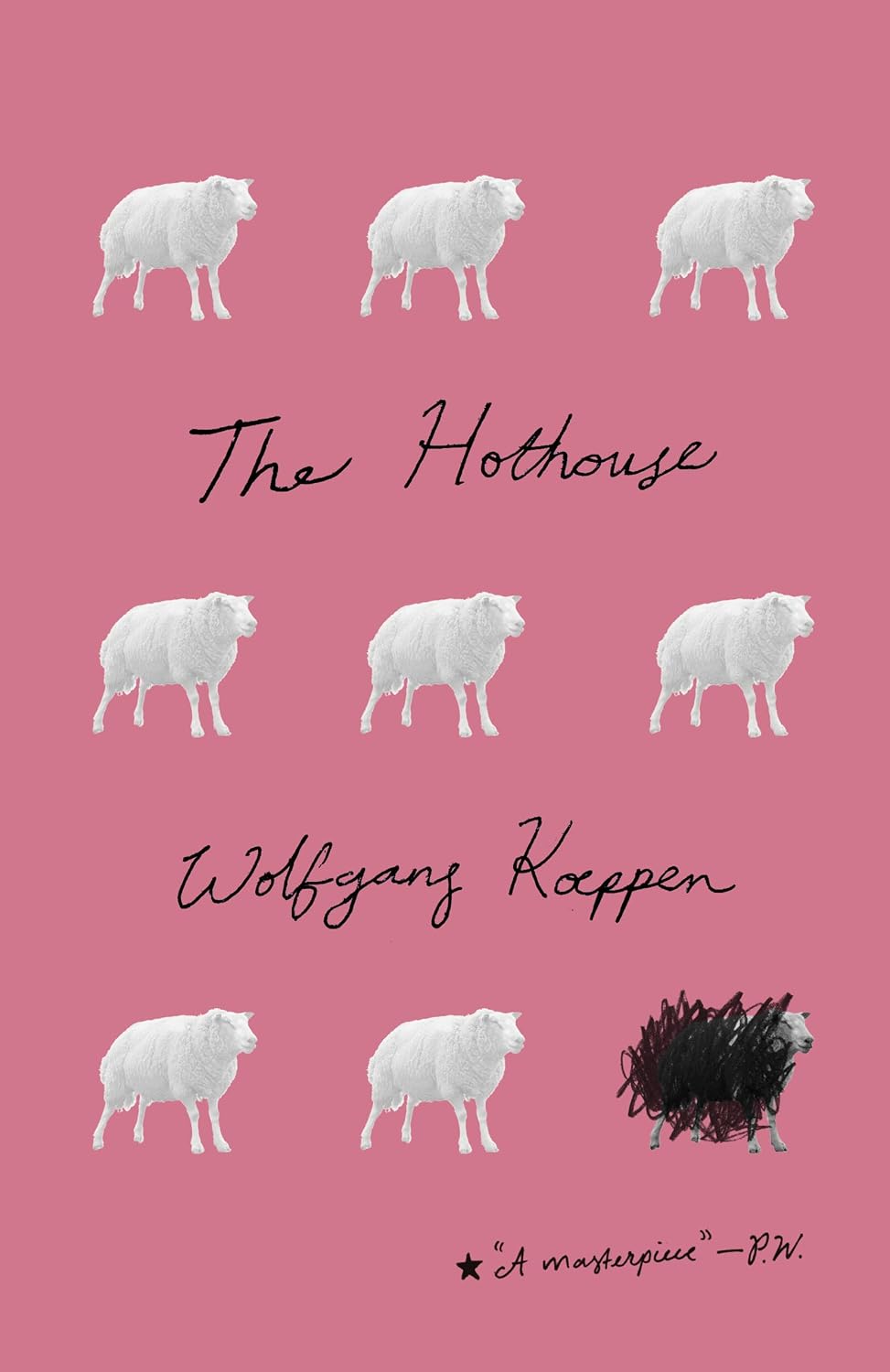
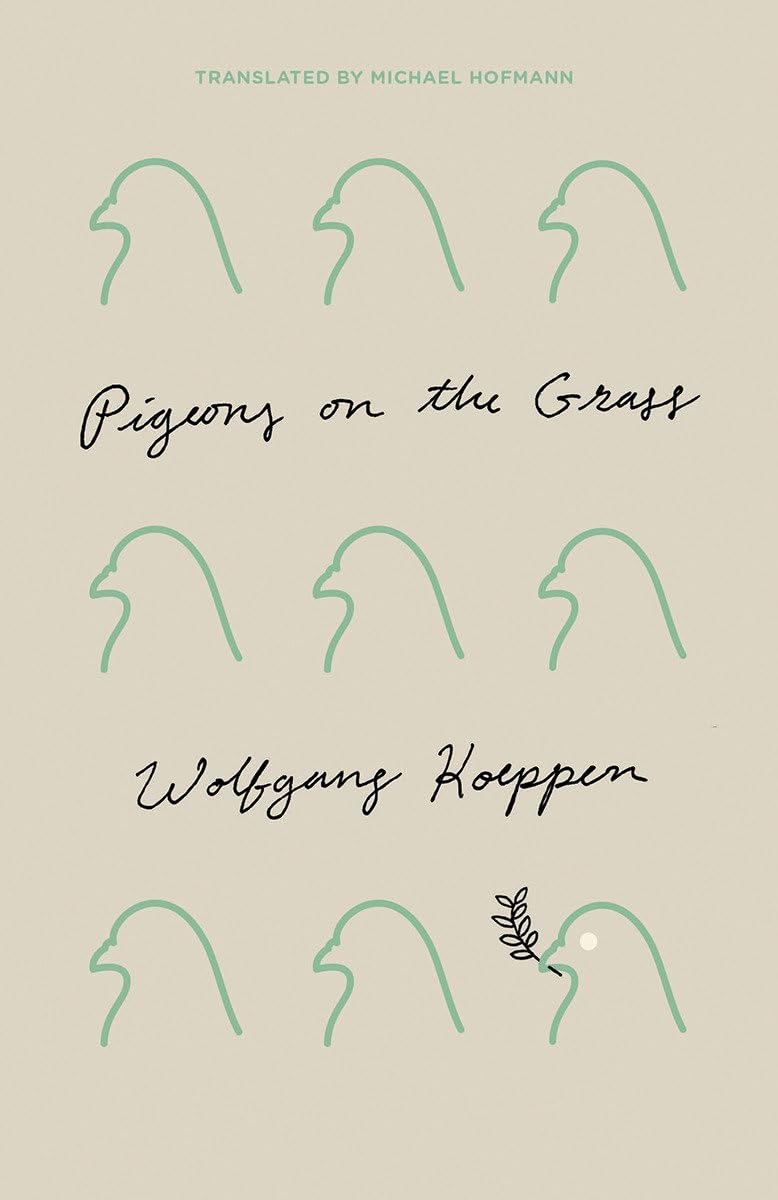
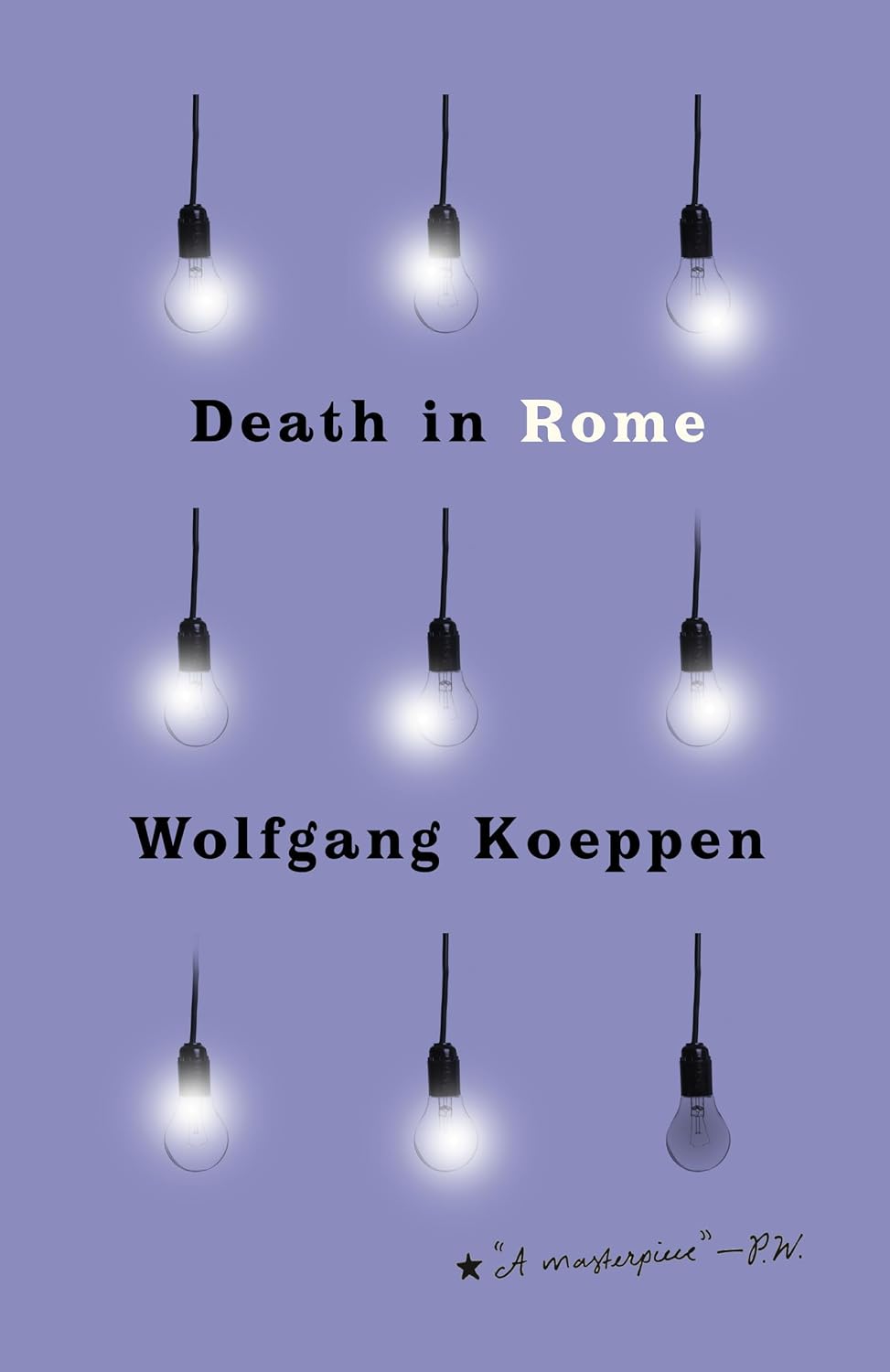
Wolfgang Koeppen was among those who understood the victors’ story to be a con. It was a form of wishful thinking that denied the abiding penchant and preparation for war in the present, and also protested too much about the degree to which Europe—and to be specific, Germany—had changed. A writer of intermittent productivity, Koeppen lived through the war and the mythmaking operation that foamed in its wake. In the early 1950s, just as the Federal Republic of Germany was laying the groundwork for its reconstitution as a military power, Koeppen published a spree of novels, often called the Postwar Trilogy, which are really an interwar trilogy: Pigeons on the Grass (1951), The Hothouse (1953), and Death in Rome (1954). These books, which were unanimously snubbed and snuffed in the press when they emerged (one critic exclaimed that they were “not to be touched with a barge-pole”), excoriated Germans for their willful amnesia over their world-historical crimes. As he watched his countrymen eagerly move on toward what they dubbed a brighter future, Koeppen worried that they had not adopted the correct emotions in regard to the past, in part because they refused to linger with its lessons. Where he expected indignation at the very least, they evinced optimism.
For Koeppen, the point of acknowledging Europe’s interwar mindset was not to have us admit that peace is unreal but to break a cycle that made peace impossible. The interwar situation was a symptom of substituting the rhetoric of reformation for the much harder work of autopsying the past. Though they share neither characters nor settings, the novels of his trilogy have the same aim: to tear down the notion that Germany was on a new course. “The cards were shuffled again,” laments Keetenheuve, the protagonist of The Hothouse. “The game was on once more. The same old game? The same.” Gottlieb Judejahn, a former Nazi general whose existential crisis is in part the subject of Death in Rome, wants only “to keep the threat of war alive.” To him, the fall of the Reich was merely a zag in the jagged trend of Germany’s racial progress. “The embers of war kept glowing. Maybe one day a spark would fly and reignite the world.” Set in a still rubble-strewn Munich, Pigeons on the Grass opens ominously with airplanes, “birds of ill omen,” which hover over the city, as if there were more yet to bomb. By the novel’s end, we are left to wonder whether anything has changed: “In the sky, the planes are droning. . . . The old bombproof bunkers have been blown up; the new bombproof bunkers will be built deeper and better.” Better for what?
KOEPPEN WAS BORN in 1906 in the Baltic port of Greifswald and raised in East Prussia. After a year of theater work in Würzburg, he drifted to Berlin in the late ’20s, hoping to apprentice himself to Brecht and ended up writing feuilletons for the daily paper Berliner Börsen-Courier. His first two novels, Eine unglückliche Liebe (A Sad Affair, 1934) and the still-untranslated Die Mauer schwankt (The Tottering Wall, 1935), were published in Berlin by Bruno Cassirer Verlag, a Jewish-owned house. Both books were banned in 1936, and Cassirer Verlag itself was suppressed by the regime in the same year. Koeppen had left for the Netherlands in 1935, in his own telling an act of dissent alongside liberal-minded friends, though others suggested that he moved to avoid the consequences of having had an affair with an SS officer’s wife. He returned to Germany before the war and survived it in and around the Nazi film industry, working on projects nobody produced: “I sheltered, I made myself small, I went Eulenspiegel’s way.” (Till Eulenspiegel is the trickster figure of German folklore, who can slip his way out of the hairiest situations.)
Were he a French writer working in German-occupied Paris, rather than a German one in the Nazi capital, Koeppen would easily have been judged a collaborationist by those leading the postwar purification. He could have stayed away from Germany after his move, as many Germans in his position did. He had no dependents to look after, no business to protect. Yet he returned to Nazi Germany. His translator, Michael Hofmann, perhaps generously chalks this up to a character flaw: Koeppen lacked “the brute necessity required to make a go of things in exile.” I suspect that he didn’t believe his friends’ most dire predictions about Hitler, and that his later insistence that Germans were unwilling to confront the national character flaws that led them into Nazism doubled, unconsciously, as a challenge to himself and his own baffling choices.
Toward the end of the war, with Berlin teetering on the brink, he fled to Munich, where he lived for the next five decades. In 1948 he ghostwrote the Holocaust memoir of Jakob Littner from the survivor’s own typescript, a literary act later reclassified, when Suhrkamp Verlag reissued the book under Koeppen’s name in the ’90s, as something closer to appropriation. That same year the publisher Henry Goverts commissioned what would become Koeppen’s Postwar Trilogy, which was completed in 1954. Koeppen did not publish another novel. He produced three travel books (on Russia, America, and France) between 1958 and 1962. And more than a decade later, in 1976, he put out a semi-autobiographical narrative, Jugend (Youth).
Everyone hoped that Koeppen would repeat the success of the trilogy. Marcel Reich-Ranicki, his editor at the Frankfurter Allgemeine Zeitung and the country’s most powerful literary critic, organized a covert subsidy from Max Frisch, Heinrich Böll, Günter Grass, and Siegfried Lenz—disbursed monthly from a bank account code-named “Reference Grass Pigeon”—to keep Koeppen going. Suhrkamp, his publisher from the late ’50s on, paid him a retainer for years and brought out his collected works in 1986. Nothing came of it. Koeppen died in Munich in 1996, almost ninety, in his apartment on Widenmayerstraße above the river Isar.
Yet we should not lament the fact that in Koeppen’s life, as Hofmann says, “writing was the exception, not the rule.” His three novels were among the earliest to capture the transformation Germany underwent in order to refashion itself from the outside, willing that the superficial changes would seep their way inward, updating its uniforms (they “were now olive-green instead of brown, black, and field gray,” he writes in The Hothouse) without changing the men inside them (“it didn’t even occur to them to change”). That Germans behaved as if the same horizons of war stretched out as before, yet professed the opposite, was not a contradiction for Koeppen, but the logical consequence of existing in a state of denial. For this reason, once the so-called Group 47 authors—including Heinrich Böll, Günter Grass, and Ingeborg Bachmann, who were all a decade or two younger than Koeppen—hit the German literary scene in the ’50s and ’60s with their clear-eyed dissections of postwar German culture, Koeppen was proclaimed their precursor.
PIGEONS IN THE GRASS UNFOLDS over a single day in occupied Munich in 1948, told in more than a hundred fragments that hop among some thirty characters and splice in news headlines, scraps of song, and radio chatter. It is often compared to John Dos Passos’s Manhattan Transfer and Alfred Döblin’s Berlin Alexanderplatz, both of which attempt to represent the information-saturated, jump-cut chaos of the modern metropolis. But Koeppen’s Munich, counting few more than 800,000 inhabitants, is not the equal of Jazz Age New York or Weimar Berlin, and by his formal strategy Koeppen clearly intends something different from his forebears. The vignettes that make up Pigeons refuse, ultimately, to cohere. They remain a heap of blasted shards. It is as if Koeppen were refusing postwar Germany a coherent story, a narrative arc that would allow it to speak of past, present, and importantly, future.
The day’s one sustained companionship is between Odysseus Cotton, a Black GI just off the train with a “musical suitcase” under his arm, and Josef, the bent old porter he hires to carry his bag. The suitcase is a portable radio: it streams Bahama Joe through the streets and, as the hours pass, bulletins from Persia and Cyprus. Josef makes out identifiable bits of the broadcast: “Truman Stalin Tito Korea.” The specter of the next war travels with Odysseus, piped into a city that believes itself at peace. Josef, meanwhile, is a cipher for the German experience since before the Great War.
The other lives glance off one another without connecting: Philipp, the blocked writer who is Koeppen’s nearest self-portrait, and his heiress wife, pawning the last of a bombed-out fortune; American schoolteachers on tour; a young German secretary who wishes to abort her child with a Black American soldier; a “nerve doctor” selling his blood for money; a film star playing an archduke; and a German-American airman who contemplates his allegiances. They converge only once, near the end, at a lecture by a visiting T. S. Eliot–esque poet on the deathless soul of the West—held in a hall the Nazis built, and slept through by nearly everyone there. The one scene that might gather the book into meaning, offering the grand consoling story of Europe, ends bathetically. It ends with everyone literally missing the point.
The novel’s patchwork is stitched together in a manner that seems to promise eventual unity, a great zooming out that will reveal the beautiful quilt. Not only do many of the characters keep passing one another, without realizing it, on their journeys through the city, but formally, too, Koeppen links their stories by braiding the language he uses to narrate them. As Philipp’s wife slinks her way across town to the pawn shop, one of her sections ends: “I’d better hurry to catch the green light.” The next sentence after the line break brings us back to Odysseus Cotton and Josef: “The green light. On they went, Bahama Joe.” This sort of Oulipian word game—beginning one section with “Lying about gossiping” because the previous one ended “and he thought, layabouts”—gives one the feeling that all of these characters are unwittingly connected by some greater plan, a common grammar.
But beyond the novelist’s plan, it turns out, there is nothing. As his characters attempt to scrape together new lives and, like Philipp, write new stories, Koeppen shows them repeating the tics and patterns of thought from before the war. There are curtains “printed with a Bauhaus pattern,” musings on Heidegger, Schrödinger, Proust, and “Sartre’s nausea,” a pervading obsession with oil (“out of the arteries of earth”). Frau Behrend, the wife of a trumpet major, says of the few Jewish people who had managed to survive and return to their home in Munich, “Those were the dark-haired people who spoke hardly any German, undesirables, aliens, flotsam.”
Even what is nominally new, that there are Americans everywhere—Americans in their uniforms, Americans in their shiny cars, Americans with their broad shoulders and canned foods—devolves into the same old. The novel ends with a pogrom, not against Jews but against the Black American soldiers and their Negro club in the city. A crowd of people stones the club, seeing it as a “symbol of defeat” and shattering its windows. Never a Kristallnacht again? “The older ones among them felt themselves reminded of something; they felt themselves reminded of another blindness, of a previous action, of other shards. It had all begun with shards, and it had ended with shards.”
ALL THREE NOVELS ARE SET during the “economic miracle” in Germany, a period of substantial growth spurred by currency reform, tax cuts, the abolition of price controls, and the extension of Marshall Aid in 1949 to the newly founded Federal Republic. The foreign policy debate that defined this era was that of rearmament. Should West Germany stay out of the Western alliance and remain neutral, keeping reunification with the East within reach—or join NATO, rebuild an army, and in doing so seal the division of the country?
The absurdity of this debate is best captured in The Hothouse, a novel populated in part by characters whose names, in an echo of Kafka, begin with “K” and seem like fun-house-mirrored shards of the K-named author himself. The Hothouse takes its title from its setting: Bonn, the ersatz capital, is an airless city where everything, as the protagonist Keetenheuve thinks late in the book, is “as unreal as flowers in a hothouse.” Keetenheuve, a mild-mannered MP and a pacifist of the official opposition, is returning to Bonn for a parliamentary session on the question of rearmament. He is a man at sea: he is mourning his young wife, Elke, whose recent death makes him the subject of pity; he is repeatedly inflamed by a sense of principle and duty, only to be pulled back to the comfort of inaction by his lack of courage; he worries about the direction his country is taking and yet, despite his station, feels powerless to do anything about it.
In fact, he is powerless, not only because of his weak constitution, but because such a person has no salience in the Federal Republic. He is a man with his nose pressed to the glass of the hothouse, not one of its many exotic plants. What the book stages, across two days, is the impossibility of his dissent and of dissent as such in the restored republic. To admit his perspective would be to acknowledge the conditions of the hothouse: none of this is natural. The governing party offers Keetenheuve the embassy in Guatemala, a barely disguised move to get him out of the way, but the bribe turns out to be redundant, since nothing he might say would alter the outcome of the debate. His objection to rearmament is a moral one—why accept, as settled, that Germany must have an army at all?—and the chamber has no mechanism for hearing a moral objection. “Not even a Demosthenes,” he understands, “could succeed in changing the policy of the government in Bonn from the opposition benches; even if one spoke with angels’ tongues, one would be preaching to deaf ears.” Koeppen plays with our hope that Keetenheuve’s sanity might finally break through. The narrative builds to his speech in parliament as if it will be climactic. He makes the speech; it changes nothing; the vote is lost. It is no surprise that, in the end, such a character, who has found himself in the wrong play, must kill himself. Stripped of any delusions of use, Keetenheuve walks to the bridge over the Rhine and goes over the rail. Koeppen’s last sentence refuses him even tragedy: “The delegate was utterly useless, he was a burden to himself, and a leap from the bridge made him free.”
Death in Rome is more generally and trenchantly concerned with the meaninglessness of German lives in the postwar period. Koeppen takes aim at a broad array of malefactors, not only would-be socialist reformers, but also and especially those who still cling to the dream of National Socialism, or else to the possibility of forgetting it entirely. The novel follows two brothers-in-law (their wives, who barely feature, are sisters), Gottlieb Judejahn and Friedrich Pfaffrath, and their respective sons, Adolf Judejahn, and Siegfried and Dietrich Pfaffrath, as the lot of them descend coincidentally on Rome for various reasons. Friedrich, who made his name as a bigwig in Nazi Germany, and who has since been reformed as the chief mayor of his town in the Federal Republic, has gathered a welcome party of Germans in Rome in a bid to bring Judejahn back into the fold. Whether this is more than wishful thinking is unclear: Judejahn, one of the most important generals in the Nazi military, has been believed dead; he was sentenced to death in absentia at Nuremberg and has been hiding out in “the desert” ever since, working to train the troops of an unspecified Levantine nation to destroy the fledgling State of Israel. Judejahn, a barrel of a man, would still like to hunt down every last Jew, even as his wanderings around Rome cause him to lust, confusingly, after a number of suspected “Jewesses.”
The multigenerational setup of this novel bears an implicit question: Are sons doomed to repeat the crimes of their fathers? There is a literal death at the end of the story, but the death Koeppen invites us to anticipate is that of the worldview of the fathers. Both of them struggle to understand the life choices of their children: Adolf is training to become a priest, and Siegfried is at the beginning of his career as a composer of twelve-tone-inspired symphonies. Only Dietrich Pfaffrath, the youngest, seems interested in becoming a real German like his father. For Adolf and Siegfried, their choices of profession represent two traditional strains of German culture—theology and music—that have remained salvageable after the World Wars. In them, the sons (and the reader) look for the ingredients of a German future that is not in denial about its past. But as with Pigeons and The Hothouse, Koeppen deflates our hopes at the final moment. As the characters converge on a performance of Siegfried’s symphony, which receives a standing ovation and perplexes both fathers, there is a moment when it seems that this aesthetic experience might have changed them. “But now, in this transfiguring hour of the night, [Pfaffrath] asked himself whether Siegfried and his symphony hadn’t sought the better home, and whether the notes jarring in Pfaffrath’s ear hadn’t held a dialogue with his own youthful soul.” But by the next morning, the winds of change have ceased to blow. Not even the well-meaning youth can counterbalance the weight of Germany’s unreckoned-with past. From his hotel window Judejahn catches sight of Ilse Kürenberg, the Jewish wife of the symphony’s conductor and the daughter of a man his family had helped murder, and shoots her dead with an arms dealer’s pistol.
THE DELIGHT OF THESE novels, whose verve and syncopation are well preserved in Hofmann’s translations, is that they don’t mind indulging in puns, low humor, and slapstick. At an important meeting, Keetenheuve tucks uneasily into a dish of Beefsteak Esterházy, wondering, “What had Esterházy ever done to cooks, to make them name all scorched onion dishes after him?” In Death in Rome, Judejahn wanders through the Castel Sant’Angelo and takes a shit in an old torture chamber. Koeppen’s fiction attests to a belief that momentous events are the sum of trivial ones. For this reason, perhaps, the news media pervades all three novels both thematically and stylistically. Keetenheuve keeps a running list of possible epithets that might appear beside his name in newspaper headlines: “Keetenheuve industrialist, Excellency Keetenheuve, Sir Keetenheuve Knight of the Realm, Keetenheuve traitor, well-intentioned Keetenheuve.” In Pigeons on the Grass, the narrative itself is intercut, in the manner of Surrealist collage, with real news clippings: “Superbombers stationed in Europe.” In fact, in all the novels, dailies serve to bring disparate characters together—Philipp is commissioned to report on Edwin’s talk for the local paper, an explosive article about France and the UK’s plans for the Federal Republic presents a political opportunity for Keetenheuve at the debate, and a profile of Siegfried in the Roman papers makes both his presence and his upcoming performance known to his family. Pigeons on the Grass ends with the newspaper editors who set the banalities of the day into permanent record, the so-called first draft of history: “Whatever that day had happened, been said, lied, murdered, and destroyed, lay set in lead like a flat flan on the trays of the typesetters. The flan was hard on the outside, and slippery in the middle. Time had baked the flan.”
How is the flan to be eaten? All of the novels would seem liable to offer an answer. A return to Nazism, to the worship of Wagnerian heroes such as Siegfried’s namesake, is obviously untenable. But the available ways forward also seem tragic, so long as Germany continues to profess its new character. They are tragic because they are not actually new. Like the modern buildings that have been put up in Munich in the “worst-affected” areas, they are all “tidied, ordered, plastered over, freshly rebuilt, and for that very reason so horrible, and so infirm.” Complete revolution, the old third way through such impasses, is also no longer tenable. To Keetenheuve, “the revolution was dead. . . . It had had its time. Its possibilities had not been investigated. And now it was a corpse.”
It’s not clear that Koeppen provides a satisfying way forward. Above all, he seems to want to universalize among all Germans the fury he feels with respect to his fatherland. The epigraph to The Hothouse quotes Harold Nicolson: “If we are unable to feel indignant at a great injustice, we will never be able to act righteously.” The central struggle for Keetenheuve, as well as for both Adolf and Siegfried, is that of channeling indignation. Keetenheuve cannot rise to the challenge. The boys in Rome have at least gotten as far as using their indignation to reject the way of their fathers. But the negative gesture must be matched by an affirmative one. Through his art, Siegfried comes closer than any of Koeppen’s characters to bringing something generally new into the world, something not infirm but vital, an Everlasting Yea to complement his absolute rejection of both his father’s and his uncle’s Germany. But Koeppen dashes even this hope. To the ears of Ilse, likely one of the few Jews in the auditorium, Siegfried’s vitality is actually mortality: there is “too much death in those sounds . . . a Northern dance of death . . . a perverse dedication to death.” Siegfried knows he has somehow failed and can only retreat into himself. “I had dreamed of a pure creation . . . my wings broke before they could fly.” He is confirmed in the worry he articulates to Adolf before the show: “It already seemed to me that Germany was past changing, that one could only change oneself, and everyone had to do that for him or herself, all alone.”
“A LONG TIME AGO,” wrote the late historian Carlo Ginzburg, “I suddenly realized that the country one belongs to is not, as the usual rhetoric goes, the one you love but the one you are ashamed of.” The Postwar Trilogy might best be read, paradoxically, as Koeppen’s love letter to Germany. After all, he chose never to leave his fatherland, and critique is often a form of care. Keetenheuve, despite his impotence and meaninglessness, cares deeply about the future of his country. His worry is not merely that Germany might repeat its past, but that it might slip outside of history entirely—that it would cease to generate a space of experience in which it recognizes its former self, and a space of possibles into which it can project itself.
In a world of permanent interwar, “why was there history?” Keetenheuve asks. Why insist “that history was still being made,” if it is only “so much clucking over no eggs,” that is, if the history you write and make produces no ethical lessons, no impulses for a new way of being? “The showdown in the plenary session affects everyone’s lives, can mean everyone’s death,” he exclaims to us, and yet there are no “rapt onlookers” in the chamber, whereas “there’s tension over the stadium in Cologne” and in Dortmund, where soccer teams are squaring off, and “twenty thousand spectators are trembling.” The public is impotent, narcotized. The culture industry is roaring ahead. The lit window of Keetenheuve’s office gleams in the night like “the eye of the dragon of legend.” But the dragon “wasn’t watching over any princess. It wasn’t guarding any treasure.” The ethno-national legend of Siegfried serves to paper over the truth: that Germany is no more than an enfeebled constitution seeking a reason to fight.
Last year, the German government amended the Basic Law to remove a debt block, enabling the country to increase military spending to such a degree that Germany now has the fourth largest defense budget in the world, just behind Russia. Billions of dollars in armaments have flowed from the Bundesrepublik to Ukraine, appeasing a jingoistic appetite that would see Europe march into nuclear warfare. For the first time since it was put into abeyance fifteen years ago, conscription is back on the table. “Let’s admit that we’re given to seeing conflagrations, and we will learn from the fears of the others that our own fears are delusory, and we will have better dreams in the future,” Keetenheuve thinks. “Let’s not set up any more global fire brigades.” But then where to start? “Let’s all just say ‘the world isn’t burning.’”
Ben Libman is the author of The Third Solitude: A Memoir Against History (Dundurn, 2025). He lives in Paris.