


IN JUNE 1964, Peter Bogdanovich and his wife, all-purpose helpmate, and eventual creative partner, Polly Platt, left New York City and took a three-bedroom house with a yard in the San Fernando Valley, not far from the Van Nuys Airport. The idea was to get into the movie business. Then twenty-four, Bogdanovich had directed some Off-Broadway shows; curated retrospectives of the films of Howard Hawks, Alfred Hitchcock, and Orson Welles at MoMA and written accompanying monographs; turned out scads of program notes for Dan Talbot’s New Yorker Theater; and filed several pieces for Esquire magazine, through which he had made the acquaintance of Tinseltown royalty like Jerry Lewis and John Ford. A year into his stay out west he began a daily diary and kept it up until May 1971; in this stretch the couple greatly expanded their coterie of friends in the industry, Platt gave birth to two daughters, and Bogdanovich directed two full features (with crucial contributions from Platt on both) and began an affair with Cybill Shepherd, the star of the second one. By the time he and Shepherd moved into an apartment in the Sunset Tower, his The Last Picture Show (1971), though months from release, was already one of the most talked about films of the year.
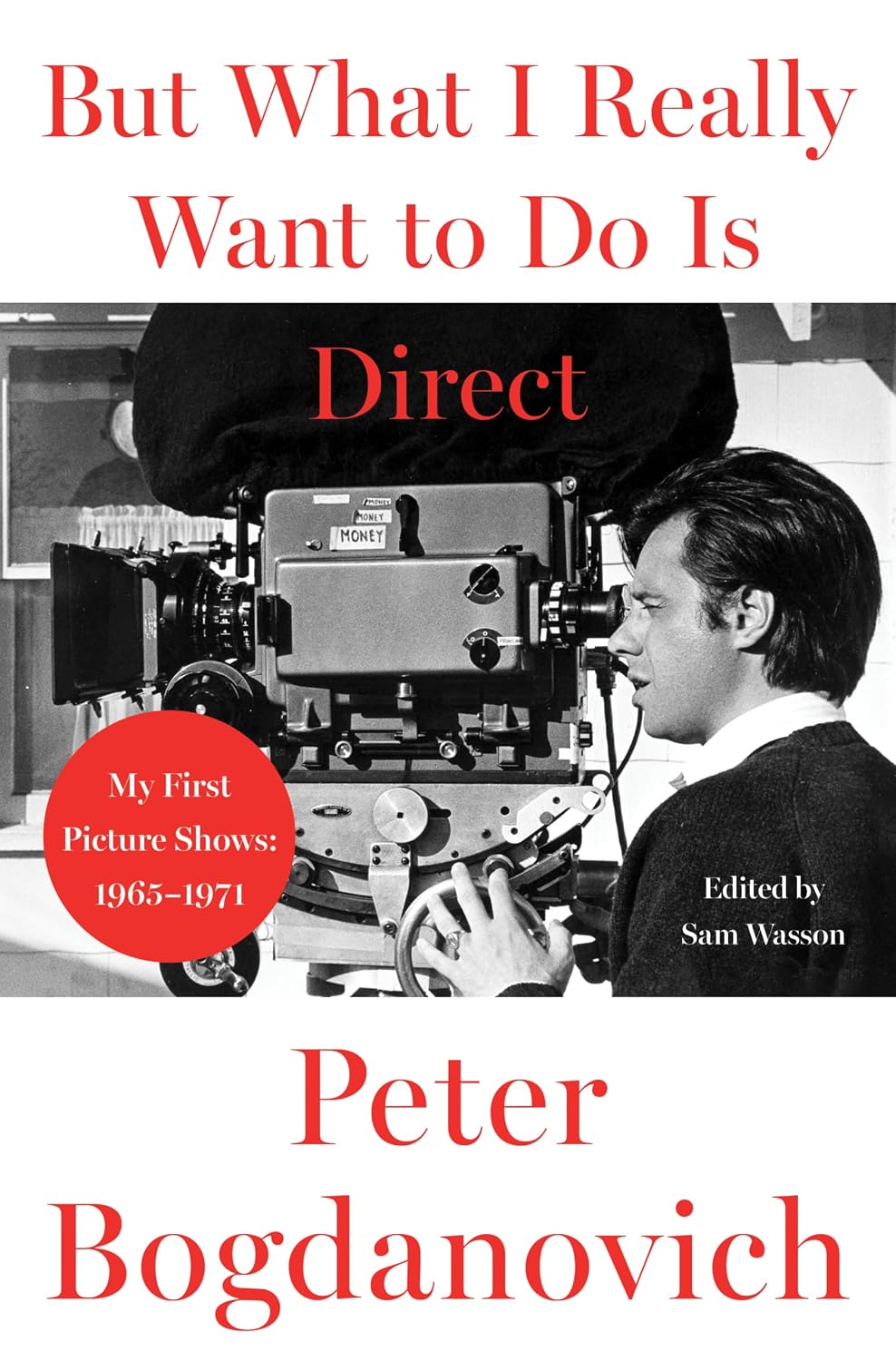
This diary makes up the overwhelming majority of But What I Really Want to Do Is Direct, a hefty new volume from HarperCollins; the remainder is given to sporadic interjections added in much later life by Bogdanovich, providing context and occasionally remonstrating with his younger self. The introduction and occasional footnotes come courtesy of Sam Wasson, a specialist in the “New Hollywood,” so-called, of the late 1960s and ’70s, and the personalities associated with it: his bibliography includes a fine biography of Bob Fosse, a recounting of the making of Roman Polanski’s Chinatown (1974), and a history of Francis Ford Coppola’s production company American Zoetrope. It was Wasson who, following Bogdanovich’s death in 2022, took on the task of editing his diaries, which the filmmaker had for some time been preparing for publication. The result is a first-person narration of a young striver’s breaking in, following the Bogdanovichs from paycheck-to-paycheck penury—Polly keeps them afloat as a prolific shoplifter—to what Tennessee Williams termed the catastrophe of success.
If nothing else, these pages bear record to the whirlwind of activities that Bogdanovich engaged in during the six-year period covered herein: filing articles and publishing monographs on Fritz Lang and John Ford; serving as an apprentice of sorts to Roger Corman; getting two features off the ground and in the can; recording reams of taped interviews with directors and stars of Hollywood’s Golden Age; relentlessly hobnobbing; and keeping up a rigorous schedule of film-viewing that must’ve involved eagle-eyed scanning of every week’s TV Guide and the calendars of every repertory cinema in Los Angeles County as well as countless phone calls to studio screening rooms. In the world of yesterday evoked by these journals, recall, the treasures of film history were not to be revealed to anyone with a Wi-Fi connection and a passing familiarity with the protocols of illegal downloading or dodgy websites ending in the country code .ru. Bogdanovich’s pathological dedication may be compared to that of the young Henry James who, in a time before the convenient assemblage of many of the great public museum collections, put in long hours on dusty, rutted, brigand-haunted Italian thoroughfares in hope of glimpsing a decaying fresco by an obscure disciple of Giotto.
All of which is enormously impressive, and even the cinephile skeptical of Bogdanovich the filmmaker must confess an enormous debt is owed him for acting as sympathetic interlocutor to so many veterans of the American film industry who’d known that fabled, Edenic Los Angeles—before the smog and gridlock had come to stay, when the air was sweet with wisteria and there was dancing and highballs into the early morning hours at Cafe Trocadero and production struggled to keep pace with the demand of a voracious public to whom the stars and starlets were as gods. The fact is, however, with all of the eager beaver-ish activity of any given day, Bogdanovich is often a perfunctory diarist at best, and large swaths of But What I Really Want to Do Is Direct are not much more revealing than would be an appointment book. In a single-sentence entry dated December 6, 1965, the author coins a personal motto—“Use every minute”—and the contents of this book attest to Bogdanovich’s determination to do exactly that. His relentless program of autodidactic self-improvement recalls in passing that of the fresh, untested Boswell in his London Journals—but there is little here of the too-human fallibility that makes Master Jamie, with his doses of the clap and derailing hangovers, such amusing company. Bogdanovich is shrewd; he is industrious; he edits his Ford book on the toilet.
Such ruthless, rise-and-grind determination doesn’t particularly lend itself to profound contemplation, something that Bogdanovich, repurposing his journals to book form, may have seen fit to redress through the addition of annotation—it is possible, had he lived longer, the effort would have gone further, or far enough. Many of the characters, famous and otherwise, who move through Bogdanovich’s chronicle are described in the most cursory terms. Those the author dislikes are “creeps”—the word, or the variant “creepy,” occurs scores of times—and those he admires receive a succinct encomium. These verdicts, once issued, are only rarely reversed: Lang, upon first blush, is adjudged as “great—a charming, funny, perverse, poetic (in his special way), brilliant man,” but then chronicler and subject clash over money matters while Fritz Lang in America is in galleys, and as a result the author’s appreciation of Herr Lang’s While the City Sleeps (1956) suffers. Dyan Cannon, when she attends a Dodgers game in June 1966 with Bogdanovich and her then-husband Cary Grant, is “a good girl—honest and exceedingly likeable,” but the aftermath of her divorce two years later reveals her in her true colors, as a “bitch.”
By virtue of their repeated appearances on the stage of Young Bogdanovich’s life, certain characters get a bit more shading and contouring. A weeklong visit to the set of Howard Hawks’s El Dorado (1966) at Old Tucson Studios in Arizona inspires Bogdanovich’s most sustained bout of page-filling, and some fairly vivid sketches of stars John Wayne, James Caan, and Robert Mitchum, the last-named exuding, per Bogdanovich, “an undercurrent of self-derision and general mockery and restlessness between the shots.” Any appearance by Orson Welles—whose genius for extemporaneous speech is set down for posterity in Bogdanovich’s invaluable, Jonathan Rosenbaum–edited interview book This Is Orson Welles—reliably livens up proceedings, dragging our otherwise relatively abstemious narrator to bars in Mexico and Rome to reel off catty comments and nuggets of gossip concerning William Randolph Hearst’s supposed role in the murder of Thomas Ince (later the subject of Bogdanovich’s 2001 The Cat’s Meow) and “how he took Marlene Dietrich to the abortionist when Jimmy Stewart knocked her up on Destry Rides Again. Things you can’t print.” Ford and family, too, are recurring presences, with “Jack” coming off as a curmudgeonly but warm presence, and getting in a couple of choice lines: “When I said the Croats were fascist during the war, he said, ‘So was I.’ I laughed. He said, ‘Wait a minute—what was Hitler?’ ‘He was a fascist.’ ‘Oh, well, I was on the other side.’”
Such morsels are not without their value, but it can scarcely be said that any of the personalities that appear in But What I Really Want to Do Is Direct aren’t more lucidly presented elsewhere, in some cases by Bogdanovich himself, notwithstanding Wasson’s flatly ridiculous claim that Bogdanovich’s smattering of anecdotes featuring Alfred Hitchcock “are more vital, more illuminating… than either Hitchcock or [François] Truffaut are in their famous and overpraised book-length chat about technique.” (Per Wasson, Truffaut’s approach was unduly “academic.” Given that Truffaut’s formal education ended at fourteen, it may be presumed that “academic” is used here as a synonym for “French.”) Take Ford’s appearance, for a few pages, as a character in A Way of Life Like Any Other, a brilliantly funny 1977 roman à clef by Darcy O’Brien, son of actors George O’Brien, a regular Ford player, and Marguerite Churchill; in scanty space O’Brien distills the essence of the man in the winter of life, “frail in body but lively in intellect,” introduced thusly:
My father had briefed me that Ford was disinclined to wear underwear, and in fact never wore it, except under arctic conditions, and while I could not verify this, I noted that he was dressed in other ways casually, in loose-fitting trousers and safari shirt, with an ascot at the throat. Of his eyes I could detect very little. One looked out from behind a thick, dark lens, the other was covered by a black patch.
In a few paragraphs O’Brien gives us a whiskey-fumed Ford in all his erudition and arrogance and truculence and hibernophilia, discoursing on Jonathan Swift’s Drapier’s Letters of 1724 and ’25and “the currency scandal that had occasioned them” and the supreme genius of James Joyce and the prospect of a film about the Great Famine that “could show just how evil people could be to one another” before `dozing off, mildly fuddled with midday drink.
While it may seem a bit much to ask for the prose of a private journal to rise to the level of fine-tuned, belle-lettrist literature—we can’t all be Helen Garner—but if it shouldn’t, one at the very least could supply some scandalous and salacious tidbits to justify their publication. Take for instance the sublimely lascivious The Diaries of Kenneth Tynan,which, by the by, also happen to be beautifully written. In their pages one can find some of the same dramatis personae as in But What I Really Want to Do Is Direct, including Bogdanovich himself, who appears at a 1976 Hollywood party at the home of high-powered agent Sue Mengers, the day before dedicated pervert Tynan gropes her during Thanksgiving dinner at Billy Wilder’s house. “Have no idea why I did this,” Tynan writes. “She responds with happy moans and intimate work with her knees. Her daunting size would of course be a detriment if it came to the crunch; but on the other hand there would be a lot of sheer buttock to whip.” On the same day, six years earlier, Bogdanovich can be found writing of his young daughters: “Tonia is simply a delight—she’s so grown up and adorable—talks all the time. Sasha is beautiful too—and gave me a big smile when she saw me.” I know which of these is the sort of thing I prefer to spend my precious time reading.
As far as the private Bogdanovich goes, we get a great deal of cooing over the little ones; expressions of anxious goodwill toward his oft cash-strapped parents and younger sister; some interjections from the older author on his lack of sexual chemistry with the mother of said daughters, Platt; an accounting of his desultory failed efforts to cheat on said wife while in Rome for work and, for the grand finale, his final success with former “Miss Teenage Memphis” Cybill Shepherd, treated with customary discretion. (Shepherd, to her credit, was good enough to inform readers that she was responsible for introducing Elvis to cunnilingus in her autobiography Cybill Disobedience.) But What I Really Want to Do Is Direct, per Wasson, serves to act as a corrective to “the acrimonious tales of personal betrayal and artistic theft” surrounding Bogdanovich and Platt’s breakup, instead showing their pairing as “a real and buoyant… good time of late nights, great friends, cuddles, ice cream, the adventure of breaking in together, and family.” I can confirm that it does, indeed, do so. What Wasson does not say is why, exactly, this should be regarded as compelling reading.
When addressing individual films, as with individuals, Bogdanovich’s insights, again, are largely divisible between the disdainful and the superlative, with little to nothing in the way of granular analysis. Per Wasson’s introduction, Bogdanovich had planned “to weave in yet another layer” to his journal/memoir hybrid, this consisting of the fabled typewritten capsule reviews he’d kept of every screening of every film he saw between 1959 and 1970, a sort of analog Letterboxd log. Only a few of these remain in Wasson’s edit and, judging from those that do, this omission is not an unbearable loss. The reader of But What I Really Want to Do Is Direct will come away with a fairly good sense of Bogdanovich’s likes and dislikes, but there is very little by way of explaining why, precisely, any given performance in a film is “weak” or “effective,” why the direction of a film is “hopeless” or “smooth” or merely “competent.” So vague, in the main, are the author’s note-to-self comments that one wonders why, exactly, he bothered writing them down at all.
The lion’s share of raves go to the Old Masters of Hollywood. “Wonderfuls” and “gloriouses” abound. Raoul Walsh’s Blackbeard the Pirate (1952) is a “vigorous, briskly directed pirate adventure yarn, with an outrageous, but thoroughly Walshian bravura performance by Robert Newton.” Ford’s 3 Bad Men (1926) boasts “really wonderful photography, lovely Fordian things.” Hawks’s Rio Lobo (1970)—on first viewing, at least—is “beautifully directed and photographed with Hawks’ touches and intelligence.” (It is, one supposes, downright Hawksian.) There is something axiomatic in these assessments: Walsh and Ford and Hawks are great, and it follows that films signed with their names are imbued with greatness. Further exegesis is unnecessary.
More recently emergent American talent Bogdanovich finds a mixed bag: Stanley Kubrick’s 2001: A Space Odyssey (1968) is “unutterably tedious” and Sam Peckinpah’s The Wild Bunch (1969), “not too good,” though Robert Altman’s M*A*S*H (1970) passes muster (“direction is smooth and has style”), and John Cassavetes’s Husband (1970) is singled out for an avid tribute. Europeans, at least those under fifty, are likewise a suspicious lot. Jean-Luc Godard’s La Chinoise (1967) is “typically recent Godard—boring, perverse, occasionally diverting,” and its director, encountered on a USC panel discussion that includes King Vidor, Samuel Fuller, Roger Corman, and the author, is as “tedious” as 2001. Michelangelo Antonioni and Sergio Leone are both taken to the woodshed, while Jacques Demy’s Bay of Angels (1963) and Bernardo Bertolucci’s Before the Revolution (1964) get passable marks, though Bogdanovich proclaims the director of the former “dull in a funny way” upon meeting (adding “I had the feeling Demy was eyeing me!”) and of Bertolucci’s film mysteriously pronounces “I’ve made that film already—in my mind, in my heart.” Unbridled praise is reserved for Luis Buñuel and Jean Renoir, both by then ensconced in the pantheon, with Renoir deemed “unarguably the best director of the Western world,” his The Rules of the Game (1939) “superbly acted, brilliantly directed.” Among Renoir’s merits, one suspects, was that of having a Beverly Hills address, where Bogdanovich could readily get at him, and did. (It’s Renoir who offers an actually incisive comment on Godard’s work here, as “not being judged as a single film but as the life of a man.”)
As to who Bogdanovich regards as the best director of the Eastern world, much less the Southern Hemisphere, we are afforded no insight, for practically no films made outside of Western Europe or the United States merit mention, save passing references to Sergei Eisenstein and the 1962 Soviet science-fiction film Planeta Bur, which Bogdanovich is hired by Corman to reedit, with original footage spliced in, to make Voyage to the Planet of Prehistoric Women (1968). Documentary and experimental film for all purposes do not exist, though his editor at Film Culture and voluble proselytizer for the New American Cinema, Jonas Mekas, gets a name-check, and Curtis Harrington, a member of the ’40s Los Angeles avant-garde that included Kenneth Anger and Gregory Markopoulos, makes a couple of cameos. (“He’s O.K. but I wouldn’t mind if I never saw him again in my life,” writes Bogdanovich.)
Of course, the record given here of Bogdanovich’s enthusiasms is incomplete, culled to a mere 504 pages, and it is entirely possible that in these ellipses our narrator could be found posted up at the Toho La Brea to check out what was coming from the Land of the Rising Sun. Nevertheless, the impression one forms here is of a rather parochial, provincial, callow all-American naïf, his knowledge of culture deep in one area of his chosen field but not otherwise particularly wide, reading largely limited to properties that show promise for film adaptation.
In fact, this partisan of the unmatched brilliance of American pictures was a first-generation American, and barely one at that: he was born in Kingston, New York, in July 1939, two months after his European-born parents had arrived in flight from the coming war. The Bogdanovich family would settle on Manhattan’s Riverside Drive; father, Borislav, was a Serbian painter; his mother, Herma, of Jewish Austrian stock. Borislav, Bogdanovich writes in a preamble to the diaries, “had an enormous impact on both my tastes and cultural opinions”—though if the author had a particular enthusiasm for the plastic arts, But What I Really Want to Do Is Direct gives no evidence of this fact—while it was Herma who kept the rent paid by begrudgingly working for her father’s import-export business.
Bogdanovich’s first language was Serbian and, given the fact that he kept up a subscription to Cahiers du Cinéma and took up the banner of le politique des auteurs, it follows that he had sufficient French to muddle his way through an issue. After his graduation from the exclusive Collegiate School on the Upper West Side, he opted for acting classes at the Stella Adler Conservatory and American Academy of Dramatic Arts rather than the Ivies, but I would hazard to guess that an elite prep school curriculum in the ’50s gave one as much if not more grounding in the cultural canon than the coursework required of an undergraduate certificate today, so it is safe to say the particularly Buy American, backward-looking tilt of his tastes was not a matter of limited horizons, but of affinity. On his first voyage abroad, arriving in Rome to discuss the possibility of directing Duck, You Sucker! (1971) with Leone as producer, he professes himself enchanted with the city, though has less to say for Saint Peter’s than a fettuccine specialist “made famous by Doug Fairbanks and Mary Pickford.” There’s a touch of the skeptical, blasé Twain of The Innocents Abroad here, or of the gabby little brother of the title character in Bogdanovich’s 1974 adaptation of James’s Daisy Miller, who can’t wait to wrap up his Grand Tour education and proclaims American candy “the only kind worth eating.”
Aside from a clutch of mildly diverting anecdotes, what one takes away from But What I Really Want to Do Is Direct is an abiding tone of concerted wholesomeness, of labored niceness,that is, alas, terribly American: it’s the story of Peter the dutiful son; Peter the hero-worshipping grade-grubber shining apples for the approval of his gallery of Grand Old Men and helping keep alive their hopes of living to work another day; Peter the devoted spouse, staying up giggling and gorging himself on sweets with the little wife. . . . None of this is necessarily dishonest—there is ample testimony to Bogdanovich’s unfailing generosity when he was in the clover—but the project of its publication has the air of an attempt to set the record straight, to rehabilitate a public image that through the years had become tarnished: by the break with Platt, depicted most unflatteringly in Peter Biskind’s smarmily moralizing Easy Riders, Raging Bulls;by the war of words with Hugh Hefner following the murder of his romantic partner and former Playmate of the Year Dorothy Stratten in 1980 (touched on here and discussed at length in Bogdanovich’s 1984 The Killing of the Unicorn: Dorothy Stratten 1960–1980), which included Hefner accusing Bogdanovich of seducing Stratten’s thirteen-year-old sister, Louise. (Bogdanovich and Stratten would be married in 1988, when Louise was twenty.) Taking up residence in Brett Ratner’s guesthouse probably didn’t help matters much.
It is difficult to believe that there is a vast audience still today invested in these episodes, more difficult still that those who are would consider relaxing their opprobrium. Certain people, it’s well established, have a cherished desire to regard artists—the ones they admire, anyway—as “likable,” as good actors. It is a compulsion I do not share and, as such, my estimation of Bogdanovich’s output as a filmmaker—a handful of movies that touch the superlative, a few more lightly likable, quite a bit of dross, and some just plain odd (a three-hour documentary about Tom Petty? A Pete Rose biopic?)—has altered not at all after reading But What I Really Want to Do Is Direct. Targets (1968), whose production under Corman’s eye and eventual release by Paramount is handled at some length here, is an inspired debut, a dialectic thriller that brings together an aging horror movie star (Boris Karloff, in his swan song) and a psychopath-next-door (Tim O’Kelley) who murders his family before proceeding to shoot up a drive-in. Here, as in the films to come, Bogdanovich shows the influence of his Golden Age mentors—Hitchcock in particular—but O’Kelley’s milk-fed, crew-cut, gun-crazy crackpot isn’t an “homage” to something the director had caught on Million Dollar Movie: he’s a character out of the headlines, his rampage inspired by ex-Marine Charles Whitman’s ducks-in-a-barrel shooting spree from the observation deck of the Main Building tower on the University of Texas, Austin, campus. It is a film that could only come from a real sense of horror at suburban soul-sickness and American gun culture run amok. Bogdanovich does not often dwell on the news of the day in his journal entries, but, significantly, every November 22 he notes the anniversary of John Kennedy’s assassination.
In 2012, shortly after the Aurora, Colorado, movie theater shooting, Bogdanovich penned an op-ed for The Hollywood Reporter proclaiming himself “sick” over having made the prescient Targets. “Peter was often criticized for being a man out of time, for offering romantic comedy and old-fashioned musicals during a period of roiling social change,” Louise Stratten wrote shortly after his death, but “Perhaps he was simply offering us both a respite from the horror and holding up a mirror to the better angels of the human spirit.”
That’s as it may be, but the Bogdanovich who was willing to expose and explore his seedier side in his work, to express a certain ambivalence toward American innocence, was the more interesting, probing filmmaker. Bogdanovich’s reputation largely rests on the three films that followed Targets—The Last Picture Show, What’s Up, Doc?, and Paper Moon—all made with contributions from Platt, which has led some to nominate her as the real source of the Bogdanovich Touch. I would trade any of the above for his Daisy Miller, with its blithe, prattling Shepherd and its touching, spaniel-eyed Barry Brown; about two-thirds of 1981’s They All Laughed (mostly those involving John Ritter); and above all 1979’s Saint Jack, based on the novel of the same name by Paul Theroux and produced, in happier days, by Hef’s Playboy Productions.
The last-named film is a downbeat character study of an American, Jack Flowers, who earns his daily bread in ’70s Bangkok by peddling flesh to tourists, fellow expats, and, eventually, US servicemen on leave from the front in Vietnam, setting up a bordello with funds from the CIA. Bogdanovich’s conception of the Flowers character, lent an air of gruff resignation by Ben Gazzara, owes not a little to those played by Humphrey Bogart in Michael Curtiz’s World War II–era films Casablanca (1942) and Passage to Marseille (1944): cynical, aloof-from-the-fray men who, in the face of an injustice too great to be borne, experience a reawakening of conscience. But the context is new, the ambiguities deeper: Gazzara’s Flowers is more morally compromised than any of Bogie’s good-bad guys, while the representatives of the good ol’ Stars and Stripes are now in the business of pimping and blackmailing. The role of Flowers’s CIA handler is played by Bogdanovich himself: clammy, oleaginous, and, to use one of his favorite words, very effective. I’ve no doubt many remember him as a perfect sweetheart, but the man made a marvelous creep.
Nick Pinkerton, a critic and screenwriter, is the author of Goodbye, Dragon Inn (Fireflies Press, 2021).