


IN HER 1964 ESSAY “Against Interpretation,” Susan Sontag famously complained that “the project of interpretation is largely reactionary, stifling . . . the effusion of interpretations of art today poisons our sensibilities.” She concluded with the influential rallying cry: “In place of a hermeneutics we need an erotics of art.”
Et voila, the work of Robert Wilson, the artistic visionary who was just beginning to formulate the aesthetics and methods that would produce some of the most stunning happenings or events, for lack of a better term (“operas” and “plays” aren’t adequate), in the history of modern art. For roughly the first half of his immensely influential career Wilson created spectacles that rendered standard critical interpretation irrelevant and even ridiculous. “If I go back today and read what critics wrote about my past work, I have not a clue about what they saw on stage, because they had ideas and wrote about those instead of what was in front of them,” he writes. “To simply describe what it is you are seeing . . . is a very special skill.” The gaseous hot air of the kind of hyper-interpretive highbrow criticism Sontag despised had distorted a great deal of what Wilson had simply put before the artistic public for his and our enjoyment.
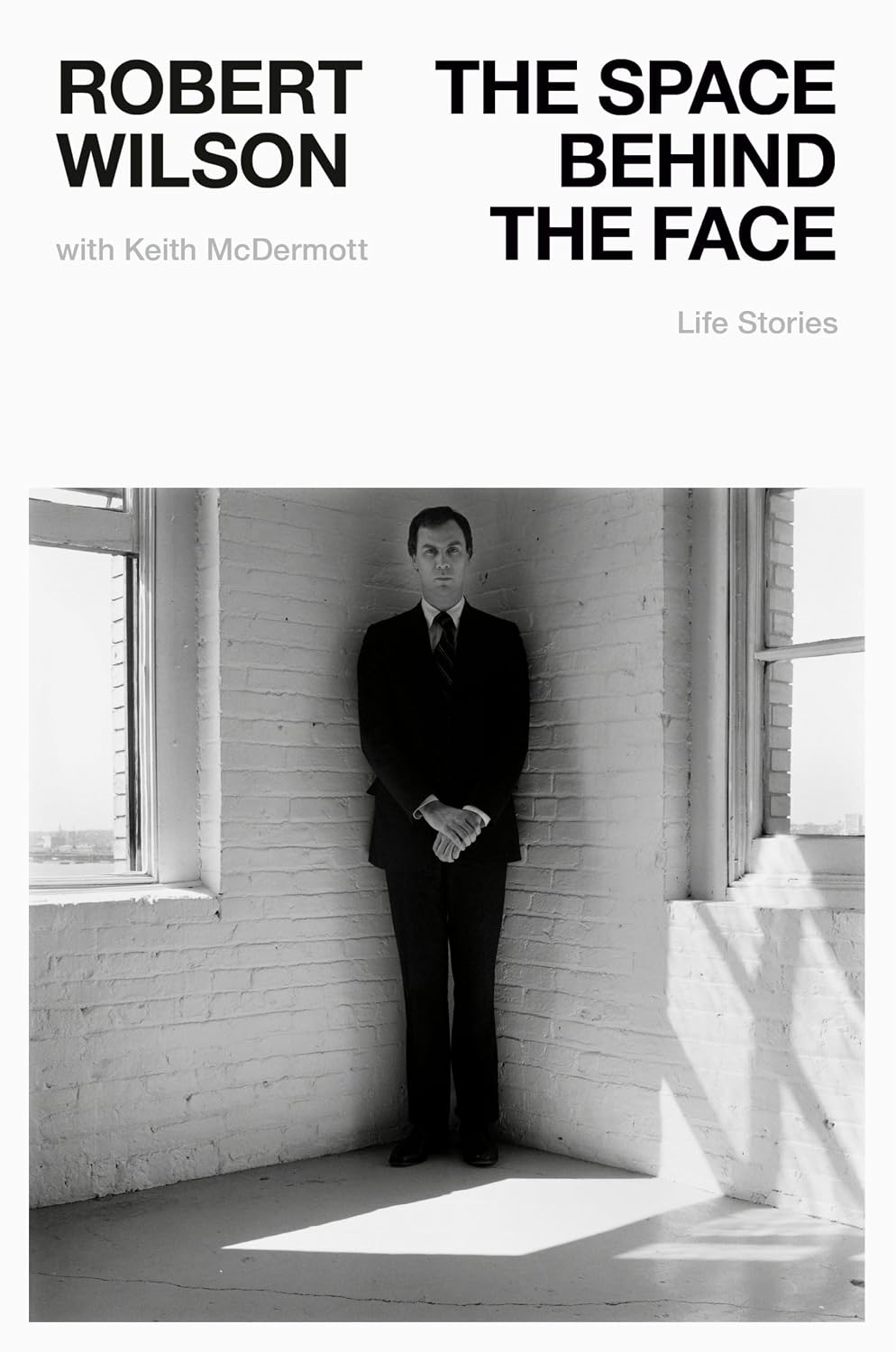
Now, with the help of his friend and amanuensis, the actor and novelist Keith McDermott, Wilson, who died last year at the age of eighty-three, is posthumously releasing what the publisher terms a “long-awaited memoir” under the title The Space Behind the Face: Life Stories.The title is Wilson’s and it underlines how consistently he frames not just theatrical matters but also things such as identity and emotion in spatial terms. As we will see, the word “memoir” is something of a stretch for the book’s contents. But it is by far the fullest piece of personal testimony that he has ever provided. For anyone with the least interest in this hero of our culture and genius of the downtown and international avant-garde, which presumably includes all readers of Bookforum,it is a book of immense and urgent importance. And, let me say up front, a whole lot of fun to read on multiple levels. “I like to tell stories,” Wilson declares early in his book, and he is very good at it.
This review of The Space Behind the Face will be far less objective and far more fanboyish than my Handbook of Critical Standards and Practices generally recommends. Wilson bestowed upon me one of the four most enjoyable and transformational non-book artistic experiences of my lifetime, all of which took place in the ’70s in New York City. I experienced them as both profound discoveries and transformational experiences at some deep personal and almost cellular level. For the record, they were: a Rolling Stones concert in Madison Square Garden in July 1972 (well, what can I say?), my first viewing sometime in that decade of Carl Theodor Dreyer’s The Passion of Joan of Arc, the 1975 Broadway production of Tom Stoppard’s Travesties starring John Wood, and, considered collectively, a stunning string of four mid-decade Robert Wilson theatrical events: A Letter from Queen Victoria (1975) in an unlikely Broadway setting; the free-form spectacle The $ Value of Man (1975) at the Brooklyn Academy of Music, Wilson’s most consistently supportive and welcoming American venue; Einstein on the Beach, the epic five-hour-long “opera” Wilson cocreated with the composer Philip Glass, with its 1976 American premiere in the even more unlikely Metropolitan Opera House, rented out for the occasion at disastrous cost; and, as a kind of diminuendo or coda, the two-hander I Was Sitting on My Patio (1977), starring Wilson and the bewitching dancer and choreographer Lucinda Childs, at the Cherry Lane Theatre. The biggest boom of these four was, of course, Einstein,my fortuitous presence at which has relieved me of any envy I might feel toward the attendees at the legendary 1913 Parisian premiere of Stravinsky’s ballet The Rite of Spring. I’d been prepared, in a sense, for what I and the other lucky attendees experienced that long evening by the two previous Wilson productions I’d seen, but Einstein was so ravishing and magical that, to be honest, I’ve spent half a century wishing I could be back there.
Wilson’s work in those years—with its unique combination of total freedom of creation with unwavering rigor of execution—enlarged my sense of what art could be and might do, and my gratitude was and remains profound. He took me to places of visual and imaginative delight I had never dreamed of and have not remotely experienced since—even in the handful of new Wilson productions I have subsequently seen. Wilson-fixated, I made, in my previous life as a book editor, a serious attempt about a decade ago to get my employer to put him under contract for some kind of memoir. Although this earned me a memorable hour-long phone conversation with my hero, I was puzzlingly unable to get anything like an adequate offer cleared. I’ll own that failure, but it tells you something about Wilson’s somewhat forbidding but deeply mistaken profile, in the middlebrow precincts of the Literary-Industrial Complex and elsewhere, as an uncompromising avant-garde artist of the eat-your-spinach variety. I would like to think that my pursuit might have in some small way set Wilson on the path to this book, but I have no way of knowing that. I do know that the diligent Keith McDermott managed to get Wilson to unbend and has captured on paper his considerable talents as a raconteur, with at times a Texan-appropriate cracker-barrel-ish tone and at others a bit of a bad boy, tales-out-of-school cackle in his voice.
As a memoir, The Space Behind the Face bears only occasional resemblance to the psychologically interior and narratively shaped form that we have come to expect. It has a slight DIY feel to it, which makes sense: Wilson experienced health challenges as the book was being assembled, and up to the end he remained perpetually overcommitted, tending to a global string of productions and the bespoke artistic kingdom he has created in the Watermill Center, the interdisciplinary arts and humanities “laboratory” that he considers his true life’s work and legacy. The book is relentlessly episodic, and the signature creations for which Wilson will be remembered are dropped in with little to no preliminaries. Ideally, the reader of this book, even moderately committed Wilsonians, will have first reread Calvin Tomkins’s superb profile of him in the January 13, 1975, issue of The New Yorker, still the best single source of facts and feelings on its subject, and then viewed the extended and richly illustrated late-in-life interview with Wilson to be found on Steven Watson’s invaluable website Artifacts, devoted to the figures of artistic downtown New York. That way you can have the sound (his Texas twang still audible) and visual sense of Wilson in your mind, and also a feeling of the man’s bedrock authority and charisma.
Wilson has divided the book into three sections, reflecting his earliest artistic ambition to be a painter: “Portrait,” “Still Life,” and “Landscape.” “Portrait” covers his growing up in Waco, Texas, in the ’40s and ’50s in an intensely Christian and strict society and family that he longed to escape. It is by far the most involving and revelatory part of the book. His father was a city manager who fully expected his son to toe the educational line and eventually pursue a career in business or the law, one of the many things that created family tensions.
This may seem eccentric, but my own take on Wilson is that he was an outsider artist of a unique, category-of-one sort. From the beginning of his career there has always been something alien and uncanny and utterly unreproducible in his work. He also showed himself to be totally open and sympathetic to radically different ways of being in and experiencing the world. While not strictly neurodivergent himself, from an early age Wilson experienced a profound otherness from his conservative and stifling milieu. The book begins with a haunting episode that offers a sharp glimpse into his artistic drives and methods. At age nine or so, wide awake and anxious in the middle of the night, the young Robert crept down to the kitchen and methodically removed every dish on the shelves and utensil in the drawers and reorganized them in a fashion precisely to his liking. The next day he did the same thing for all the cans and bottles of food in the pantry. Only then was he able to sleep. This almost metabolic drive toward order has served him splendidly in bringing off his immensely complicated and microscopically precise productions.
Wilson has always had a complicated and ambivalent relation with language. Despite his evident ability as a self-narrator and yarn spinner, it is not a medium he feels entirely comfortable with. “Bob thinks by drawing,” his mother presciently noticed. As a boy he suffered from a painful stutter, and as a last resort his parents sent him to a local dance teacher by the name of Bird Hoffman. As he writes, “Miss Hoffman had an intuitive understanding of the body,” and she was also kind and patient. Through a regimen of movement and relaxation exercise, she was able to slow down the racing brain that caused Wilson’s stutter and cure him of it. In gratitude he would later name his first artistic outpost on Spring Street in emerging Soho “The Byrd Hoffman School of Byrds.”
There are two other aspects of Wilson’s outsiderness that should be noted. One was that as a white Southerner in a racist and segregated milieu, he had African American friends and frequented Black music clubs on the outskirts of town. The first painting this inveterate collector bought was by Clementine Hunter, a “primitive” Black painter who lived on a plantation in Louisiana and depicted its work, play, and religious life. Later, two of the finest performers he ever discovered would be Black: the orphaned and deaf Raymond Andrews, whom he adopted and who was the centerpiece and inspiration of one of his earliest “plays,” Deafman Glance; and the phenomenal Sheryl Sutton, one of the most riveting stars of A Letter from Queen Victoria and Einstein.
The final aspect would of course be Wilson’s gayness, which he recognized at an early age. “My sexual orientation was just another facet of my otherness,” he writes. Wilson had a knack of being taken up and shepherded along by older gay men, some of them lovers, others not. One early mentor was a man named Noel Monod, the treasurer of the United Nations, who spoke at the University of Texas at Austin when Wilson was a freshman there majoring in, of all things, business. He liked what he heard Monod say about art, introduced himself, and the older man would be instrumental in helping Wilson travel first to New York and later to Europe, deeply revelatory trips that showed him an artistic path forward. Early on and for the rest of his life Wilson would prove to be an adept at navigating what poet W. H. Auden once termed the “Homintern,” that influential network of cultured gay men and women. Part of this was serendipity, but underneath it was the kind of shrewdness a budding genius would need in order to bring his outsized ambitions to fruition.
Part Two, “Still Life” brings Wilson to New York and his studies in architecture and interior design at Pratt, just as the downtown art explosion at Judson Memorial Church and similar venues was taking place. He would meet John Cage, Merce Cunningham, Martha Graham, and similar figures from whom he would take instruction and inspiration. Wilson found work as a dishwasher at an Italian restaurant (a job he loved) and then as a therapist with troubled children and adults, work that was crucial to his evolving theatrical aesthetic. In one especially poignant episode Wilson was hired as a recreational therapist at Goldwater Hospital on Welfare Island (now known as Roosevelt Island) working with paraplegic patients trapped for life in iron lungs and mostly catatonic. With distinct echoes of Oliver Sacks’s Awakenings, Wilson brought an inspiring inventiveness to a seemingly impossible task, even managing to persuade Otis Redding and Carla Thomas to come and sing for the patients.
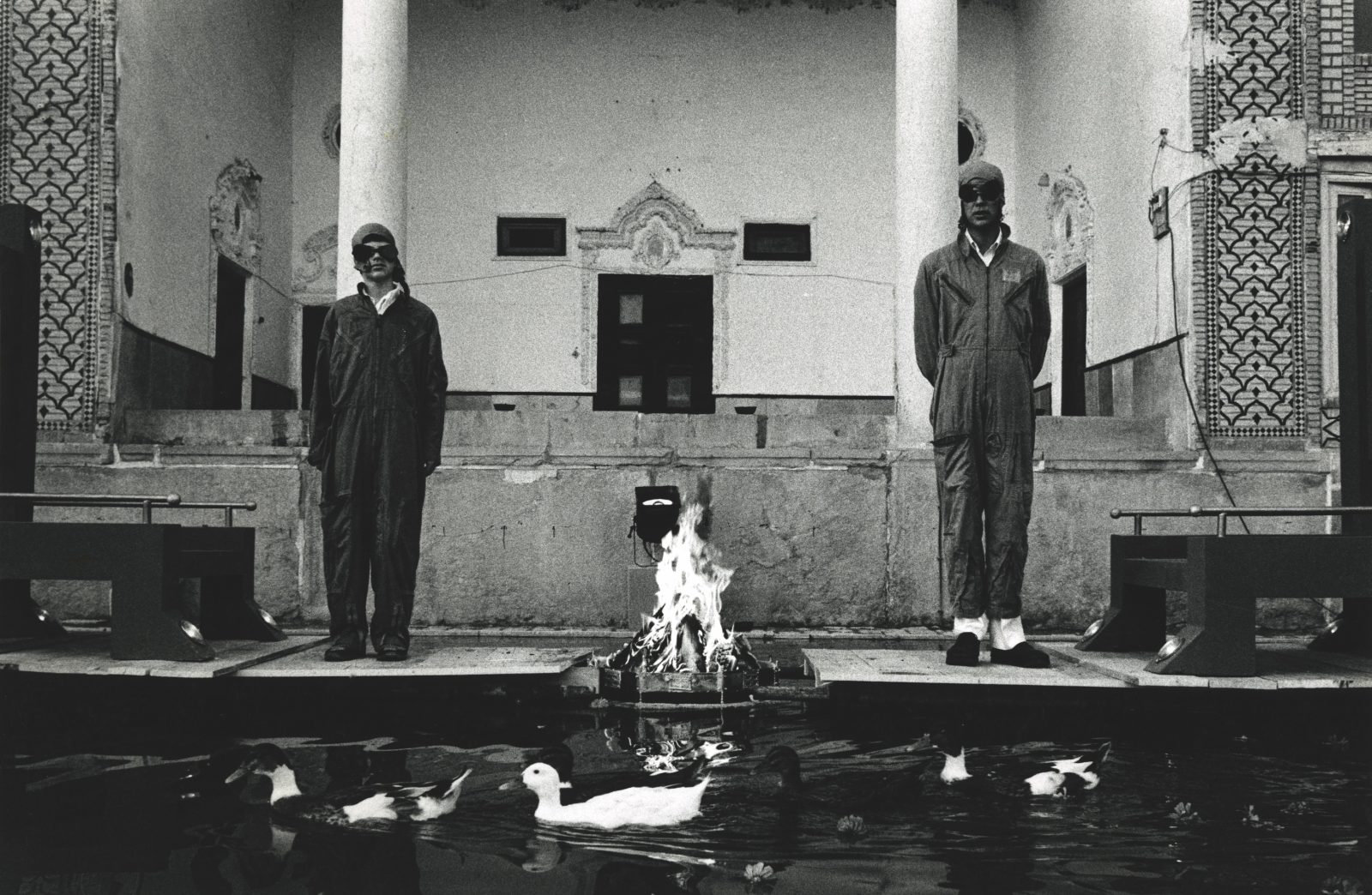
This is the section of the book that cultural historians will most strongly gravitate toward, and while it is full of the interest of watching a visionary genius come into his own, it must be said that Wilson does not tell the reader a great deal that is new or striking about the productions of the late ’60s and ’70s—The King of Spain, Deafman Glance, The Life and Times of Sigmund Freud,the sprawling cast-of-hundreds Ka Mountain seven-day extravagant happening in Shiraz in pre-Revolutionary Iran in 1971, the twelve-hour The Life and Times of Joseph Stalin, and others previously mentioned—for which Wilson will be remembered in future decades. Artistic royalty of the wattage of Jerome Robbins and Edwin Denby gather around, and Wilson discovers the astoundingly talented young linguistic and mathematical savant Christopher Knowles as a key collaborator.
The final section, “Landscape,” brings Wilson through the succeeding decades, when he would purchase a building in Water Mill on the South Fork of Long Island that formerly housed a telecommunications laboratory and develop it into the now thriving arts institution of the same name. He becomes something of an institution himself, although Wilson productions would become increasingly hard to see in this country, as it was only in Europe that the government and private financial support adequate to his elaborate creations could be reliably procured. This part of the book, while enjoyable to read, is something of a jumble sale of anecdotes and vignettes, many of them of the dishy and catty variety, too good not to use but without much of a chronological structure or narrative through line.
These were the years when Wilson slipped the surly bonds of earthbound social life and entered the empyrean realm of a certain kind of ultra-refined international celebrity. The boldface names begin dropping with accelerating frequency: George Balanchine, Samuel Beckett (Wilson would memorably perform his Krapp’s Last Tape), Diana Vreeland, Rudolf Nureyev (huge cock duly noted), fellow Pratt student Robert Mapplethorpe, Louis Malle (he wanted to cast Wilson in Pretty Baby, but no soap), Richard Avedon, Warren Beatty, Marianne Faithful, Andy Warhol, Gloria Vanderbilt (Wilson arrived at her apartment right after her son threw himself off the balcony to his death), artist of the moment Paul Thek (Wilson was the expert executor of his estate), und so weiter.Well, he’s Robert Wilson and you’re not, but it was necessary for him to navigate these waters to keep his whole enterprise afloat, and he was skilled at it. The glitzy annual benefit dinner at Watermill would become the East Coast avant-garde equivalent of Vanity Fair’s Oscar party. Madonna will be displeased to learn that her idol Marlene Dietrich told Wilson that she thought her “trash,” and for extra measure, found Meryl Streep “boring.” Edwin Denby walks out of a dinner that Wilson arranged with Susan Sontag, driven away by her relentless opinionating.
One story he tells is especially delicious. I attended the 1992 revival of Einstein on the Beach at BAM, and one of the people I noticed in the audience was none other than Arthur Miller. I had always wondered what the entirely conventional Miller made of the spectacle, and now I know. Wilson, wandering about, found an aisle seat next to a man he thought looked familiar and gradually recognized. Miller asked Wilson, “What do you think of this?” Wilson replied, “I don’t know. What do you think?” Miller said, “I don’t get it.” Wilson puckishly opined, “I don’t get it either.” A few minutes later Miller left the theater for good. The perfect title for this section: “Bad Reviews.”
It is an interesting and even nervous-making question just how Wilson’s fame and artistic legacy will fare in the decades to come. It is unclear how much visual documentation of his landmark creations there is, as so much of it took place before the era of widespread videotaping, let alone smartphones. In any case, even the most skillfully filmed rendering of Einstein on the Beach would sorely lack the visceral impact of the real thing. Some of his productions could of course be revived, but without the master’s hand on the tiller with his obsessive attention to even the smallest detail, their unique aura might be impossible to recapture. The Watermill Center will carry on diligently, but there is some reason for concern. A great deal will depend upon Wilson getting just the right skilled biographer to tell the full and unvarnished and fully documented story of his life and art, the dark along with the light. Wilson’s warmly personal memoir is uniquely invaluable, but it is only a start.
As for me, I have been haunted a bit lately by the road or street not taken. I lived in downtown New York in the ’70s (on Vestry Street, a block or so away, I learn, from Wilson’s loft), and I walked past the Byrd Hoffman School on Spring Street countless times. I had a perfectly fine but fairly boring job as a copywriter at a textbook publisher, but I wanted more. Quite often I thought, I could drop into that place and, I dunno, volunteer my services. Surely there were chores that would need to be accomplished. I was a hard worker and who knew what adventures it might lead to. Wilson was an adept in taking in strays and helping them discover things about themselves they’d never suspected. If I’d made that turn and that visit, I might have had a very different life from the one I actually led.
Gerald Howard is a retired book editor and the author of The Insider: Malcolm Cowley and the Triumph of American Literature (Penguin Press, 2025).