


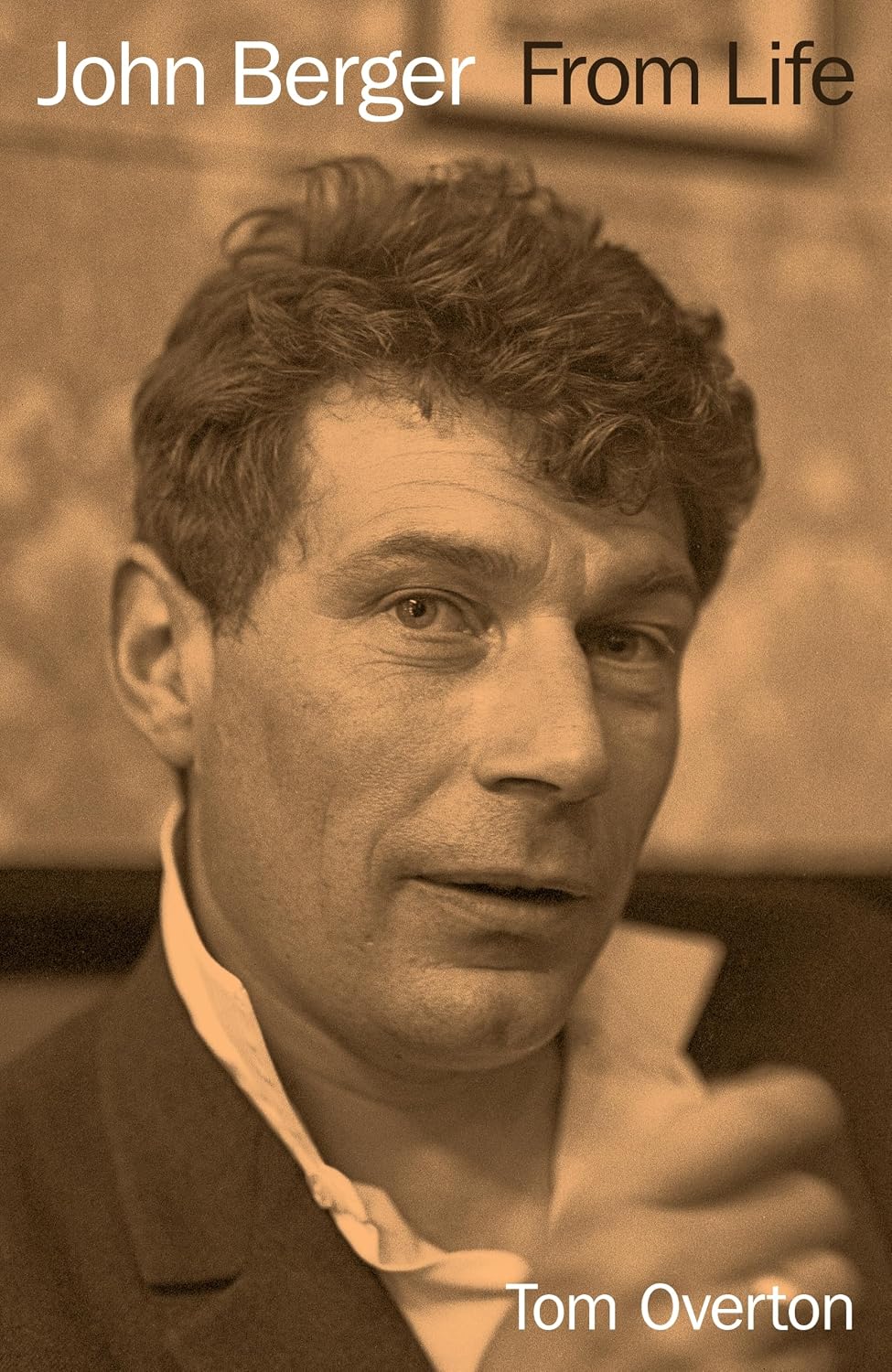
“IN GENEVA, IN 2017, when I first saw the pile of letters to John from Lorraine Gill, I wanted to believe their relationship couldn’t have been that significant or consequential,” writes Tom Overton in John Berger: From Life. “A confused sense of loyalty made me want Anya’s life to be less complicated, less painful,” he explains, referring to the woman who was, in the years the letters from Gill were dated, Berger’s partner. The letters were from 1972, and Overton already had his work cut out for him when it came to historicizing that year in particular. “Simple laziness made me want to reject it as (yet another) avenue of research. I also couldn’t quite believe it was possible—that there was space for another grand, tumultuous passion in the chaotic intensity of 1972.” Still, much to the chagrin of Overton, Berger the eternal romantic had somehow found the time for yet another of his trademark intense and epistolary love affairs. Maybe reviewing the correspondence would take him an afternoon, he thought. He hoped. Going through those letters would take Overton months.
The John Berger of 1972 is the John Berger who became someone we would read a biography about. Everything happened to him in 1972: first he won the Booker Prize for G., his fifth book, a novel that managed to be both experimental and classic in its small sketches of earthy horniness traversing history, both written in words and drawn by hand: simple sentences, tiny pictures of dicks, to tell the story of a man’s life in romances. Notified in advance of his win, he prepared himself to refuse the prize on its terms, stating in his acceptance speech that in protest of the Booker family’s profit from the Caribbean slave trade and to refute the hypocrisy that uses a financial prize bestowing literary prestige to simultaneously hide and cleanse its own evils (the other term for this is money laundering), he would be splitting the money between the British Black Panthers and to subsidize his next book, A Seventh Man, about migrant labor in Europe.
Ways of Seeing premiered on the BBC in ’72 and played for four consecutive winter Saturday nights. There was Berger, his face and his voice, wearing the unmistakably poly blend material of a cream and brown patterned shirt buttoned up over his thin frame, the faux silky sheen of fabric from a last-minute panic purchase from a nearby thrift store, after he and his crew realized that the shirt he had worn that day was too similar to the set’s background screen. His arms and hands gestured as he pointed and punctured at art, both its appearance and its meaning, the precision of his voice matching the emphasis of his speech. On those weekend evenings people all over England saw Berger, as he was in that extraordinary year, for themselves. Since then, countless others have watched Berger and the series, in seminars or lectures or on laptops, or they have read the book version because it was assigned to them or because they knew, or sensed, or were told, of its importance.
But there are decades’ worth of reasons to know Berger. He was a creatively promiscuous man, and his career was prodigiously—incredibly—productive: ten novels, five screenplays, four plays, hundreds of essays and works of criticism, dozens of poems, uncountable collaborations, and an oeuvre of works in forms that resist genre, blending photography and documentary and film with lecture or conversation or sketches or prose. He was born in England, never liked living in London, tried Switzerland briefly, and traveled all over the world to see places that others wanted to make invisible, like the Soviet Union and Palestine. He loved settling in the French countryside, which was where he passed away. He married four times, and his partnerships, including affairs and other relationships too private or too brief to be accurately counted, number much higher than that.
One can understand Overton’s disbelief—dismay, too—at realizing there was yet another woman to include in the biography that he began writing some time after he and Berger first met in 2010, while Berger was still alive and their relationship was its own kind of indefinable dynamic. Lorraine Gill contacted Overton after Berger’s death at the age of ninety, after Berger’s daughter Katya found an entirely new and until then unknown storage of her father’s archives, supplementing what Berger and his fourth wife Beverly had officially donated to the British Library in 2009. Those materials were extensive, but had a noticeable lack of anything between 1960 and 1972. When Overton asked Berger about this gap he had no answer; it turns out they had been put into the fallout shelter that Berger and his third wife Anya were legally required to have when they were residents of Geneva. Despite having been divorced for many years, Anya kept all of it safe; she never told anyone about the papers, but, as Overton notes, she also didn’t burn them the way John’s second wife Rosemary did after their divorce in 1958.
The details of Berger’s life came to archivists and biographers in a manner that is not that unlike how it comes to someone living their own life: in stages of awareness that are sometimes purposeful, the result of real introspection, and more often accidental, brought to our attention whether we want to see ourselves or not. The ordinary details are documented by their repetition and the epiphanies savage in their rarity, their abrupt unannounced presence. Overton has worked for Berger for over fifteen years, not in the sense of being in his employ (not exactly, anyway), but as a laborer for Berger’s canon. He edited two volumes of Berger’s writing for Verso Books, Portraits (2015) and Landscapes (2016), and devoted himself to documenting all he could from Berger, the person, as well as from Berger’s life lived. He was close enough to the family to climb over the ski boots and boxes of sweaters that accompanied Berger’s almost-lost archives after the funeral, close enough to Berger to pick up the phone in the last years of his life and hear his voice: “Then there’d come a call, very early, very late. Hello? Is that Tom? This is John. John Berger. Can I tell you a story? Over the phone, we reinhabited the image. I accompanied him there.”
In Overton’s telling, he’s not sure Berger ever fully trusted him with the task of writing his biography. Berger made Overton promise not to publish anything until after his death. “To me, you say you’re encouraged by the book,” Overton recalls. “To others, you say I remind you of a stonemason.”

Overton has an artist’s approach to From Life, his own reading of his choices sounding somewhere between a vocation and a chore. When describing his process of cataloguing Berger’s archive, he writes in the biography, perhaps referencing the stacks of photographs, that he “climbed into his memory through images.” He is sensitive and a little awkward, careful with what he writes and revealing in the emotions that surface in something as innocuous as a phone call or as loaded as a letter from a secret lover. (“In the space of a sentence, it suddenly seems ridiculous not to talk to you directly, John,” is one such example of Overton’s address. “You’ve been reading over my shoulder just as I’ve been reading over yours.”) It is this tenuous, or perhaps fragile, connection between Overton and his subject that creates a delicate sensibility in the biography itself, which avoids anything as boring as authority or as cheap as secrets and instead is somewhere between a letter and a diary, Overton writing directly to Berger as a bridge between how he felt about the man he knew and how he feels about the project of writing about him, using his first name pointedly and conjuring Berger as though he could, at any moment, be reading the book for himself. Depending on the page, it’s a tone that’s a little familial, or a little romantic. Berger believed that the dead surround the living, that some people are “aware of the Dead as neighbors.” This is the same “instinct which might lead you to pick up a biography,” notes Overton, “or write one.”
There are other biographies of Berger, some of which take a more traditional approach, some of which also reveal the influence of knowing Berger on the heart of the biographer. Overton notes that Berger’s other biographers might have chosen to ignore the personal side of his life, or to keep it on the periphery; that’s not how Overton approaches it, but he doesn’t bring Berger’s secrets to the forefront, either. How could he? For all the fears the biographer inspires—that he will be an investigator or an excavator, making judgments or revealing unknown darknesses—he is also just a writer. The damage is more likely to be simply capable, proof of the author’s insights and access, than the dreaded catastrophic.
But that’s a very cold comfort to the biographee. Berger feared the same things that any person fears, famous or otherwise: losing control of the story. “The past should have a clean surface like ice,” Berger apparently once said; Overton quotes him as saying it to Lorraine Gill. Such an odd wish for a critic like Berger, though maybe just contradictory enough to explain how and why his life fascinates so many. A surface clean as ice is a kind of shell: a crack is always the risk, a plunge is always the point. But ice—ice? Berger had no ice to him, as his fans and readers well know. There was no frozen affect or aloof chill. At his best his was a temperate, moderate heat: calm and reassuring. I was reminded of Sigrid Nunez’s Art of Fiction interview in The Paris Review: Lidija Haas asks Nunez if she believes a writer must keep a sliver of ice in their heart, staying cold in order to do their best work. “Yes,” Nunez replies, paraphrasing Graham Greene, “but not for the reader.”
NEVER FOR THE READER, NO. If anything, at times Berger’s heart was molten hot for the reader. There’s a certain kind of critic who uses intelligence to intimidate, which is its own powerful kind of seduction. You wouldn’t get it. Has anyone ever wanted something more after being told they would never—couldn’t attempt, even—to have it for themselves? But Berger seduced with his populism, his approach framed as sensible and just: anyone could understand anything was the surface of his approach, with, in his earlier years especially, a tinge of fetishization for those he considered to be outside the categories of an intellectual or upper class. He veered into sentiment sometimes. He was a romantic, though had the good sense to examine that impulse with enough balance toward reality. He was welcoming, occasionally patronizing. Sometimes, in his descriptions of oppressed people, he wrote as though they were only capable of being heroes or saints, venerating them with such praise without examining how this pedestal went both ways: to see them as such, he must have held himself apart, and to qualify them with such gravity, he must possess some sacred powers.
But I also, in rereading and in these biographies, understand how he came to be that way, and that way of being is the reason I have always loved Berger’s writing and his approach to being a writer. I hope I would always choose a person who is soft in their heart and strident in their speech instead of the alternatives: to choose to associate instead with someone warped in the corrosive bitterness of apathy or bloated from a self-loathing alliance with dominance. Ask a writer what made Berger most famous, Overton points out in his introduction, and they’ll say it was “maybe just the quality of his essays, the way they make compassion visual.” In Hold Everything Dear or A Seventh Man, for example,he worships and idolizes ordinary people so much that there is a flattening of their character, but I wouldn’t say he eliminates their depth; I would say he chose to make a portrait, not take a picture.
And so his hesitation to be drawn into biography is understandable, maybe. In Berger’s own writing, he often relied on ellipses for style or effect—the half-finished or unfinished thought extending his own words well past his time, most notably on the last page of Ways of Seeing, which reads: “To be continued by the reader . . . ”
Maybe he didn’t want to be seen as so easily captured, so readily completed. Maybe he did want to extend his own words beyond the place where they would usually end. Who knew better than him how flat the page is? He lashed out at Overton at least once: “When, eventually, I ask if I can write your biography—to do formally what I’m already doing—you tell me I can when you’re dead. . . . For now, I should keep asking questions, just not about ‘my fucking biography,’ a sudden snarl from somewhere else. I nodded on the phone, and carried on, too shocked by the snap to ask: what really is the difference? This job I’ve taken on myself to do: if I do it well enough, convince everyone that the dead surround the living, then you’ve sat across the page from me, reading every word, a part of the process through which people find out your pain and failings.”
In a few different forms, “John wrote that there were two sorts of time in a human life: the time of the body, and the time of consciousness,” Overton explains. “A biography explains the first to try to extend the second: to make the argument that we should keep this consciousness going a little longer.” (One of the delights of reading about Berger is finding out about the mainstream, even trashy, media that he was a part of; for example, he is the voice of Albert, a gangster character in Grand Theft Auto London 1969. But the argument to keep consciousness going after death is more like Resident Evil. The dead are usually supposed to stay dead.)
When Berger died, in 2017, his son Yves drew his face for the invite to the funeral. The year Yves was born, Berger had drawn his father’s face, too. “How many repetitions until you’ve silted down a tradition?” Overton asks. “By the second time, there is already a rhythm, a sense of return.” It is not just that consciousness asks for an extension when we memorialize the dead, preserving a life into something contained in thought, but it creates an endless repetition of a tradition that the formerly conscious will never participate in. Like so many of the living, Berger did not like death, intellectually rejecting the theories of its meaning while perhaps emotionally rejecting the finality of it—the dead staying so forever, the living turned into a host for grief. “There are those who think, my god, that remembering is gentle,” Overton quotes Berger as writing. “They confuse it with nostalgia. Nostalgia’s a barbie doll. Remembering is silent—a kind of excavation, a hacking out of ice. The bigger the memory the more it sunders when pulled out.”
Ice! Ice again. In Jenny Diski’s essay “A Feeling for Ice,” she writes about the expansiveness of frozen water as a surface and a landscape, both on its own terms and as a means to explain the brutal conditions of her childhood. “Living with her,” she says of her mother, “was like skating on newly formed ice. It constantly shattered, every day, but there was no alternative, no other place to go.”
Diski wanted very badly to go to Antarctica, a desire that was tied, for her, to her adolescence, when she was institutionalized for a psychotic break. She writes of the freedom in what’s frozen, sort of:
The clear distinction between yourself and the ice you are on strengthens the sensation of your own body, and of its capacity both for control and for letting appropriate things happen. And for all the impression of physical mastery, skating is still strange and dreamlike. Dreams of flying are the nearest you get to the feeling of being on the ice.
To fly, to glide, to spin: all of this is being done on a surface that cannot be trusted, one that could break by accident or melt by design. (Ice appears somewhere else in From Life: in Edward Said’s review of Berger’s Another Way of Telling for The Nation, in which he wrote of Berger that “no-one can more ably turn frozen surfaces into tractable worlds.”)
Dreams of flying, though? Diski writing of ice to write about a parent; Berger writing or speaking of ice to talk to his lover, or to describe his fear of reckoning with the past—there are some obvious associations I’m noticing here, and I am lucky that Overton as well as Joshua Sperling, the author of the 2018 biography A Writer of Our Time: The Life and Work of John Berger, bring up Sigmund Freud on their own, so that I do not have to unprompted.
The connection to Freud is not entirely referential: Anya was the grandchild of a couple who lived in the same apartment block as Freud, and when she was young they consulted him on her slight speech impediment (the thinking was that the family spoke so many languages in front of her that she had developed a stammer trying to parse both what to say and how to say it; Freud recommended that she drop German and focus on Russian). And then there’s the fact that Berger, when he was young, rented a painting studio in the house of D. W. Winnicott. The world’s leading theorists of people being weird about their families, their impulses, their desires, were neighbors to Berger in his mind and his living arrangements. It is Sperling who points out that the first words of G., that life-changing work of art for Berger, are: “The father.”
And those father-son dynamics are very much in the story of Berger’s life, with his family and with other men, other writers. Sperling writes:
One of the only young critics Berger ever adopted as a kind of protégé, Peter Fuller, famously came to reject his mentor, deciding to amend the title of an early hagiography, Seeing Berger, to an attack, Seeing Through Berger. (As Fuller later complained: “It was as if either I had to be Berger’s other leg, or his deadly enemy.”) One of the family tragedies of Berger’s adult life was his estranged relationship with his first son, Jacob. Though they eventually, if only partially, reconciled, the trauma ran deep for both of them. It was a pain that Jacob, with the perspective of time, was able to historicize: not only was his father an overpowering presence in the home, but he belonged to a generation of political “alpha-males,” “megalomaniacal” in their belief they could remake society from scratch. Such a mind-set had no room, he said, for the physical and emotional needs of an infant, who would always be kind of an intruder.
Berger once wrote that the autobiography is an “orphan form”: writing one’s life requires some kind of reckoning with the people who made you, but I think he meant that it’s only after being orphaned that one can take their life story as entirely their own. What, then, is the biography as form? Is the biographer a stonemason, breaking open rock to find or make a shape, or is the biographer the son, the boy with eyes only for what his father is and isn’t? Well, neither. The biographer is just a biographer; the rest is interpretation. To wonder about these relationships and to see, or assign, some Freudian understandings is because Overton has Berger in his sights with all the clarity and cloudiness of someone who cares deeply about who he sees. This is reminiscent of a child, yes. It’s reminiscent of a lover, of course. Those are the kinds of people we most closely understand as being constantly looking, always seeing, in ways we want and ways we fear. “For me, the point when John seemed to be most directly returning my gaze was the 1960s and 70s. . . . This is the period of his life we know most about—and also the period where I found I most wanted to address him directly, to challenge him, to speak to him in the first person. To face him. To cut through the mushy reverence which can build around any writer of his scope of achievement, but to which John Berger seems especially prone.”
This period also includes 1973, the year Overton writes that he finds the hardest to respect Berger. “You will spend the rest of your life trying to outrun this moment,” he writes. “The more you refuse to define a revolutionary novel by its market value, the more its market value increases. That speech is why you become famous enough for your archive to go to the national library in the city of your birth, why I end up cataloging it, and why I find myself speaking to you now.”
The quality of Berger that makes Overton write and us read is celebrity. His is a face that needs an audience more than it needs a reflection. The filmmaker Brett Story has been working on a documentary about Berger for some time now, programming a festival of his film works with Devika Girish for Lincoln Center in New York this past summer, and once I saw Story post on her Instagram story that she sometimes casts a dream version for a fiction film; Josh O’Connor would be her perfect choice for a biopic.
In an essay by Story published by Film Comment in its Summer 2026 issue, she wrote: “Whenever there’s an establishment consensus around a cultural phenomenon, it is worth asking why, and where the money’s coming from—and it’s worth trying to be historical in conducting one’s inquiry. In a way, this is Berger’s legacy as an art critic: not just to teach us ‘ways of seeing,’ but to ask a more critical question—what had to happen for me to come into contact with this image?”
Often, in contemporary culture, a protagonist is defined by how he feels about what he’s done. Does he know he was bad? That makes him good. Does he know he was wrong? Then we can see him as right. There’s something in that experience to reading a biography, especially one like Overton’s, which is as much about the form of biography as it is a straightforward reading of what is known about Berger’s life. I was wrong to worship him, the reader who held on to the simple idea of a person’s character might think. I was right to feel seduced by him, the reader who wanted something from Berger they could never fully explain might realize. But how was it that we came to even look so closely? Why must we watch and rewatch his tapes, read and reread his books? And why, once we know enough to think we know the answer—the Booker! Ways of Seeing! All the books! His compassion, his politics, his endlessly renewing capacity for romance, his commitment to and belief in and support of artists of all kinds—why is that the moment Overton says he finds it hardest to respect him?
“Your loneliness keeps me talking to you,” is what Overton says of the time. Berger is wandering through his own past, sure that he’s done the right things but also convinced that some force will enact revenge on him for having done it (another of Berger’s more human qualities, Overton notes, is that he thrived against an oppositional force, so much so that sometimes he may have exaggerated or invented one for himself, just for the motivation). He’s married to Anya, he’s writing to Lorraine, he’s traveling around the places he once went with both of them separately. He sounds like he might have been suffering from the idea—self-imposed to some extent, but not without some truth—that all eyes are locked on him, that he has invited the sight of many harsh critics and will be judged with all their harshness; he sounds like perhaps he coped with that surveillance by doing what he believed only he could see, or what only the people he chose to look at him would know. It is hard to respect someone when their actions so completely contradict their beliefs, yes; harder still to maintain respect for someone that you’ve examined so closely you can see every flaw and have begun to lose perspective on who it was you were looking at.
Berger was a celebrity, if a rarefied one, and the reasons for that were both elegant (prestige, critical success) and coarse (looks, television). Maybe it just happened that way. But certainly what made and kept Berger the biographer’s subject was his women. His wives, his girlfriends, his lovers, his daughter—all of them did the work of preserving what is now Overton’s material. Some of them did so deliberately and others were part of his pattern, a tendency to keep in touch with ex-lovers that left a long record of receipts. “When John wrote that the number of lives that enter our own is incalculable, he meant that he almost never closed the door,” Overton describes. “The living, like the dead, never went away. Their number accumulated endlessly; a placenta for dying. I wonder if this is why John reached for an image of motherhood: a constant shoring-up of love and company.”
Motherhood! Well, fine. Daddy issues are pedestrian; mommy issues are the advanced work. (Berger’s essay about his mother’s death was originally titled “Her Secrets.” Which—I can’t even begin to get into that right now.) Berger’s women, and the role they played, are Overton’s companions here; they might also be his competition. There are the celebrity contenders. The other video I have watched of Berger on repeat is his 1983 conversation with Susan Sontag, in To Tell a Story. Their dialogue and dynamic is sweet, tense, sharp. There’s a little smile Sontag gives as Berger is talking—maybe pontificating, a little, not in a bad way so much as in the way of a man used to holding court—as he talks about his idea of a story. But John, don’t you think, Sontag says, as a way to start her disagreements with his ideas, friendly and cutting; to listen to their banter is to feel soothed, like real eavesdropping. In the 2016 film The Seasons in Quincy, the first section is him in conversation with Tilda Swinton, who gives him a similar little smile as she peels and cuts apples at his kitchen table while they discuss—what else—their dads. I knew that Berger dedicated one of his essays on film to Swinton and to Derek Jarman, and that he cultivated many friendly and professional and creative relationships with the artists of his time. But did I know, already, that Berger had been involved—I am using that word, “involved,” on purpose, with all its loaded implications though with the caveat that only some of these are confirmed relationships and others are only charged with the suggestion—with Doris Lessing, Edna O’Brien, and Nuala O’Faolain? “It’s easy enough to treat sex as a comic aspect of John’s life, or in some way a reprehensible one,” says Overton. “It caused plenty of hurt. As his lovers were mainly women, it bound him up in critiques of gendered power which he and his partner-collaborator Anya Berger helped become mainstream. It’s even easier, as most biographical writing about John has done, to simply politely ignore it and pretend we can just talk about the work. But it is there in his work, sometimes in its form, sometimes in its content, as lovers showed him their worlds.”
Berger married his first wife, Pat, in 1949; he was unfaithful. He married Rosemary in 1955. I was a little confused about when exactly he began a relationship with Anya, as his relationship with Rosemary overlapped in the timeline, it seems. In his letters, Overton writes that it was “obvious” Berger was “falling more, not less in love with Anya, but unclear if he quite knew it himself. There’s an ache to the letters; they seem to think if they describe the room around them intensely enough, their reader will appear.” When he and Rosemary divorced, she described signing the papers as “today I countersigned my death warrant” in her diaries. When she burned all the letters and journals, she said “it was as if I was burning him.” He married Anya and cheated on her with Lorraine. “They tried, for some time, to understand it as an alternative living arrangement: a side-stepping of anything so conventional as a bourgeois marriage. Anya spoke of respecting John’s ‘convictions.’ . . . But there was still the immediate, visceral hurt of it, and then there was the shame of the project of their lives together being caught up in something so petty, so beneath them. A dysfunctional marriage seemed more, not less bourgeois.” He met Beverly, married her. “The courtship was a quick one. Lorraine called it a rebound—I suppose she would—but it lasted. John described it, with cruel clarity, in letters to Lorraine. She replied describing the abortion she’d just had.”
“You were eternally caught up in the need to have your image of yourself confirmed by a woman,” Overton writes of Berger, or perhaps of the very nature of a certain kind of man. I am also quick to notice a person who believes themselves to be most real when they are made new again by a new romance. Berger himself put it very well, unsurprisingly:
Sexuality is a source of continual renewal—renewal of the species and renewal of itself. The sexual is forever unfinished, is never complete. It finishes only to rebegin, as if for the first time.
By contrast, the utopia of love is completion to the point of stillness. The ideal act of love is to contain all.
It was Anya, according to Overton, who saw G. as perhaps a way of Berger trying to understand his own behavior, the contradictions between what he seemed to feel for his loves and the way he behaved, as though love and its inexhaustible capacity for heartbreak was as essential for his existence as oxygen or art. O’Faolain wrote in her memoir Are You Somebody? that Berger was the only writer she knew who “looked and behaved like ‘a writer’ all the time,” and “hints, delicately but unambiguously, that you had sex in the evenings, and reproaches herself for not thinking of those back in Geneva, for imagining you above bourgeois fidelity,” Overton writes. “No one is above anything, she imagined Anya saying.”
Overton is pointed when he says that Berger’s initial donation to the British Library was, in fact, Beverly’s: “Her careful collation of your work since the mid-1970s, the typing of manuscripts, the filing of letters in the granary across from the house: always kept separate so as not to get caught in a fire.” And while Berger was alive, here was Overton, another third in a triangle no matter what relationship he was looking at, a complicated role for any writer but probably the inevitable place the biographer must land. Overton maintains Berger’s compassion for the subject throughout. “What’s it like for you, though? Am I a chaperone for the company of the past, my arms round the shoulders of the long-dead, guiding them unannounced into your present at random? At one point I find a story by Evelyn Jordan and ask you who that is. A woman friend, you mumble, hesitant. I find out myself that it’s the pen name of Rosemary Kilmarnock, your second wife.”
Her secrets. Secrets about her, from her, for her: From Life keeps them all. I can’t really sense or see the timelines of all the other relationships scattered throughout his life and the book, but that is likely because they are impossible to understand in terms of dates, and Berger’s reporting on his own affairs was not so concerned with timeline as it was with feeling. There was so much more material than a biographer could have known, though nothing compares to the endless unknown of someone’s life; you could spend forever trying to get to the bottom of it all and never come close. It’s not like being a child, or a wife, or a lover. It’s the form for those who get close enough without knowing exactly why. Overton gets close enough to talk about the color of John’s eyes. “Descriptions go by averages and approximates, but you might’ve called parts of John’s icy blue,” he says. “The sort of color which reflect in a meltwater lake. . . . A human iris is never one shade.” A human iris is never one shade. That’s the sort of thing we wish a lover would say about ours. And the idea that John’s eyes had an ice to them? That parts of them showed signs of ice melting, of a calm pool underneath? What can I say except that it’s all so romantic.
Haley Mlotek, a writer and editor living in Montreal, is the author of No Fault: A Memoir of Romance and Divorce (Viking, 2025).