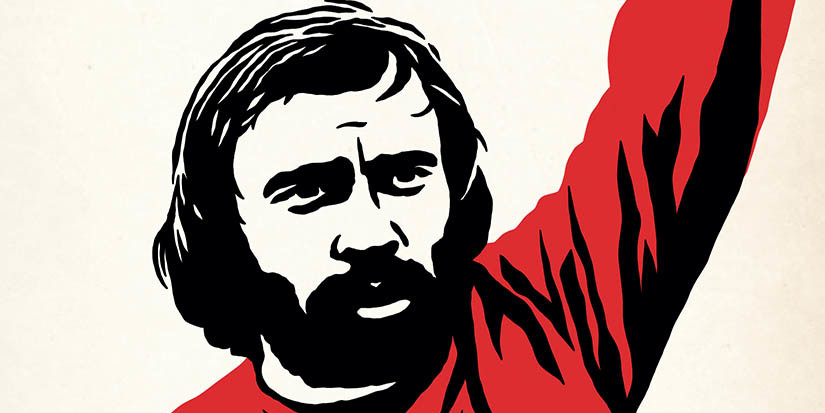
From The Nation, what legacy did Harold Pinter leave behind? Richard Byrne investigates (and more). Follow Emma Bovary and send your lover messages filled with "flowers, verses, the moon and the stars", but what does literature tell us about love? Inside the rise of the warbots: An interview with Peter Singer, author of Wired for War (and a review at Bookforum). An excerpt from The Gamble: General David Petraeus and the American Military Adventure in Iraq, 2006-2008 by Thomas Ricks (and more and a review). BHL on why foreigners shouldn't expect Obama to be the president of the "decline of the American empire" (and an interview). Why do Americans love peanut butter? Losing our religion: Do more than light a candle for the patron saint of capitalism. Staying in bed is a particularly attractive idea right now — but what kind? Che, the Ronald McDonald of revolution: A look at the cliches of the revolutionary's admirers and detractors. A love letter to good men: Let us reiterate, men don’t suck — in fact, sometimes they’re downright heroic. A review of Photography and Philosophy: Essays on the Pencil of Nature. You've Got Mika: Scarborough and Brzezinski on "Morning Joe" are less Tracy and Hepburn than the Matthew Perry and Jennifer Aniston for this nutty age. An interview with Tom Perrotta on the evolution of Tracy Flick.


From Open Democracy, the concept of genocide has become a weapon of political polemic, but the violence inflicted on civilians in four conflicts shows how it is also rooted in the logic of modern wars, says Martin Shaw; and in the current crisis the strongest regions economically are being hardest hit; Putin's policy of centralizing government is also being called into question by widespread demonstrations in the Far East. Wagging the "fat tail" of climate catastrophe: How much should we pay to avoid the tiny risk of total destruction? Why the press should declare itself a religion. Yellow Journalism: There's nothing kitschy about the taste of good mustard. Why did Stauffenberg plant the bomb? Whatever his motives for killing Hitler, Stauffenberg was no role model for future generations. The Internet is made of kittens: How the lowly cat, shunned by Hollywood, became an online star; and an ode to loud, stinky, filthy canines and the pathologically needy people who love them. Core Principles: How science can help form a theory of design. Crisis on the color line: After 100 years of "pleading our own cause", is the NAACP equal to the task ahead? A review of Classified: The Secret History of the Personal Column by HG Cocks. It is worth remembering that bipartisan coalitions are not inherently good and that some have pushed Congress in the wrong direction. 


A new issue of Judgment and Decision Making is out. From Wired, Felix Salmon on the secret formula that destroyed Wall Street. From Foreign Affairs, Richard Katz on The Japan Fallacy: Today's U.S. Financial Crisis Is Not Like Tokyo's "Lost Decade";  an essay on The Geoengineering Option: A Last Resort Against Global Warming?; a review of Egypt After Mubarak: Liberalism, Islam, and Democracy in the Arab World by Bruce K. Rutherford; and Michael D. Bell (Windsor), Daniel C. Kurtzer (Princeton), and Prem G. Kumar (CFR): The Missing Peaces. Bill McKibben and Wendell Berry call for mass civil disobedience against coal. We're on the brink of disaster: Violent protests and riots are breaking out everywhere as economies collapse and governments fail — war is bound to follow. From Standpoint, it's fashionable to say the US is in terminal decline — don't bet on it, still less wish for it; to hell with niceness: The spread of political "compassion" has led to the breakdown of family and school discipline; and a review of The Vanishing Face of Gaia by James Lovelock and He Knew He Was Right by John Gribbin and Mary Gribbin. Brad DeLong on why the Obama deficit-spending plan will (probably) work. Americans are going to have to pay higher taxes in order to continue to field a strong military and maintain popular programs like Medicare.


A new issue of H+ Magazine is out. The tallest building in the world is still going up — but what is the point of the Burj Dubai, and does it even have a good view? A review of Accounting for Mother Nature: Changing Demands for Her Bounty. An excerpt from Art Without Borders: A Philosophical Exploration of Art and Humanity by Ben-Ami Scharfstein. Avoid the apostrophe apocalypse: A survey of recent books on spelling, grammar, and punctuation. Styles of radical shill: The problem that Shephard Fairey presents also leads to a fear — that he may be, in fact, the perfect portraitist to render Obama. When is special treatment unequal treatment? Reflections on Tim Geithner, Michael Phelps, and Rod Blagojevich. Michelle Rhee on teaching, the toughest job there is. Plastic Surgery Confidential: Cosmetic surgery is now so popular that even young, healthy, attractive women are choosing to be "enhanced". The wisdom of the discount rack: The 25-cent rack at a local library offers some insights into the literary taste of a different time. How Wall Street mocked American values: Just look at the lifestyles of these uberconsumers. A review of Ancient Rome and Modern America by Margaret Malamud. Can A Beginner's Guide to Philosophy help those of too old for PHIL 101? Vanity Fair sits down with the members of Spinal Tap, whose genre-defining mock-umentary just turned 25. 

Advertisement