• print • Summer 2020
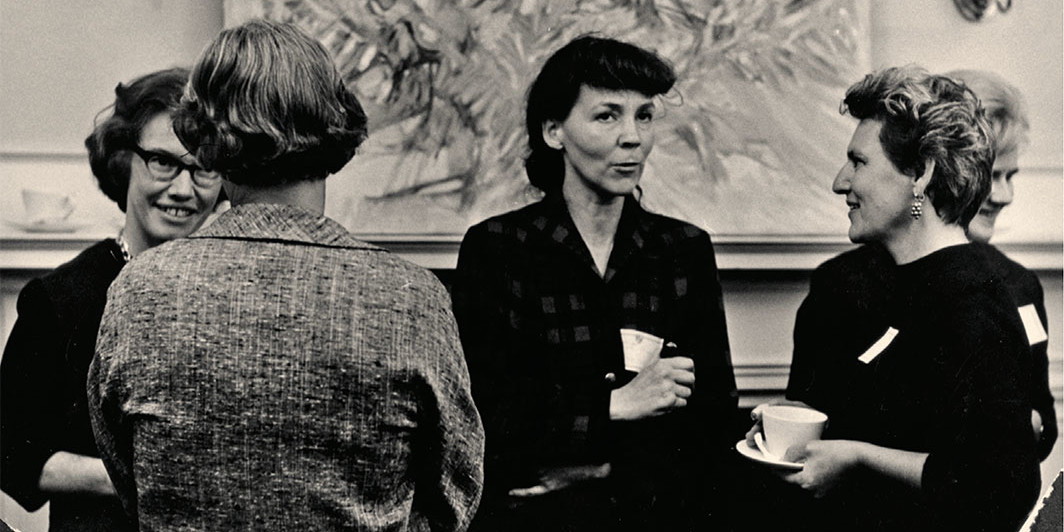
    *The Bunting fellows in conversation, ca. 1963–65.* Olive R. Pierce

    For many of its participants, the women’s liberation movement represented a saving break with an unremittingly bleak past. A switch flipped at the end of the 1960s, and the culture flooded with light. Where once there had been only darkness—Ladies’ Home Journal, back-alley abortions, MRS degrees—now there was feminism: Kate Millett made the cover of Time, Shirley Chisholm made the ballot, and young women picketed bridal fairs and beauty pageants that they might have attended a year before. In 1971, fiction writer Tillie Olsen remarked with awe that “this movement in three years has accumulated a vast new mass of

    Read more
  • print • Summer 2020

    “In Athens, Georgia, in the 1980s, if you were young and willing to live without much money, anything seemed possible,” Grace Elizabeth Hale opens her new book Cool Town, about how the B-52s, R.E.M., Vic Chesnutt, and scads of lesser-known alternative-rock artists sprang out of one small southern college town four decades ago. My first impulse was to substitute the line Tolstoy might have written if Tolstoy had been really into rock bands: All local music scenes are the same, but every music scene is local in its own way. Young people coalesce around a few emerging performers or spaces

    Read more
  • print • Summer 2020
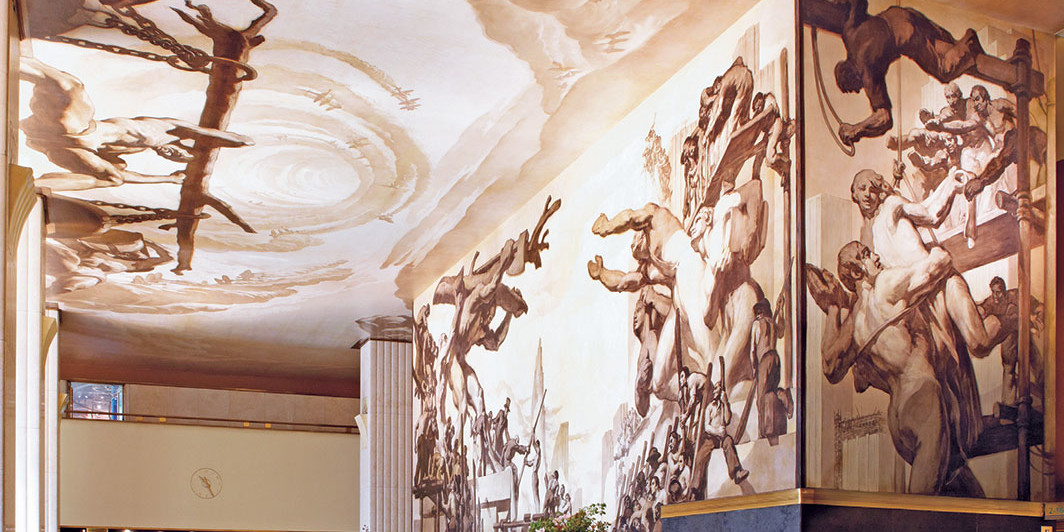
    *Detail of José María Sert’s 1937 mural _American Progress,_ Rockefeller Center, New York, 2013.* © Joshua McHugh, Courtesy Tishman Speyer

    In Murals of New York City, all of the Big Apple’s bygone eras seem to blend together. On the walls of Neoclassical courthouses and Art Deco airports, hallowed hotel bars and brick borough halls, we see the Rockefellers and Roosevelts still running things, and the Astaires, the Barrymores, and the Fitzgeralds forever flitting around. People smoked in restaurants, and artists—apparently—had studios in the attic of Grand Central Terminal. Graffiti didn’t yet have a name. The New School was still new, as was the New Deal. The Works Progress Administration paid for everything. It’s the Gilded Age, and the Jazz one,

    Read more
  • print • Summer 2020
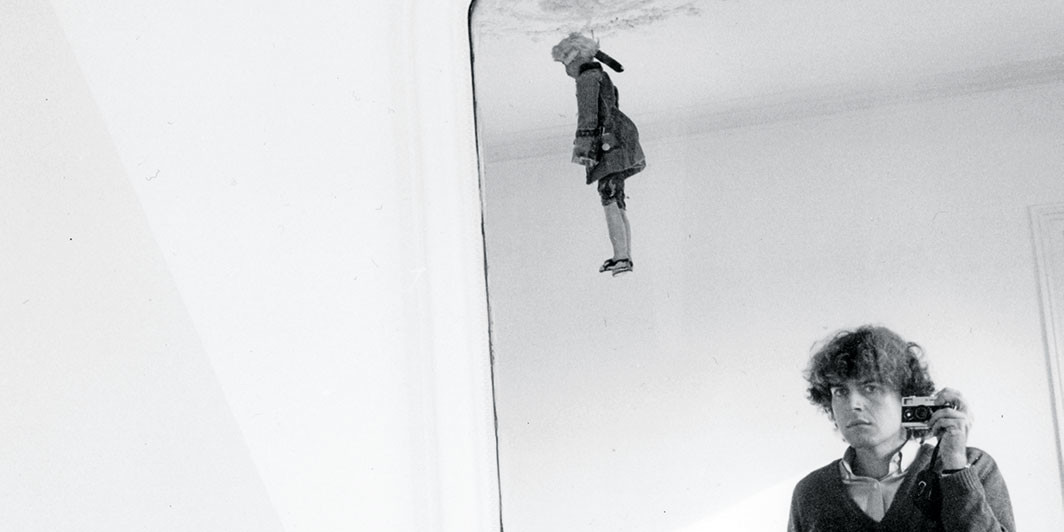
    *Hervé Guibert, _Autoportrait et pantin_ (Self-portrait and puppet), ca. 1981,* gelatin silver print, 5 7⁄8 × 8 7⁄8". Courtesy the Estate of Hervé Guibert, Paris, and Callicoon Fine Arts, New York

    A few months ago, the thirtieth-anniversary republication of a book written at the peak of the HIV epidemic and chronicling the impact of the virus on an intimate social circle of French writers, artists, medical professionals, and intellectuals—Michel Foucault among them—might have been a boutique or scholarly curiosity. AIDS, after all, has become one of the few medical and socio-biological “success” stories of recent decades. Testing plus an effective cocktail of antiretroviral drugs, alongside newer prophylactic treatments like Truvada, has reduced the illness to a chronic condition rather than a death sentence. In so-called advanced nations, the disease is mostly

    Read more
  • print • Summer 2020
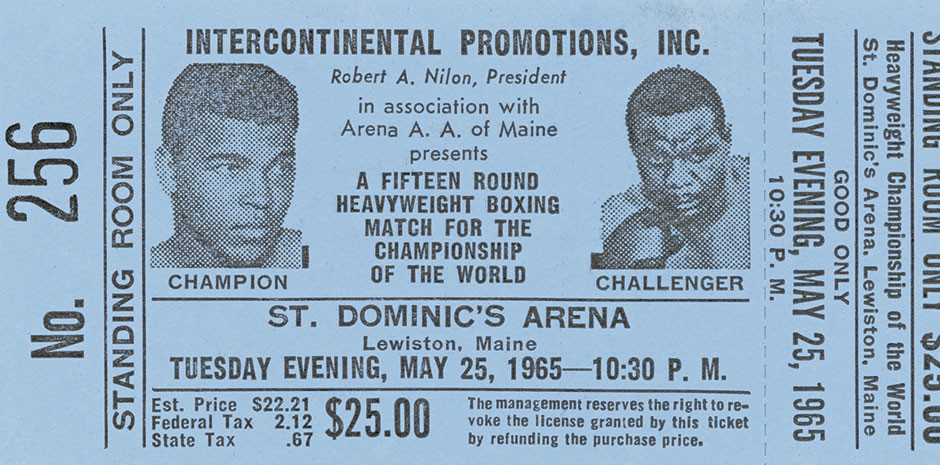
    *Ticket for a Muhammad Ali vs. Sonny Liston boxing match, 1965.* Collection of the Smithsonian National Museum of African American History and Culture

    For all his love of Dante, I don’t think Nick Tosches was much of a Boccaccio man. Still, he might have admired the saga that begins The Decameron. It is the story of one Ser Cepparello da Prato, un pessimo uomo, a dandy gentleman who wets his beak in every vice—blasphemy, forgery, booze, sex, crooked dice, marked cards, you name it. But nothing gives him a bigger kick than stirring up bad feelings, for, according to our storyteller, “the greater the evils he saw . . . the greater his happiness.” Dispatched to Burgundy to collect on the Boss’s loans,

    Read more
  • print • Summer 2020
    *Anthony Cudahy, _Expelled_, 2016*, oil on canvas, 13 x 13". Courtesy the artist and 1969 Gallery

    A FEW NIGHTS AGO, I WAS VISITED BY AN EMAIL. Back before the world gasped, my brother, the doctor, hardly ever wrote me anything beyond a “dinner Friday y/n,” and yet here he was, in the breathless thick of it, attaching a file of 7,241 words. I’d thought that he was far out in the boroughs intubating the sick or putting them through dialysis—and he was—but somehow he’d also found the time and adrenalized energy to put more language down on the screen than I, the ostensible writer, had managed to eke out in weeks, even months. The instructions that

    Read more
  • excerpt • April 30, 2020

    What’s the opposite of nostalgia? I ask that question because the stories in this book take me back to a time & place I thought I’d forgotten—but I really wouldn’t want to go back there.

    Read more
  • excerpt • April 28, 2020
    _On Vanishing: Mortality, Dementia, and What It Means to Disappear_ by Lynn Casteel Harper

    The cultural critic Susan Sontag’s classic Illness as Metaphor emerged from her rage at seeing, after her own cancer diagnosis, “how much the very reputation of this illness added to the suffering of those who have it.” In 1978, Sontag contended with cancer’s reputation as scourge, invader, predator, demonic pregnancy, demonic enemy, barbarian within. Cancer’s roots were then imagined, at least in part, as psychological, resulting from repressed emotion. These metaphoric conceptions of cancer saddled its sufferers with shame and prevented many from seeking proper treatment or even knowing their diagnosis. A decade later, in AIDS and Its Metaphors, Sontag

    Read more
  • review • April 16, 2020
    University of Michigan Law Library. Photo: Wikicommons/Cadop

    Social distancing may have brought us farther from our friends, but we have never been in more constant contact with our bookshelves and word processors. Many of us are dusting off unread classics, or attempting to write the book we’ve always meant to. Though they aren’t physically open, universities, literary institutions, and bookstores are providing online classes and community events on literature and composition. Grab your Milton and open “Novel.doc”—the experts are (virtually) in.

    Read more
  • review • April 9, 2020
    San Francisco’s Green Apple Books

    Reading at home can’t replace the sense of community and connection offered at your local bookstore, but virtual book clubs, talks, and classes may help fill the void. Independent booksellers and publishers across the US are moving their scheduled spring programming online and some are launching entirely new web series for your quarantine-viewing pleasure. Attending these won’t be the same as meeting in person, but it’ll come close.

    Read more
  • print • Apr/May 2020
    *Benny and Josh Safdie, _Uncut Gems,_ 2019.* Howard Ratner (Adam Sandler).

    Benny and Josh Safdie, Uncut Gems, 2019. Howard Ratner (Adam Sandler). A24 We were called hip-pocketers, because we lived from one deal to the next: Your business could fit in the wallet in your pocket. You bought a used Rolex at a pawnshop for a thousand bucks from the kid who’s just paid five hundred […]

    Read more
  • print • Apr/May 2020
    Don DeLillo. Photo: © Joyce Ravid

    Do you find it as obvious as I do that Don DeLillo richly deserves to receive the Nobel Prize in Literature? And right away, as in this year?

    Read more
  • print • Apr/May 2020
    *Martin Wong, _Stanton Near Forsyth Street,_ 1983,* acrylic on canvas, 48 × 64". Courtesy the Estate of Martin Wong and P·P·O·W, New York

    Deacon King Kong (Riverhead, $28) is a warm-blooded free-for-all, a donnybrook, a rumpus, what in baseball lingo would be called a “rhubarb.” And, as it happens, baseball, a steadfast metaphor for democratic ideals, plays a marginal role in James McBride’s bountiful and compassionate comedy of errors, bloopers, and near misses. The generosity of detail and range of emotional life infused in McBride’s vision of working-class Brooklyn at the hinge of the 1960s and 1970s are more characteristic of a nineteenth-century novel than of its counterparts in the twenty-first. And McBride is so adroit at manipulating his characters through myriad complications

    Read more
  • print • Apr/May 2020
    *Davide Sorrenti, _Popcorn,_ 1996,* C-print, 14 × 20". © Davide Sorrenti

    Davide Sorrenti excelled at the part of photography that takes place long before a camera comes into play. He got people to relax, to be vulnerable and unselfconscious. (To be naked, too, sometimes.) Small and young and rapscallionish, he slid into complicated situations with ease, arrogance, and poise. He was the sort of photographer people in front of the lens wanted to please, because in his big-ego, small-package cocksureness, he seemed privy to some idea of beauty or freedom that maybe, if you let him snap the picture, you might access too.

    Read more
  • print • Apr/May 2020
    *Lorrie Moore at her home, Wisconsin, 2010.* © Alec Soth/Magnum Photos

    Please don’t bury me Down in that cold, cold ground No, I’d rather have ’em cut me up And pass me all around —John Prine, “Please Don’t Bury Me” Fearful indeed the suspicion—but more fearful the doom! It may be asserted, without hesitation, that no event is so terribly well adapted to inspire the supremeness of bodily and of mental distress, as is burial before death. —Edgar Allan Poe, “The Premature Burial” There could be unexpected chiming or clanging. —Lorrie Moore, “Author’s Note” to Collected Stories IF THE STRANGEST THING ABOUT LORRIE MOORE’S COLLECTED STORIES is that it didn’t exist

    Read more
  • print • Apr/May 2020
    *Göran Hugo Olsson, _The Black Power Mixtape 1967–1975,_ 2011.* Angela Davis. PBS

    SET THE NIGHT ON FIRE, written by Mike Davis in collaboration with historian Jon Wiener, is a kind of sequel to City of Quartz, the cultural analysis of Los Angeles Davis published in 1990. In the beginning of CoQ, Davis described the focus of that book as “the history of culture produced about Los Angeles.” And that is true for roughly two hundred pages of CoQ, as Davis reviews the work of California historians like Carey McWilliams (he approves) and “the European reconceptualization of the United States” carried out by Los Angeles transplants like Theodor Adorno (he’s torn). Davis also

    Read more
  • print • Apr/May 2020
    *Ken Kesey’s Merry Pranksters bus “Further,” San Francisco, 1966.* Ted Streshinsky Photographic Archive, Bancroft Library, U.C. Berkeley, Courtesy of Taschen/From Tom Wolfe’s The Electric Kool-Aid Acid Test (Taschen, 2014)

    WHENEVER I SEE A COPY OF A ROBERT STONE NOVEL in a used-book store, I buy it, pretty much to introduce him to others, to press his work upon others. I recently acquired a copy of A Flag for Sunrise, one of his masterworks—1981 first edition. Out of print. Nine dollars. Between its pages, a folded note. Black ink. Neat handwriting. Life is hard. We’re trying to prepare you for that. Make mistakes . . . fine . . . good. But make them because you don’t know. Learn from them. Do not make them b/c your friends are making

    Read more
  • print • Apr/May 2020
    *Chelsea Flea Market, New York, 2015.* Peter Burka/Flickr

    The last particule of the once-sprawling Chelsea Flea Market closed down on December 29, 2019. That remnant occupied a parking lot on 25th Street, between Broadway and Sixth Avenue, but earlier the market, which opened in 1976, had in addition comprised three lots along Sixth Avenue, as well as a garage on 25th Street, the principal setting and primary subject of this beguiling memoir. Flea markets have been in serious decline for years; in many parts of the country a “flea market” is where you go to buy batteries, aftershave, and car parts. The recent, possibly terminal phase has everything

    Read more
  • print • Apr/May 2020

    Katie Roiphe is someone who, by her own account, writes prose as if heading into combat: She describes her preferred authorial voice as “a vehicle, a tank.” But a while back she began to feel something lacking. “My usual ways of being in the world were no longer working,” she writes at the beginning of her new memoir, The Power Notebooks. “My theories and interpretations were wrong or inadequate.” She was used to building arguments and taking stands, but she wanted to try something different—something looser, more fragmentary, more vulnerable. She began keeping a notebook where she collected thoughts on

    Read more
  • print • Apr/May 2020
    *David Maisel, _South_Ballistics_Grid_04_,* nine dye sublimation prints on aluminum, each 40 × 40". © David Maisel

    Throughout 2015 and 2016, the US Army set off multiple clouds of deadly chlorine gas, not in some secret location in the Middle East or Afghanistan, but about an hour’s drive south of Salt Lake City. The Dugway Proving Ground, established during World War II, occupies a swath of desert larger than Rhode Island. During the war, the military built villages that resembled German and Japanese towns in order to try out weapons, including poison gas. This activity continues to the present day. In Proving Ground, David Maisel’s aerial and ground-level photos of Dugway—he reports that gaining access to the

    Read more