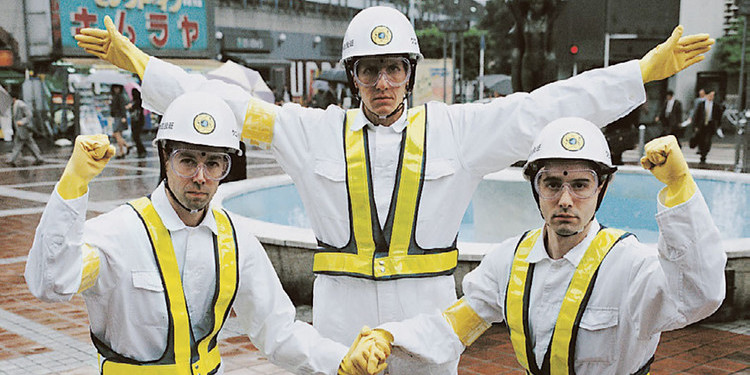
Few acts in pop-music history have a reputation quite as lenticular as that of the Beastie Boys. As such, their new memoir Beastie Boys Book (Spiegel & Grau, $50) seems to pinball from one reputational-perspective tug-of-war to the next. Are Ad-Rock, Mike D, and MCA innovators or carpetbaggers? Serious musicians or stumblers onto greatness? Agents of positive cross-racial understanding or flimsy bridges between cultures? Curious creative-class kids or schmucks?
- print • Feb/Mar 2019
Ashes to Ashes, the second volume of Chris O’Leary’s song-by-song chronicle of David Bowie’s work, reaches its title track around page 155. Of 1980’s “Ashes to Ashes,” which was Bowie’s second-ever No. 1 single in the UK—the first had been “Space Oddity,” to which “Ashes to Ashes” was the mischievous sequel (We know Major Tom’s a junkie)—O’Leary remarks that it is, “in a way, his last song, the closing chapter that comes midway through the book. Bowie sings himself off-stage with a children’s rhyme: eternally falling, eternally young.”
- print • Feb/Mar 2019
BENJAMIN KUNKEL: The scenario of your book is different from our own world, although our present is increasingly resembling the future of The Wall (Norton, $26). Could you outline the world of the novel?
- print • Feb/Mar 2019
here is a scene in Douglas Keeve’s 1995 documentary, Unzipped, in which Keeve films his then-lover, the American fashion designer Isaac Mizrahi, getting a haircut. Mizrahi’s mane is wild, a crimpy bristle that forms a compact tangle over his forehead as single corkscrews try to escape the mass. Mizrahi, thirty-three at the time, is more or less oblivious to the snipping happening around his face. He’s too preoccupied with explaining his vision for a new fall runway collection, which he says came to him in a bolt of revelation before Christmas. “It has to be this kind of, like, you
- print • Feb/Mar 2019
Twenty years ago, Nigella Lawson, at the time a freelance op-ed columnist and sometime book reviewer, sat down for a revelatory working lunch. Her husband had suggested that Lawson, a former London restaurant critic, write a food book, but even as she discussed her enthusiasm for the subject with her agent, she expressed vehement opposition to putting it between covers. She felt she would be “looked down on” and seen as “the little woman,” as she recently put it in an interview. Whereupon her agent, as great agents have been known to do, pronounced his certainty about this marriage of
- print • Feb/Mar 2019
Vivian Maier, New York City, 1959, C-print, 10 × 15″. Vivian Maier, Miami, FL, 1960, C-print, 10 × 15″. The entry of Vivian Maier—a Chicago nanny who died in 2009, leaving an enormous trove of unpublished and often unprinted images—into the first rank of American postwar photographers has proved as revelatory as it was precipitous. […]
- print • Feb/Mar 2019
There is little to recommend the rich, except of course their money. After all, the greater a fortune, the more likely it was ill-gotten. (No one ever hit pay dirt performing a good deed.) Until the revolution comes, we still have taste as the great leveler, evidence of democracy in action. What distinguishes good taste from bad, however, matters less than the fact of its presence at all. The worst plight is having no taste whatsoever, of being boring. Far better to vigorously exercise the right to get it all very, very wrong.
- print • Feb/Mar 2019
Etel Adnan has two desks. One for writing, the other for painting, they face opposite walls of the quietest room in her Paris home. When she finishes a painting she hangs it over her writing desk to dry. For half a century, Adnan has been revered as a titan of Middle Eastern literature and a beacon of avant-garde poetry. As a writer Adnan is beyond categorization, equal parts philosopher and journalist (she toiled for years as the culture editor of a leading French-language daily in Lebanon); her two dozen books of poetry and prose plumb subjects such as war, exile,
- print • Feb/Mar 2019
The roster of musicians—Charlie Parker, Miles Davis, Max Roach, Charles Mingus, and many others—who played the Three Deuces nightclub on Manhattan’s 52nd Street from the 1940s through the ’50s nearly encompasses the whole of modern jazz history. Yet any trace of that iconic locale, as well as all the other jazz venues that once lined the block, has long been obliterated by office towers. Some redress for this cultural disregard can be found in Jason Moran’s installation STAGED: Three Deuces, which was featured at the 2015 Venice Biennale. A pianist, composer, and visual artist, Moran demonstrates his reverence for his
- print • Feb/Mar 2019
As Denis Diderot’s lengthy and preposterously productive run approached its end in 1784, the question of his posterity loomed in an even more concrete way than usual. In the months before he expired, aged seventy, over a bowl of stewed cherries, he relocated from the conservative parish of Saint-Sulpice to the more renegade-hospitable precinct around Église Saint-Roch, on the other side of the Seine. The move offered a way for Diderot the atheist to avoid the fate of Voltaire the deist, whose corpse had had to be disguised as a still-living being and hustled out of Paris sitting upright in
- print • Feb/Mar 2019
In 2006, the late teacher, critic, and blogger Mark Fisher contributed an essay called “Gothic Oedipus: Subjectivity and Capitalism in Christopher Nolan’s Batman Begins” to ImageTexT: Interdisciplinary Comics Studies. Fisher routes his discussion of Batman Begins around the gothic, noir, Lacan’s concept of the Symbolic Father, and a 2001 interview with Alain Badiou, all of which are funneled into the concept of “capitalist realism,” Fisher’s best-known idea and the title of his 2009 book.
- print • Feb/Mar 2019
I turned Adam Pape’s new book of black-and-white photographs, Dyckman Haze, over and around several times before I was sure where to begin. Identically sized images of indeterminate orientation appear on both the front and back covers, neither accompanied by a title. One is of a dark cistern; in the other, a person of ambiguous gender folds backward, possibly mid-fall, long hair streaming toward the bottom of the frame. It’s unclear whether this is a moment of fear or of ecstasy.
- print • Feb/Mar 2019
The shooting of The Wild Bunch was not a pretty picture. If a film were made today the way Sam Peckinpah shot The Wild Bunch in Mexico in 1968, and if people found out, members of the cast and crew would be facing time in jail. The history of the film’s production fascinates because it was all so wrong. What happened encompasses many vices and several crimes, including manslaughter and statutory rape. It is an often repellent tale, a stew of toxic masculinity feeding a movie designed to dismantle the very myths about heroic cowboys, gun violence, and la frontera
- print • Feb/Mar 2019
Victor Tausk was one of the more restless of the many bright young men and women surrounding Freud in the 1910s. Born into a Jewish family in 1879, he first studied law, practicing in Sarajevo, then Mostar, where he made his reputation defending a young Muslim woman accused of murdering her illegitimate child. The prosecutors had asked for the death penalty; he got her acquitted. He then moved to Berlin, setting out on a new career as a critic, which no doubt contributed to the nervous breakdown he suffered soon after. At the sanatorium he decided to study psychiatry, completing
- print • Feb/Mar 2019
Saul Steinberg couldn’t fully enumerate the contents of The Labyrinth in words. For a retrospective at the Whitney Museum of American Art in 1978, he composed a list of the subjects explored in the book of drawings, originally published in 1960 and recently reissued by New York Review Comics. It begins with “illusion, talks, women, cats, dogs, birds, the cube” before trailing off, a dozen items later, with “geometry, heroes, harpies, etc.”
- print • Feb/Mar 2019
Imagine Manny Farber’s double career—unparalleled vernacular-modernist movie critic and tenaciously evocative, obliquely iconographic painter—as a board game. Dub it Polyopoly, an incessantly self-revising, once-upon-a-time-in-America contest of chance, mental play, and adventure. Like the kindred gamesmanship of filmmaker-photographer-writer Chris Marker, Farber’s output remains elusive: It’s hard to tell whether he was so far ahead of his time he overshot it or so far behind he caught up with it on the rebound.
- print • Apr/May 2019
Valeria Luiselli began volunteering as a translator for children in immigration court around five years ago. Drawing on that work, and the activism that followed, she wrote two books: Tell Me How It Ends, an extended essay based on the questionnaire used to interview the children, and her latest, Lost Children Archive (Knopf, $28), a novel about a family traveling by car from New York City to Arizona so that the father, an audio documentarian, can work on a project about the Chiricahua Apache. During the trip, the mother becomes obsessed with news on the radio of migrant children being
- print • Apr/May 2019
Novels and films tend to portray postapocalyptic cities as either devastated or abandoned. While the former might take inspiration from photos of Hiroshima or Dresden, places long emptied of people can be somewhat harder to imagine. What would Poughkeepsie or Staten Island look like years after a plague swept the planet? Some hint can be found in David McMillan’s photographs of the town of Pripyat, Ukraine, and the environs around the former Chernobyl nuclear power plant. In late April 1986, a reactor there suffered a catastrophic failure that spread radioactive material for thousands of miles and forced the complete evacuation
- print • Apr/May 2019
At some point while reading Coders (Penguin Press, $28), technology writer Clive Thompson’s enjoyable primer on the world of computer programmers, I started to note the metaphors being deployed by Thompson and his subjects to explain what it is they do, exactly. Coding, my incomplete list tells me, is “being a bricklayer,” “playing a one-armed bandit in Las Vegas,” “deep-sea diving,” “combat on the astral plane,” “oddly reminiscent of poetry,” “oddly like carpentry,” “like knitting and weaving,” “like being a digital plumber,” and “like the relationship of gardeners to their gardens.” It “summons to mind all the religious traditions where
- print • Apr/May 2019
In Self-Portrait with a Cat (1928), Lotte Laserstein’s hair is short, pushed off her face. The cat holds its pose because it’s tranquilized with brandy. Laserstein’s muse, and maybe lover, Traute Rose, also had short hair and liked loose clothing. In Tennis Player (1929), Rose watches a match while sportily grasping her own racket, waiting to play. For In My Studio (1928), however, she is La Grande Odalisque or she is postcoital. Laserstein, wearing a white linen smock, pays attention to what she is painting; the painting pays attention to Rose’s body. Laserstein’s and Rose’s androgyny was not an attempt